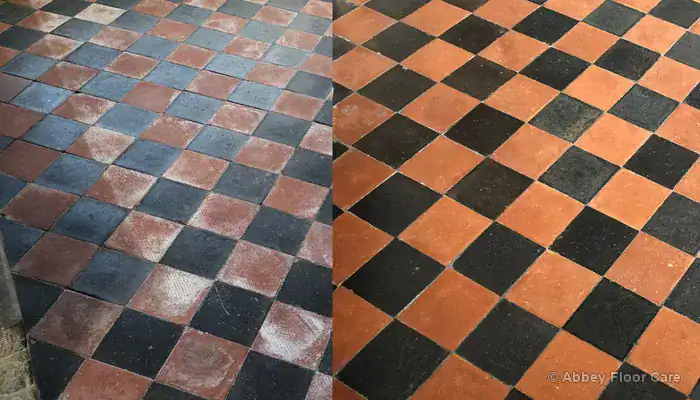
Quarry Tile Floors: Why They Darken and How to Restore Breathability
Why quarry tiles behave differently from every other floor in your home
What the Clay Body Is and Why It Matters
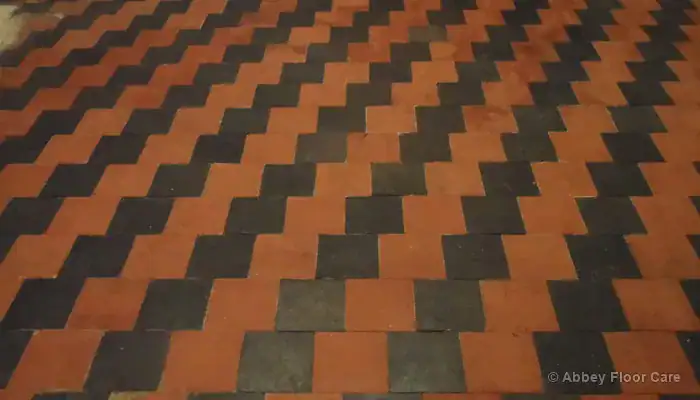
Quarry tiles begin as dense, unglazed clay fired at high temperature — producing a hard, moisture-active surface with no protective coating of any kind. Unlike ceramic or porcelain tiles, there is no glaze layer sealing things off. The clay body is exposed directly to foot traffic, cleaning products, and moisture from day one. That continuous absorption and release of liquid across the tile’s lifespan is not a defect. It is how the material was designed to function.
The clay body is composed of fine mineral particles with interconnecting voids throughout its structure. These voids are what allow moisture vapour transmission to occur — water vapour moves up through the tile from the subfloor and evaporates at the surface. In most UK period properties, quarry tile floors sit directly on a lime bed or compacted earth base without a damp-proof membrane, which means this moisture movement is continuous and intentional. Sealing off that pathway is not protection — it is interference with the system the floor depends on.
The Firing Process and What It Produces
Firing temperature determines the final density, colour, and porosity of a quarry tile. Lower temperatures produce a softer, more porous tile that absorbs liquids more readily — common in older Victorian and Edwardian properties across the UK. Higher temperatures produce a denser tile with tighter voids, which resists absorption more effectively but still remains unglazed and moisture-active. Neither type has a sealed surface. Both behave fundamentally differently from any glazed or polished floor covering.
This manufacturing process also means quarry tile colour is integral — it runs through the entire clay body rather than sitting as a surface layer. Colour cannot be stripped away by cleaning in the way a painted or coated finish can. What does change over time is surface texture through abrasion, and apparent colour as contamination accumulates within the tile body. A floor that looks permanently dark is usually holding embedded contamination inside its structure, not displaying its original clay colour.
Why the Absence of Glaze Changes Everything
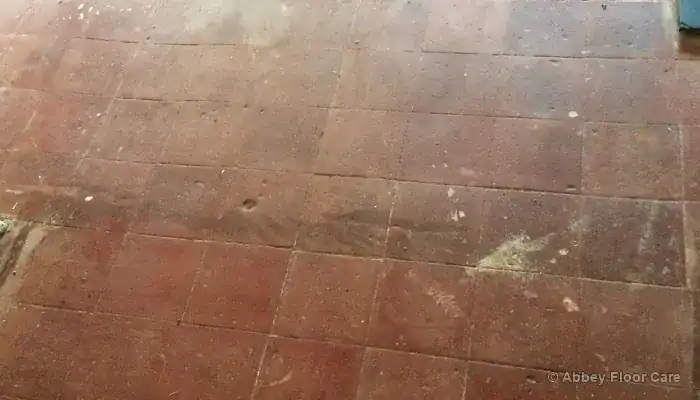
A glazed tile has a glass-like surface coating that repels liquid, resists staining, and keeps dirt at the surface where it can simply be wiped away. Quarry tiles have none of this. The open clay surface accepts liquid directly — grease, cleaning residue, soil, and water all enter the tile body rather than sitting on top of it. Over time, that material accumulates below the surface layer, and no amount of surface mopping can reach it.
This is why the standard approach to floor cleaning — apply product, mop, rinse — produces diminishing returns on quarry tiles. The products are acting on residue at the very top of the tile, whilst the deeper contamination layer continues to build. A floor mopped regularly for years can still hold decades of embedded contamination because the cleaning chemistry never penetrated far enough into the clay body to remove it. That understanding is the foundation for recognising why these floors eventually need professional deep cleaning rather than simply more frequent maintenance.
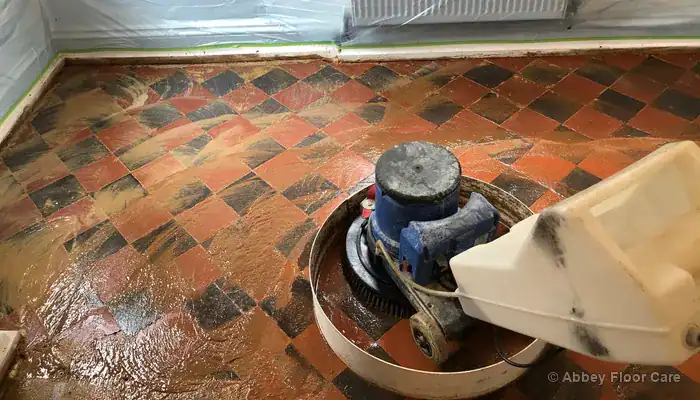
The quarry tile silo on this site covers the full lifecycle of these floors — from the quarry tile hub through to cleaning, restoration, and sealing guidance for every stage of condition.
Moisture Vapour Transmission and Why Blocking It Causes Failure
Moisture vapour transmission is the continuous movement of water vapour upward through the subfloor, through the tile, and out into the room above. In a properly functioning quarry tile floor, this happens invisibly and without damage. The floor breathes. The tile stays stable. Salts carried by the moisture evaporate harmlessly at the surface or disperse through the open clay structure.
When that transmission is blocked — most commonly by applying a film-forming surface sealer that closes the tile’s surface pores — the moisture has nowhere to go. It builds up beneath the coating, which then begins to blister, peel, or mottle. The salts it carries deposit within the tile body and at the interface between tile and coating, producing the white crystalline deposits known as efflorescence. Additional cleaning does not improve things at this point. The root cause is the blocked breathability, and the only correction is removing the coating and restoring the tile’s ability to move moisture freely.
Embedded Contamination and Why It Builds Invisibly
Embedded contamination is the accumulated grease, soil, organic matter, and residue that has migrated into the clay body over years of normal use. It is not visible on the surface the way a fresh spill is visible. It shows itself as a general darkening, a permanent dullness, or a floor that never quite looks clean regardless of effort. In heavily contaminated floors, it also produces a slightly tacky surface feel as old wax and grease residues sit in the upper layers of the clay body.
The accumulation is gradual and invisible. Every meal cooked, every muddy boot, every application of general-purpose floor cleaner contributes a small amount of residue that the tile absorbs. Over a decade or two, this builds into a contamination layer that cannot be removed by any product designed to act on the tile surface only. Removing it requires chemistry that penetrates into the clay body — typically controlled alkaline cleaning with wet vacuum extraction — reaching the contamination where it actually sits, not where cleaning products are usually applied.
Why the surface stays dirty even after you clean it
If your quarry tile floor still looks grimy after mopping, the contamination is no longer on the surface — it has moved into the clay body itself. This is the point at which standard floor cleaning stops producing visible results, and continuing with the same approach will not change the outcome. The floor is not failing to respond because it is beyond recovery. It is failing to respond because the cleaning is acting on the wrong layer.
Residue cycling is what happens when each cleaning session disturbs surface contamination without removing the deeper layer. The floor looks temporarily cleaner immediately after mopping, then returns to its dull, dark appearance within hours as the surface dries and the embedded layer becomes visible again. This cycle can continue for years without the underlying condition improving. The deep cleaning process for quarry tiles addresses the embedded layer directly rather than repeatedly treating the surface — and the difference in outcome is immediate and lasting.
Why quarry tiles look so different from one property to the next
Repeated cleaning that produces no visible result is not a technique failure — it is a sign that soil has already migrated below the surface layer. But before applying that diagnosis, it helps to understand why two quarry tile floors in similar condition can look completely different from one another. Manufacturing variation is a significant factor that affects both appearance and behaviour.
Quarry tiles fired at higher temperatures emerge denser and with a tighter clay structure. These are slower to absorb liquid, hold their colour more consistently under traffic, and resist surface abrasion dulling over longer periods. Tiles fired at lower temperatures are more open in structure, absorb liquid more readily, and tend to show the effects of embedded contamination more quickly. Both types are unglazed and moisture-active, but the rate at which problems develop differs considerably.
Why dirt goes into the tile instead of staying on top
Capillary draw is the reason grease and soil disappear into a quarry tile rather than sitting on top — the open clay structure pulls liquid contamination inward under normal foot traffic. Every step applies pressure that drives liquid residue into the surface voids. Grease from kitchen use, soil carried on footwear, and residue from cleaning products all enter the tile body through this mechanism. Once inside, they are beyond the reach of surface cleaning.
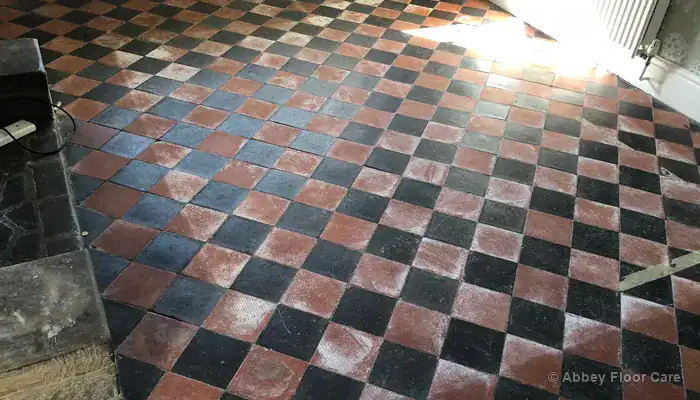
Over time, the voids within the upper clay layers become progressively filled. The tile darkens from within. Residue cycling begins — each clean disturbs what is on the surface but cannot reach what lies below. The floor absorbs new contamination more slowly as the upper voids fill, but the existing embedded layer does not reduce without targeted intervention.
The practical implication is that cleaning frequency does not compensate for cleaning depth. A floor cleaned daily with a general-purpose product can still accumulate a significant embedded contamination layer over five to ten years. The maintenance routine that prevents this from becoming a problem uses correctly formulated pH-neutral chemistry — avoiding detergents that leave their own residue behind — combined with removing grit before wet mopping so that surface abrasion does not compound the contamination issue.
Why ordinary cleaning products stop working over time
If your usual floor cleaner produced results for the first year or two and now seems to make no difference, the contamination layer has moved beyond the reach of surface-acting chemistry. General-purpose floor cleaners are formulated to act on residue sitting at or very near the surface. They are not designed to penetrate a porous clay body and lift contamination that has been building for years. Once the embedded layer is established, these products maintain whatever cleanliness remains at the surface but do not reduce the underlying problem.
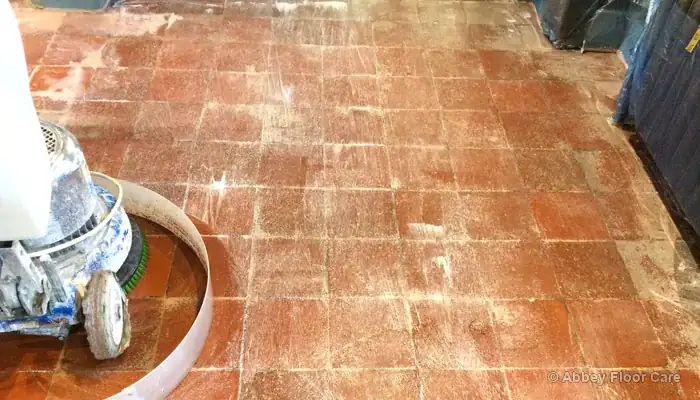
Many household cleaners also leave their own residue behind — surfactants, fragrance compounds, and pH-modifying agents that the tile absorbs along with the soil the product was supposed to remove. This accelerates residue cycling and can eventually produce a surface that feels slightly sticky or appears consistently dull regardless of how recently it was cleaned. The chemistry required to act on the clay body rather than the surface layer uses controlled alkaline concentrations combined with mechanical agitation and wet extraction — a sequence that general-purpose products are neither formulated nor intended to replicate.
Why the wrong sealer makes the floor worse, not better
Applying a film-forming sealer to a moisture-active quarry tile floor does not protect it — it traps the moisture the floor depends on releasing. Film-forming products sit on top of the tile surface and create a physical barrier across the pores. On a modern glazed tile, that is entirely appropriate. On an unglazed quarry tile floor sitting on a moisture-active base, it creates the conditions for sealer failure, efflorescence, and accelerating deterioration.
Sealing a quarry tile floor correctly means working with moisture movement, not blocking it.
Breathability failure follows a predictable sequence. The sealer is applied and looks good initially. Within months, moisture vapour building below the coating begins to cause blistering or milky patches. The coating peels or breaks down unevenly. Salts deposited by the trapped moisture appear as white crystalline patches at the surface. The homeowner cleans the floor again, often applying more product, which compounds the problem. The tile itself is undamaged throughout this process, but removing the failed coating and restoring correct moisture vapour transmission requires professional intervention. An impregnating sealer — one that penetrates into the tile body rather than sitting on top of it — allows moisture to move whilst protecting the internal structure from further contamination.
Why quarry tile floors fail — and what the warning signs look like
White powder on the tile surface, patchy finishes that return after cleaning, and coatings that peel without obvious cause are not separate problems — they are connected failure signals from the same underlying system. Each one indicates a specific point in the deterioration sequence, and recognising which signal is present identifies what stage the floor has reached.
Efflorescence is the white crystalline or powdery deposit that appears when moisture carries dissolved salts upward through the tile and deposits them at or near the surface as the water evaporates. It signals active moisture movement and often indicates that something above — a surface coating or incompatible sealer — is partially obstructing the evaporation pathway. The homeowner sees a chalky white residue that returns within days of being wiped away.
Salt migration produces a similar visible result but operates deeper within the tile body, depositing mineral compounds inside the clay structure rather than at the surface. Over time this causes the tile surface to appear progressively lighter in affected areas. Sealer failure manifests as peeling, mottling, or uneven sheen — areas where the coating has separated from the tile below.
What a properly maintained quarry tile floor actually needs
If your quarry tile floor has been professionally restored, the maintenance routine that follows determines whether it stays in good condition or begins deteriorating again within months. The single most important factor is using a pH-neutral cleaner formulated for breathable natural tile — not a general-purpose floor product, and not anything containing bleach, vinegar, or surfactant residues that the tile will absorb. The wrong product choice restarts the residue cycling process from day one.
Grit removal before wet mopping is equally important. Hard particles of sand and soil carried indoors act as fine abrasives under foot traffic, accelerating surface abrasion dulling in the upper clay layer. Dry sweeping or vacuuming before any wet cleaning prevents this. Resealing at the correct interval — typically every two to three years for an impregnating sealer, depending on traffic — maintains the tile’s internal protection without building up surface residue.
When the floor has gone beyond what maintenance can fix
Persistent darkening that does not shift with correct cleaning products, white salts that return within days of removal, and coatings that fail repeatedly are diagnostic thresholds — each one indicates the floor needs professional assessment rather than further maintenance.
Use this sequence to assess your floor’s current position:
- Clean the floor with a correctly formulated pH-neutral product and allow it to dry fully. If the darkening returns within 48 hours and the floor looks the same as before cleaning, the contamination is embedded below the surface layer.
- After removing any visible white deposits, check whether they reappear within a week. Deposits returning this quickly indicate active moisture movement combined with a blocked or partially blocked evaporation pathway — this is a sealer failure condition, not a cleaning problem.
- Examine any coating applied in the last two years. If it has begun to peel, mottle, or show uneven sheen in traffic areas, the product was incompatible with the moisture movement profile of the floor and professional removal is required before any further treatment.
Where to go next depending on what your floor needs
Every quarry tile problem routes to a different part of the restoration system — and the right starting point depends on what the floor is currently showing.
If the floor looks dirty after cleaning and the problem keeps returning, the starting point is the deep cleaning process: deep cleaning quarry tiles and removing decades of grime covers the full sequence. If the floor has white deposits, patchy finishes, or failing coatings, the restoration pathway applies: quarry tile restoration explains what professional correction involves.

David Allen — Abbey Floor Care
David Allen has spent over 30 years restoring quarry tile floors across the UK, working on everything from Victorian kitchen floors in period terraces to heavily contaminated utility rooms where decades of incorrect treatment had produced compounding failure. His approach to quarry tile work is grounded in understanding the clay system first — breathability, moisture movement, and embedded contamination — before any cleaning or restoration sequence begins.
Recent Posts:
We work throughout the country, just some of our work counties:
Copyright © 2026 Abbey Floor Care. Tile And Natural Stone Cleaning Consultants FAQ - Privacy Policy - Terms And Conditions
Abbey Floor Care is a participant in the Amazon Services LLC Associates Programme, an affiliate advertising programme designed to provide a means for websites to earn advertising fees by linking to Amazon.co.uk. As an Amazon Associate, we earn from qualifying purchases.