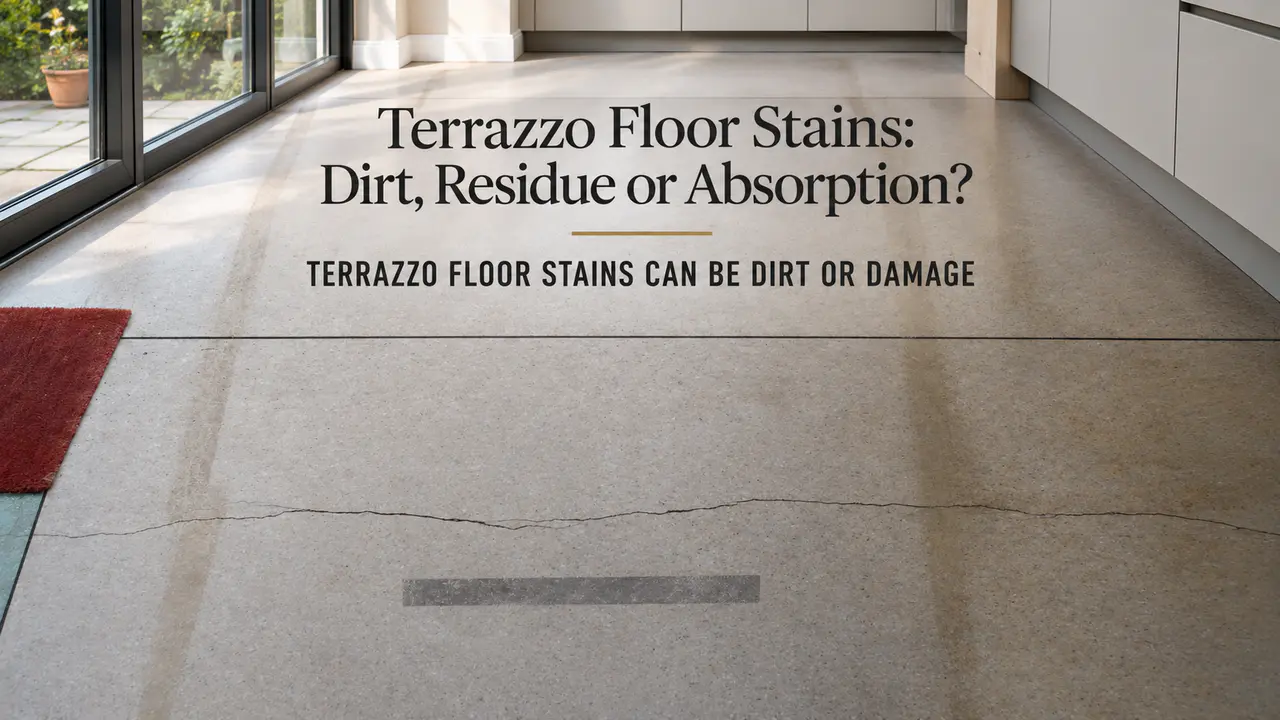
Terrazzo Floor Stains Can Be Dirt Or Damage
Last Updated on November 19, 2026 by David
The most useful first check is a small, controlled cleaning test, assessed after the floor has dried. If the mark becomes lighter, removable contamination is probably contributing to it. If it remains, that does not automatically prove an absorbed stain: worn binder, an old coating, etching or moisture-related darkening can look similar.
The aim is to identify what is changing the floor’s appearance before choosing a stronger cleaner, a stain treatment or resurfacing. Repeated scrubbing with increasingly aggressive products can damage terrazzo without removing the original mark.
Why terrazzo can look stained when it is not
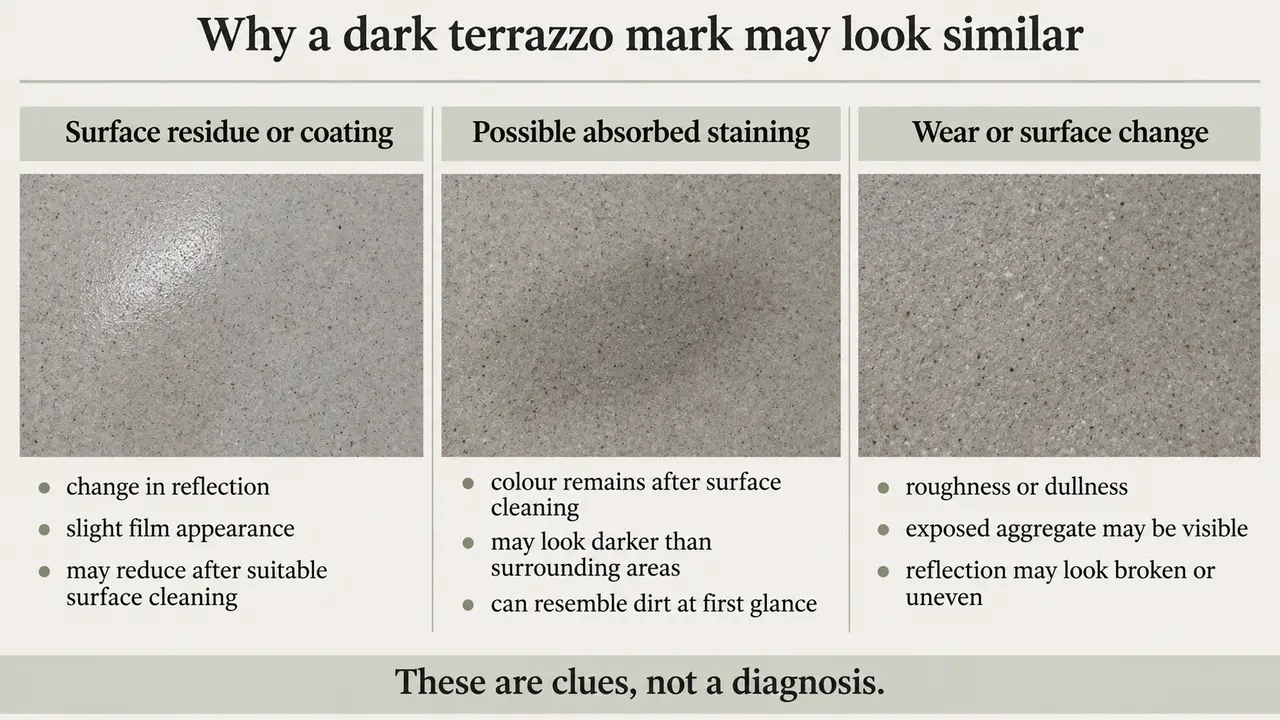
Most traditional domestic terrazzo contains marble chips in a cement binder. The binder can retain soil and liquids, particularly where its surface is porous or worn. Meanwhile, detergent residue, waxes and other coatings can hold dirt above the terrazzo itself.
This means a dark patch may be on the surface, within its pores or simply an area with a different texture or finish. Several conditions can exist together: cleaning might remove a greasy film but leave absorbed discolouration or wear beneath it.
The guidance below applies to cement-based terrazzo. If the floor has a resin binder, including epoxy, identify the system and obtain suitable advice before selecting cleaning or restoration treatments.
Read the mark before treating it
Compare the affected area with the rest of the floor in good light. Look at colour, reflection and texture, rather than colour alone. Areas beneath furniture can offer useful comparisons, although their finish and exposure may differ from the walking route.
| What you notice | Possible explanation | Useful next check |
|---|---|---|
| Dark tracks through doorways or along a walking route | Tracked-in soil, a dirty coating, absorbed contamination or surface wear | Test-clean a small section and compare both colour and texture once dry. |
| Cloudiness, mop marks or a greasy-looking film | Detergent residue, polish or another surface treatment | Check the maintenance history and whether a compatible cleaning and rinsing test improves it. |
| A localised spill-shaped mark | Surface contamination, absorbed staining or chemical damage | Consider what was spilled and whether the patch is also duller or rougher. |
| A dull mark that is most obvious in reflected light | Etching, abrasion or an altered coating rather than dirt alone | Compare its reflection with the surrounding floor; avoid further abrasive treatment. |
| Darkening that changes as the floor dries or repeatedly returns | Moisture-related colour change, retained contamination or another recurring source | Observe the pattern and assess moisture exposure before stain treatment or sealing. |
| A patch following a repair, joint or old covering outline | Different repair material, adhesive residue or adhesive staining | Establish what material is present before attempting removal. |
These are clues, not diagnoses. A spill outline does not prove penetration, and a dark traffic lane does not prove that the cement binder has deteriorated.
A safe cleaning check you can make at home
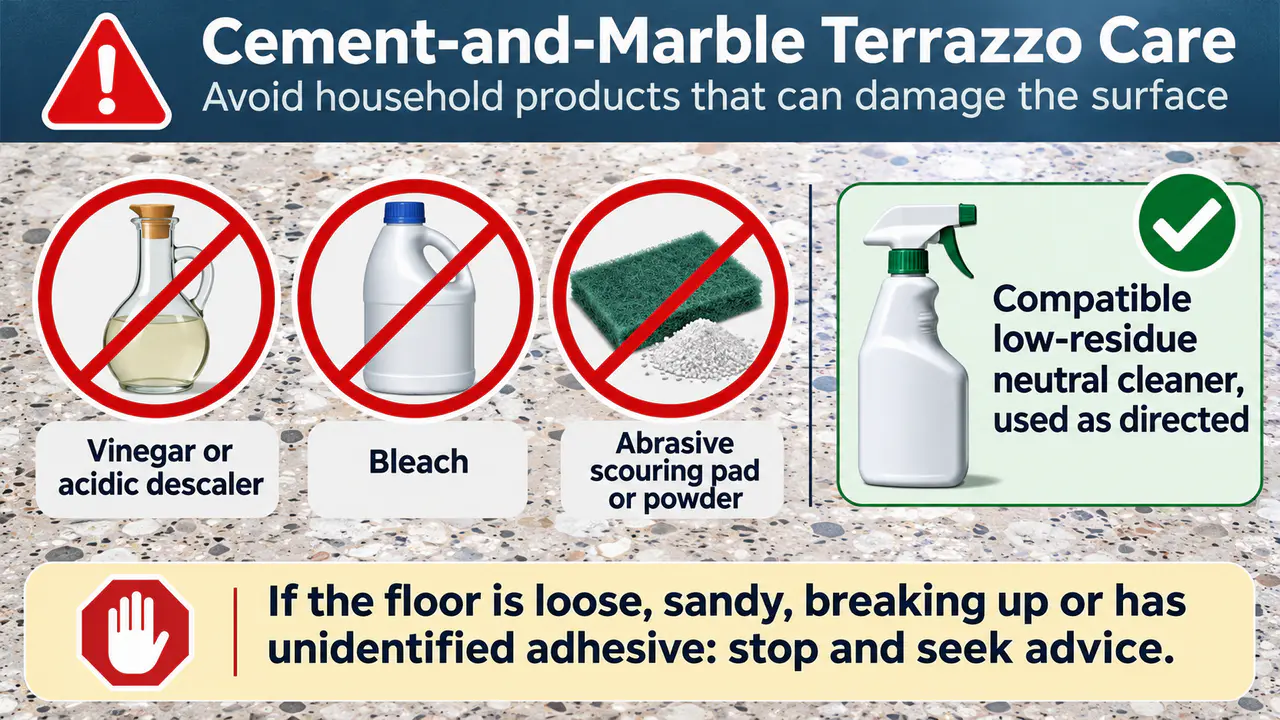
Start with the least aggressive suitable method. If the floor is loose, sandy, visibly breaking up or covered with unidentified adhesive, stop and seek advice rather than scrubbing it.
- Remove loose grit. Use a soft brush or a suitable vacuum attachment so that grit is not dragged across the surface.
- Choose a small, discreet test area. Include part of the mark and some neighbouring terrazzo where practical. Check that the cleaner is compatible with both terrazzo and any existing sealer or coating.
- Use a low-residue, normally pH-neutral stone cleaner. Follow the manufacturer’s dilution and contact-time instructions. More concentrate does not necessarily clean better.
- Agitate gently. Use a soft, non-abrasive cleaning tool. Keep the solution from drying on the floor and avoid flooding joints, cracks or adjacent finishes.
- Lift the dirty solution. Remove it with clean cloths or suitable extraction rather than spreading it with dirty mop water. Rinse as directed, collecting the rinse water.
- Let the area dry before judging it. Wet terrazzo often looks darker, and wetting can temporarily disguise differences in sheen. Keep people off the wet area to reduce slipping risk.
Do not use vinegar, acidic descalers, bleach or abrasive scouring products as diagnostic tests. Acids can attack both the cement binder and marble chips, creating an etched patch that cleaning cannot reverse.
What the result tells you
- The mark largely disappears: removable dirt or residue was probably the main issue. A controlled clean of the wider area may be sufficient.
- It improves but does not disappear: surface soil may be covering another condition, such as staining, wear or a remaining coating.
- It does not change: stop repeating the same treatment. The contamination may need different chemistry, but the mark may also be absorbed staining or physical surface change.
- The surface becomes rough, sandy or loses material: stop cleaning and have its condition assessed.
A neutral-cleaner test has limits. It will not reliably remove every oil, adhesive or old polish. An unchanged patch means that further identification is needed—not that the floor necessarily needs grinding.
When a deeper clean is justified
Greasy deposits and some accumulated maintenance films may need a compatible alkaline cleaner or a specialist stripping treatment. Alkaline cleaning is not automatically harmful to sound cement-and-marble terrazzo, but product choice, dilution, contact time and thorough removal matter. Existing sealers may have different chemical tolerances from the terrazzo beneath them.
Where the coating or contamination is unknown, a specialist test area is safer than experimenting across the whole floor. Do not scrape, sand or grind unidentified old flooring adhesive: some historic adhesives and coverings may contain asbestos and need assessment before disturbance.
What if the mark is an absorbed stain?
An absorbed stain remains within the receptive parts of the material after surface contamination has been removed. Oils, food spills and some old adhesives can leave persistent discolouration, but its depth and response to treatment cannot be established from appearance alone.
Targeted stain treatment should be selected for the likely contaminant, the binder, any existing protection and the condition of the surface. A specialist may consider a poultice for certain stains, but it is not a universal remedy. Unsuitable chemistry can alter the surrounding colour or finish, and complete removal may not be achievable.
Do not assume that sanding or grinding will remove a deep stain. Mechanical treatment permanently removes terrazzo, while discolouration may extend beyond the amount that can safely be taken away.
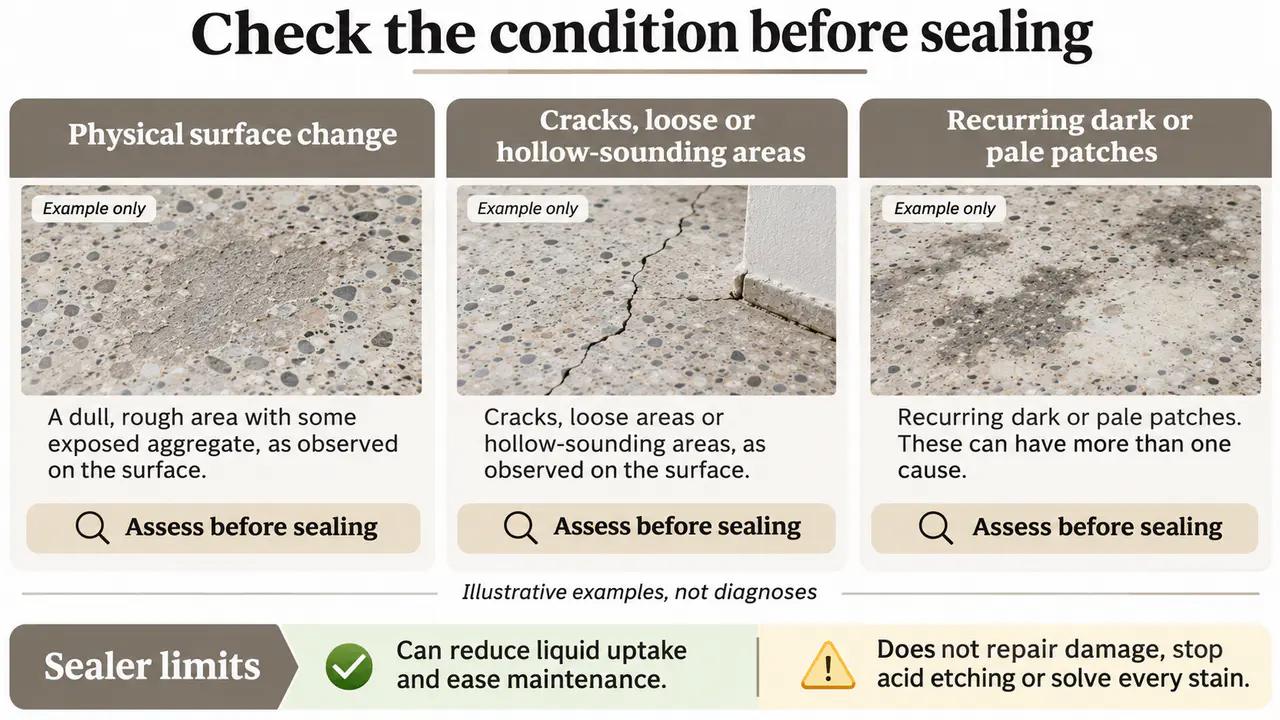
Etching and wear are not dirt. A dull or rough spill mark may be acid damage; exposed chips and recessed binder may indicate material loss. Appropriate honing or polishing can improve some surface defects, but only after assessing stability, remaining terrazzo thickness and the necessary removal depth. Cleaning cannot replace missing binder.
Persistent dark patches or white deposits need a different assessment. White material may be cleaning residue or salt deposits; appearance alone does not establish its source. Recurring moisture-related changes should be considered alongside floor exposure, moisture movement and bedding or subfloor conditions before treatment or sealing.
Seek professional assessment where marks recur, extend into cracks, sit beneath an unknown coating or accompany loose material, movement or hollow-sounding areas. Avoid heavy mechanical work until unstable areas have been assessed.
Will sealing prevent the stain returning?
A suitable sealer can reduce liquid uptake and make cleaning easier, but it will not remove an existing stain or prevent every new one.
- An impregnating sealer may reduce absorption without forming a substantial surface film. Compatibility, appearance, vapour transmission and floor moisture conditions still need checking.
- A topical, film-forming sealer creates a coating that can alter sheen and develop scratches or discolouration. Its suitability depends on the floor, moisture movement, salts, adhesion and the maintenance system.
Neither approach makes terrazzo acid-proof or scratch-proof. Do not seal over an unexplained mark simply to hide it; establish the cause and assess the floor’s readiness first.
The practical decision
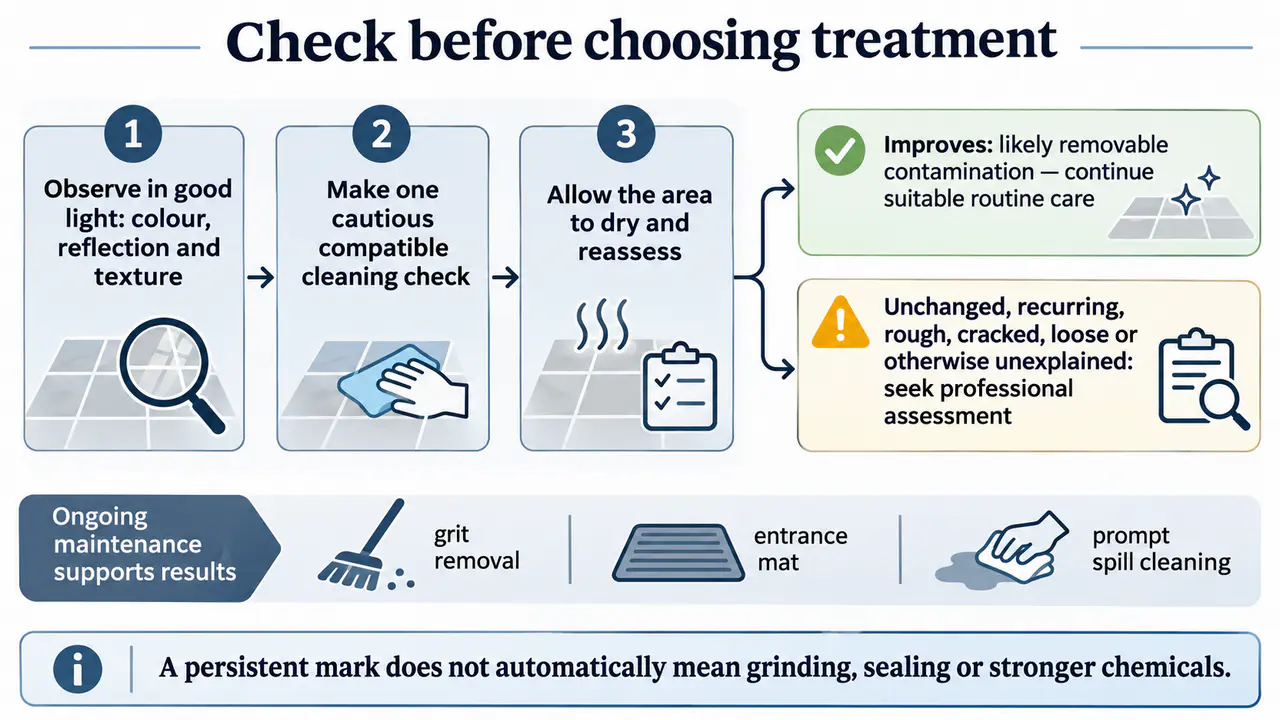
Clean once, assess when dry, then choose the next step from the evidence. Improvement points towards removable contamination. A persistent mark calls for identification—not automatically stronger chemicals or resurfacing.
Pro Tip: Products suitable for the pH-neutral cleaning test and ongoing terrazzo maintenance.
Disclosure: As an Amazon Associate, Abbey Floor Care earns from qualifying purchases at no extra cost to you.


For ongoing care, remove grit regularly, use entrance mats, clean spills promptly and measure a compatible low-residue cleaner accurately. These habits reduce both staining risk and the residue build-up that can make a sound terrazzo floor look dirty.

David Allen — Abbey Floor Care
David Allen of Abbey Floor Care has more than 30 years of hands-on floor restoration experience. His experience with terrazzo cleaning and restoration includes assessing surface contamination, absorbed staining and wear before selecting an appropriate treatment.
Recent Posts:
We work throughout the country, just some of our work counties:
Copyright © 2026 Abbey Floor Care. Tile And Natural Stone Cleaning Consultants FAQ - Privacy Policy - Terms And Conditions
Abbey Floor Care is a participant in the Amazon Services LLC Associates Programme, an affiliate advertising programme designed to provide a means for websites to earn advertising fees by linking to Amazon.co.uk. As an Amazon Associate, we earn from qualifying purchases.