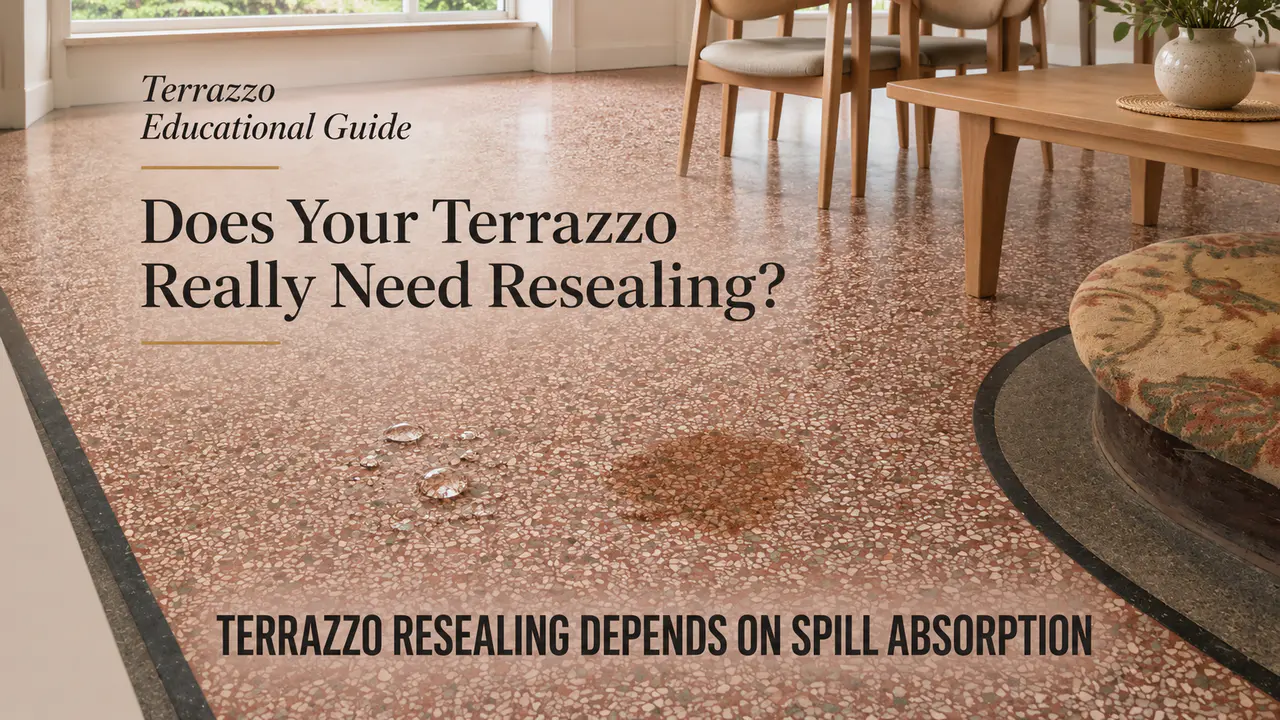
Terrazzo Resealing Depends On Spill Absorption
Last Updated on November 18, 2026 by David
Terrazzo should be resealed when its existing protection needs renewal—not automatically every year or every three years. The right interval depends on the sealer, foot traffic, cleaning routine and condition of the floor. Follow the product’s maintenance guidance, then use changes in absorption and surface condition to decide whether treatment is needed.
Some floors may remain adequately protected for several years; others need attention sooner. A calendar reminder is useful for checking the floor, but it is not a reason to apply another coat.
Why Terrazzo Needs Protection
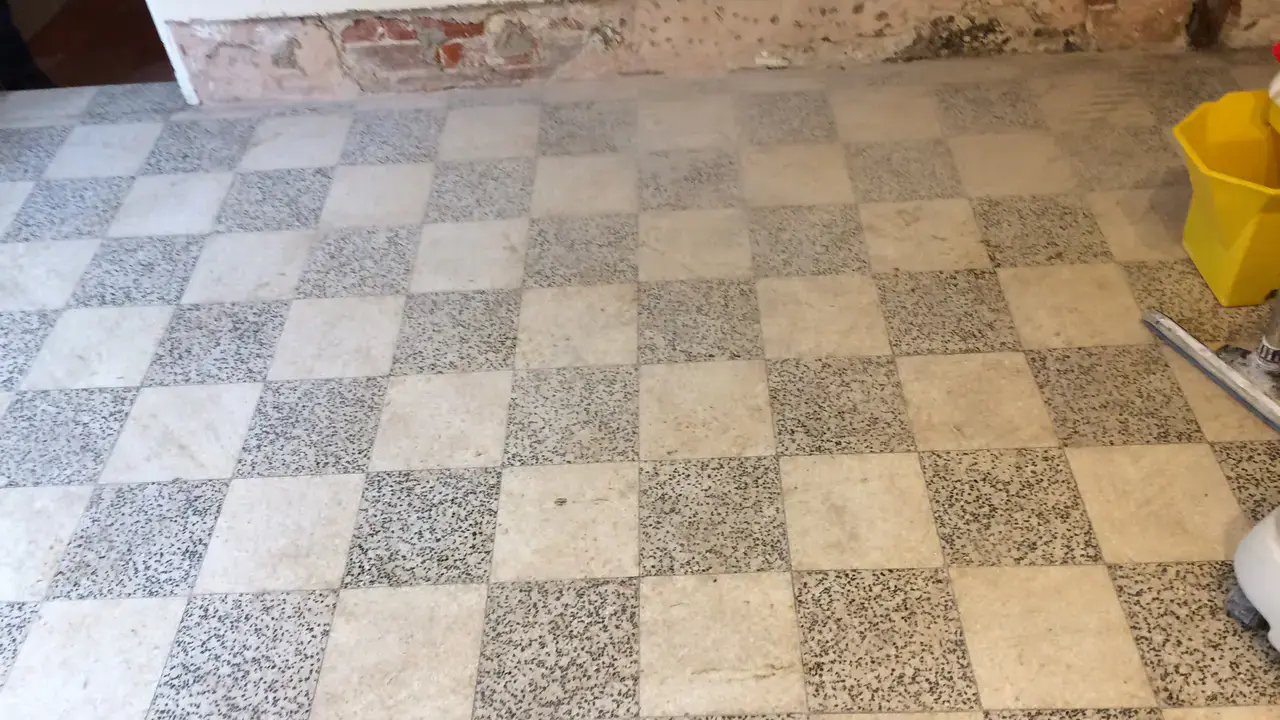
Most traditional domestic terrazzo in the UK consists of marble chips in a cement-based binder. Its ability to absorb liquids varies with the original mix, surface finish, wear and previous treatments. Worn or damaged binder may absorb spills and retain soil more readily than sound areas.
A compatible sealer can reduce liquid uptake and make maintenance easier. It does not make terrazzo stain-proof, prevent scratching or stop acidic spills from etching the surface. Wiping up spills promptly remains important, even on a recently sealed floor.
This guidance concerns cement-based terrazzo. If your floor has an epoxy or other resin binder, obtain guidance for that particular system rather than assuming the same treatment applies.
The Sealer Type Determines How It Is Maintained
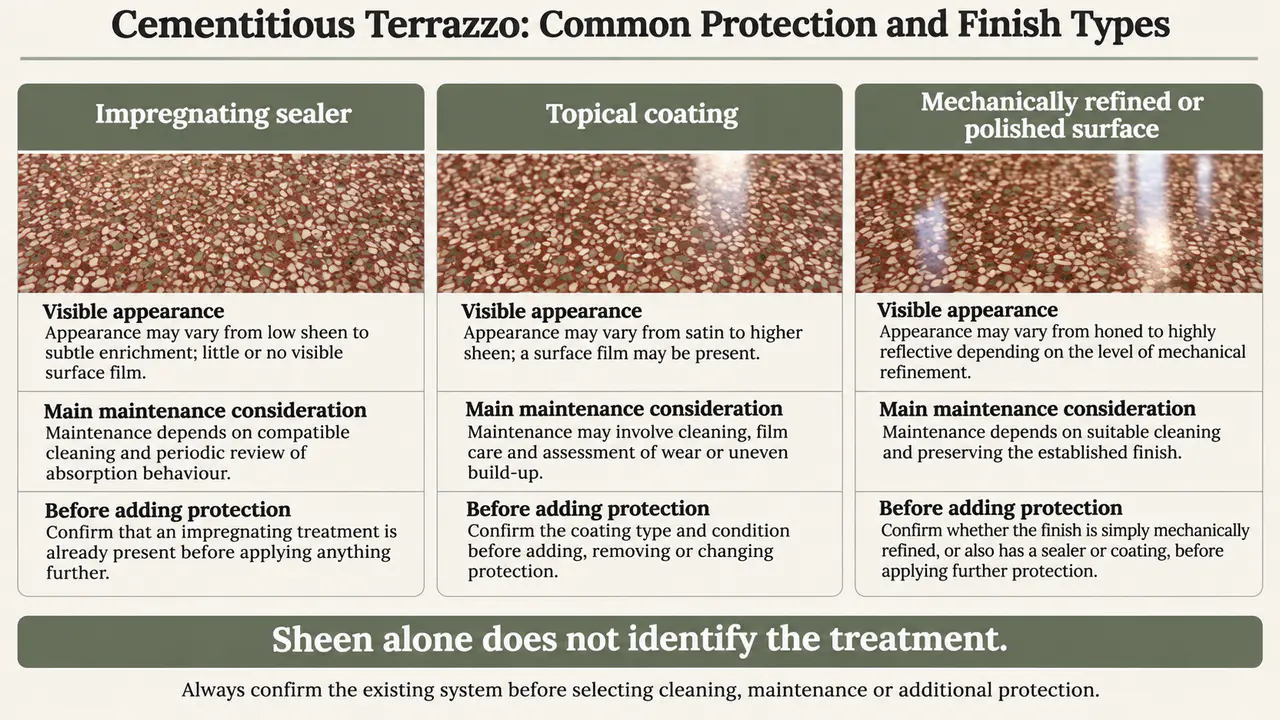
Before deciding when to reseal, establish what is already on the floor. Previous restoration paperwork or the original product details are more useful than judging by shine alone.
| Protection type | What it does | What renewal involves |
|---|---|---|
| Impregnating sealer | Reduces liquid uptake within receptive pores without forming a substantial surface film. Some versions also deepen the colour. | Assess water repellency, surface condition and product guidance before reapplying. Remove excess as directed; more product is not necessarily better. |
| Topical or film-forming sealer | Creates a surface film that may change the sheen. That film can become scratched, worn or discoloured. | Follow the coating system’s maintenance instructions. It may need maintenance treatment, renewal or eventual removal, but there is no universal stripping interval. |
A polished appearance does not tell you which protection is present: terrazzo can gain its sheen through mechanical polishing rather than a coating. A cement-compatible densifier is another distinct treatment and is not a substitute for a sealer.
What Actually Changes the Resealing Interval?
- Traffic and grit: entrance halls and main walking routes receive more abrasion than areas beneath furniture.
- Cleaning products: incompatible cleaners may affect protection. Some impregnating sealers can be damaged by unsuitable strong alkaline products.
- Surface condition: worn, pitted or damaged binder may behave differently from a sound, evenly finished surface.
- Previous work: grinding, honing or coating removal can change the floor’s absorption and protection requirements.
- The chosen system: application requirements, maintenance methods and renewal criteria vary between products.
Check busy areas as well as sheltered ones. Local changes may appear before the whole room needs attention, although any localised treatment must be compatible with the existing system and acceptable in appearance.
Signs Worth Checking Before You Reseal
The following changes justify a closer look, but none proves on its own that another coat is needed:
- Small spills darken the terrazzo more quickly than they previously did.
- A cleaned traffic lane takes up water more readily than a less-used area.
- A film-forming finish has visibly worn patches, scratches or peeling edges.
- The floor has been ground, honed or stripped since it was last protected.
Dullness alone is not evidence of sealer failure. Detergent residue, old polish, surface scratches, acid etching and binder wear can all reduce clarity. Similarly, recurring dark patches may involve retained soil, staining or moisture rather than simply insufficient sealer.
A cautious water-drop check
Where the existing product guidance permits, a few drops of clean water can help compare water repellency in different areas:
- Choose a small, inconspicuous area that has been appropriately cleaned and allowed to dry.
- Place a few drops on the surface and watch for darkening or absorption. Do not leave a puddle or allow prolonged soaking.
- Blot the water up promptly with a clean, absorbent cloth.
- Compare the behaviour with another inconspicuous, less-used area.
Do not use a universal timed pass-or-fail rule. Coatings, residues, finish and natural differences in the terrazzo can affect the result. Beading is only an indication of water repellency; it does not establish resistance to oil, acids or every possible stain.
What Must Happen Before More Sealer Is Applied?
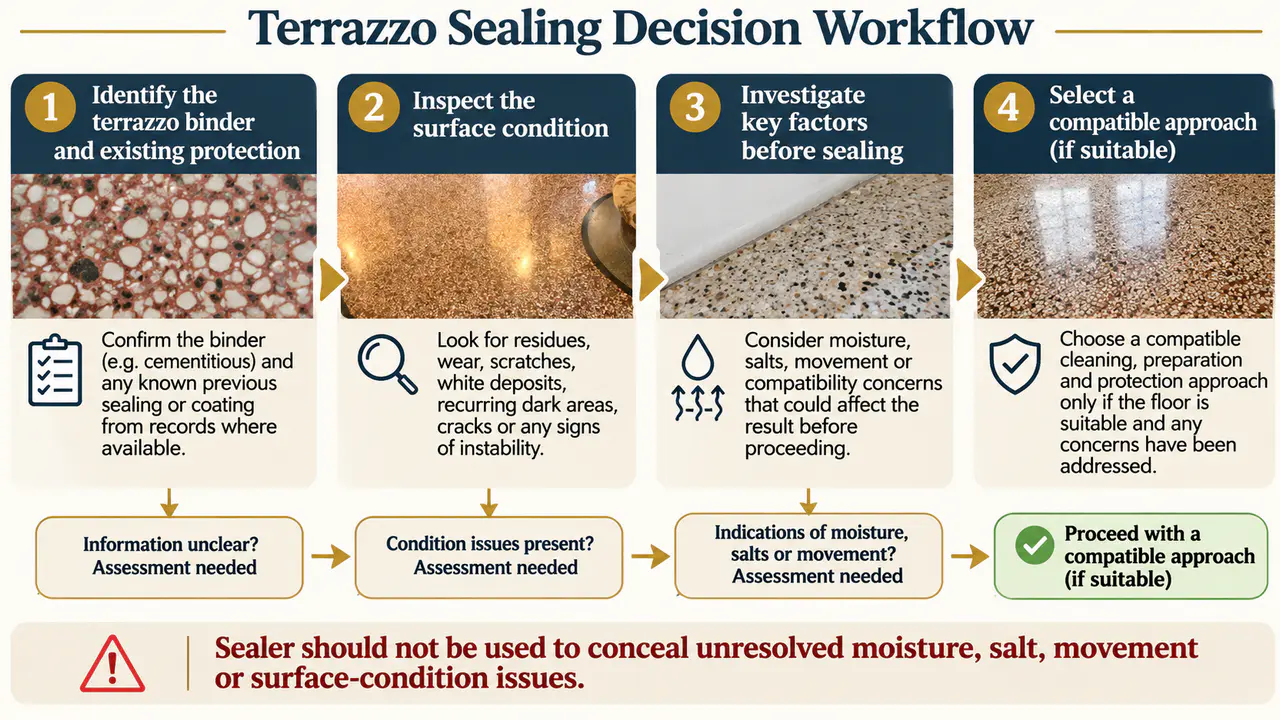
Resealing is sensible only when the surface is suitable and the proposed product can work with what is already there.
- Identify the existing treatment. An impregnating product cannot reliably reach the terrazzo through an intact topical coating. Do not layer unknown products.
- Clean and reassess. Use a compatible cleaner and remove residues thoroughly. Controlled alkaline deep cleaning can be appropriate for particular contamination, but requires suitable dilution, dwell time and rinsing.
- Check for damage. Sealer will not repair missing binder, scratches or etching. Persistent dullness needs diagnosis, not automatic grinding or another coating.
- Confirm suitable moisture conditions. Meet the selected product’s substrate-moisture and drying requirements. A surface that looks dry is not, by itself, proof of suitability.
- Test compatibility and appearance. Trial the proposed treatment discreetly before wider application, particularly with colour-enhancing products.
White salt deposits or persistent dark areas need assessment before sealing. They do not establish their own cause. Floor construction, moisture movement, salts and product vapour transmission all matter, particularly when considering a film-forming finish. An older floor is neither automatically suitable nor automatically unsuitable for a coating.
For application, follow the manufacturer’s coverage, excess-removal, drying and curing instructions. Adding extra coats beyond those instructions can leave unwanted residue or an uneven finish rather than useful additional protection.
Does Terrazzo Need Sealing After Restoration?
After grinding, honing or removal of an old coating, the newly exposed surface should be assessed for appropriate protection. The decision depends on the terrazzo, intended finish, absorption and floor conditions—not simply on the fact that restoration has taken place.
Ask the restorer to record the product used, its routine cleaning requirements, when the floor can return to use and what signs should trigger a maintenance review. That information makes future resealing decisions much more reliable.
How to Avoid Unnecessary Resealing
- Remove loose grit regularly using a suitable vacuum or soft dust-control method.
- Use entrance mats to reduce abrasive dirt.
- Clean with a compatible, low-residue, normally pH-neutral stone cleaner at the stated dilution.
- Wipe up spills promptly.
- Avoid vinegar, acidic cleaners and descalers: they can attack both cement binder and marble chips.
- Avoid bleach, unsuitable strong cleaners and residue-forming products. Specialist deep cleaning is a separate, controlled process.
The practical rule is to inspect, identify and then treat. If protection is performing as intended, do not add sealer simply because another year has passed. If absorption has changed, the coating is failing or the existing treatment is unknown, have the floor assessed before choosing a renewal method.
Pro Tip: Recommended products for routine terrazzo maintenance cleaning
Disclosure: As an Amazon Associate, Abbey Floor Care earns from qualifying purchases at no extra cost to you.



David Allen — Abbey Floor Care
David Allen of Abbey Floor Care has more than 30 years of hands-on floor restoration experience. His experience includes cement-based terrazzo cleaning, mechanical refinishing and the assessment of suitable sealing and maintenance treatments.
Recent Posts:
We work throughout the country, just some of our work counties:
Copyright © 2026 Abbey Floor Care. Tile And Natural Stone Cleaning Consultants FAQ - Privacy Policy - Terms And Conditions
Abbey Floor Care is a participant in the Amazon Services LLC Associates Programme, an affiliate advertising programme designed to provide a means for websites to earn advertising fees by linking to Amazon.co.uk. As an Amazon Associate, we earn from qualifying purchases.