
Travertine Floor Restoration Surrey For Failed Filler
Last Updated on July 20, 2026 by David
When Your Surrey Travertine Floor Needs Restoration
A Surrey travertine floor usually needs professional restoration when dark pits, failed filler, rough pale patches or dull traffic lanes remain after normal cleaning. Restoration may combine contamination extraction, cavity repair, selective diamond honing and compatible sealing, depending on whether the problem is dirt, surface damage or deteriorating protection.
If your travertine still looks dull after mopping, feels rough beneath your fingertips or has dark pits that quickly reappear, it may need professional restoration rather than stronger household cleaning. Surrey homeowners often first notice dull tracks along kitchen routes, through entrance halls and across open-plan family spaces, where the surface no longer reflects light evenly.
Rough pale marks tend to look quite different from loose dirt because they remain lighter and textured even when the surrounding stone is damp. Cloudy spots left by wine, fruit juice or unsuitable bathroom cleaners indicate that an acidic liquid has dissolved part of the surface. That visible dullness is a permanent physical change, not residue, so ordinary cleaning will not remove it.
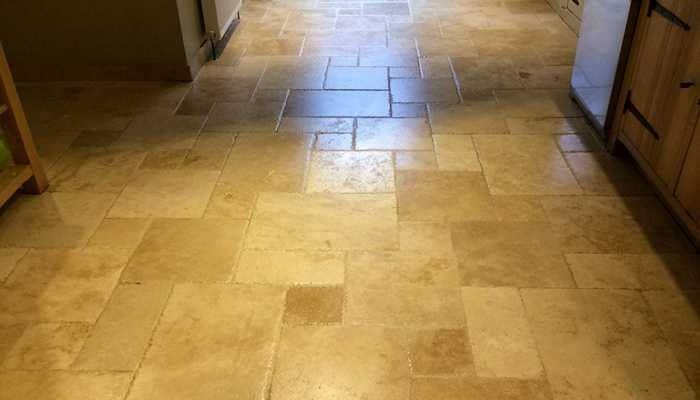
Recurring pits may appear as small holes with dark edges or as larger cavities where older factory fill has broken away. Failed filling often feels sharp or recessed beneath a fingertip and can collect soil soon after cleaning. A newly visible hole does not automatically mean the tile is failing, but it does show that the surface needs closer inspection.
Thin areas over natural cavities can also break through after years of abrasion. What the homeowner sees is a deeper hole, an irregular edge or an isolated area where the previously smooth plane has opened. Floors showing this pattern should be assessed before further scrubbing, as abrasive pads or repeated aggressive cleaning may enlarge the visible disturbance.
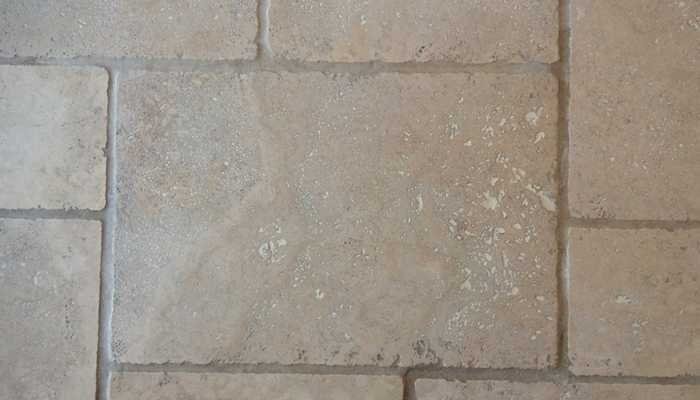
Travertine restoration is available for Surrey kitchens, hallways, bathrooms, conservatories and garden rooms where the floor continues to look dirty despite regular care. The service covers isolated defects as well as whole-floor deterioration across the GU and KT postcode areas. The work required is determined only after the floor has been seen and its condition recorded.
How We Assess and Restore Your Floor
Identifying the Existing Finish
Before travertine floor cleaning and restoration begins, the first question is what finish is already on the Surrey floor. Raking light, touch testing and close inspection distinguish worn coatings, exposed stone and compacted cleaning residue that can appear similar in normal room lighting. The assessment also confirms whether the original surface was filled and honed, filled and polished, tumbled, brushed or chiselled before cleaning, honing or coating removal is planned.
This distinction controls the treatment. Smooth factory-filled travertine must not be cleaned or refined like open textured stone. A filled and honed floor should retain a consistent satin plane, whereas tumbled or unfilled travertine contains visible cavities that remain matt even when filled or colour enhanced. Identifying that original character prevents unnecessary abrasion and protects the intended appearance.
Checking the Previous Protection
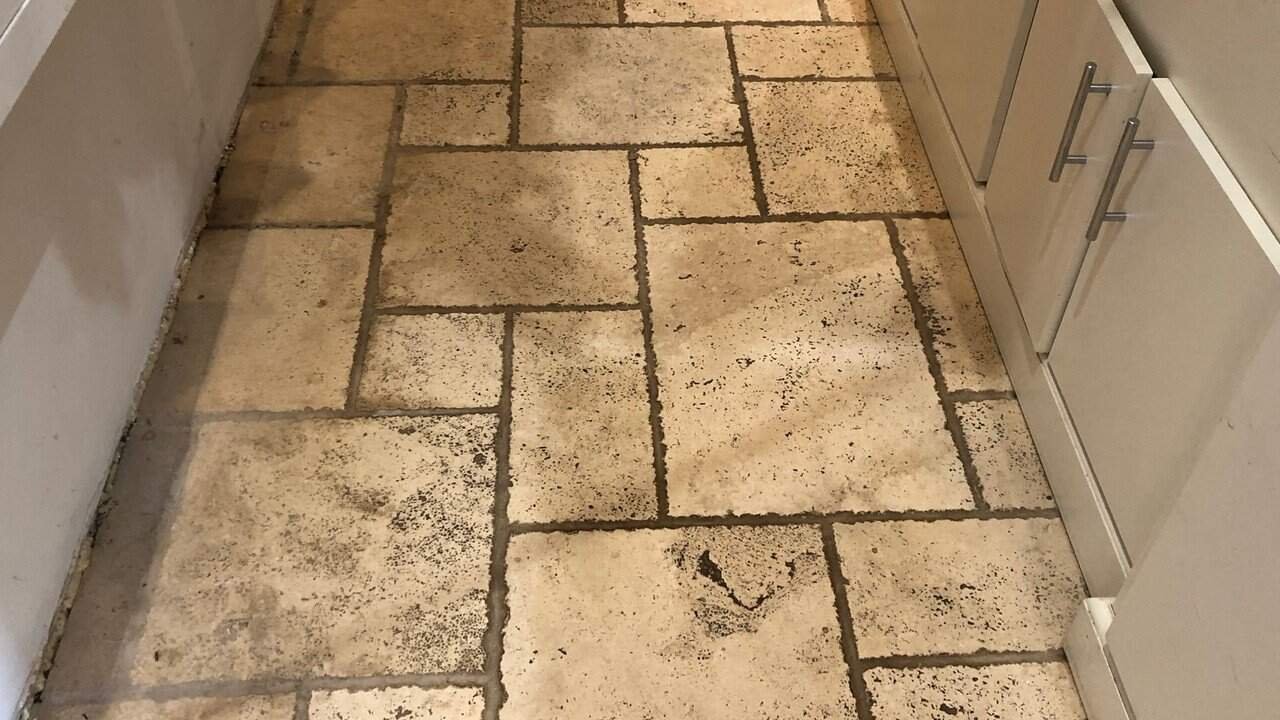
A Surrey homeowner may know the travertine looks dull or patchy without knowing which sealer was previously applied. Test areas establish whether the floor carries an impregnating treatment, a topical film, old polish or a natural mechanically refined sheen. The safe removal of old travertine sealer starts with that identification, because stripping the wrong layer can expose repairs, alter the finish or leave adjoining tiles visibly uneven.
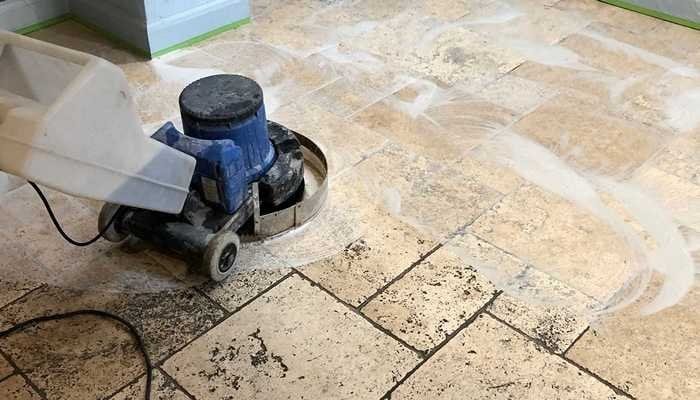
Peeling, yellowing, tackiness and patchy gloss usually indicate a degraded coating holding contamination at the surface. During professional travertine restoration, the failed film is softened under controlled conditions, scrubbed without unnecessary abrasion and extracted immediately. Removing the contaminated slurry rather than spreading it into nearby pits and grout gives the subsequent cleaning and sealing stages a stable foundation.
Controlled Cleaning and Extraction
When dark pits and grout lines keep returning, professional travertine floor cleaning must remove the contamination rather than circulate it. Alkaline chemistry loosens organic soil, while a nylon brush and rotary machine provide controlled agitation without aggressive abrasive pads.
Hot-water extraction then combines pressurised rinsing with immediate slurry recovery. Contaminated liquid is lifted from natural cavities and recessed grout before it can settle elsewhere. This is fundamentally different from a domestic steam mop, which has no extraction stage; the guidance on why steam cleaning is unsuitable for travertine floors explains that distinction.
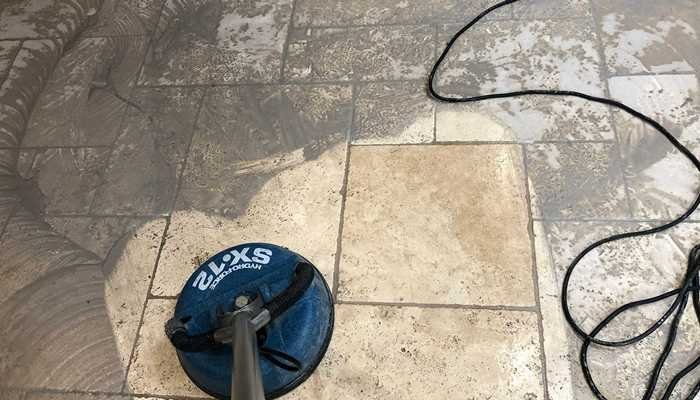
Rinsing continues until the recovered liquid becomes progressively clearer, showing that residue and suspended soil are no longer being redeposited.
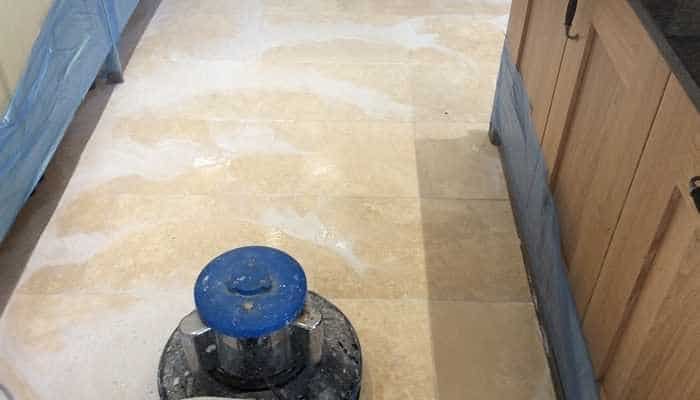
The floor is finally dried before repair, honing or compatible sealing is confirmed.
What Restoration Can Realistically Achieve
Homeowners searching for travertine floor cleaning and restoration in Surrey usually want to know how much visible improvement is realistic. The aim is not to erase every filled cavity, colour band or historic mark, because excessive refinement can remove more stone than necessary and make natural travertine look artificial. A proportionate restoration concentrates on cleanliness, stability, safety and a more consistent finish while preserving the geological character of the floor.
Surface contamination can normally be improved substantially through controlled cleaning, rinsing and extraction. Dark pits become cleaner, grout loses ingrained discolouration and dull traffic routes stop appearing permanently dirty. Once the floor is dry and protected with a compatible sealer, routine maintenance also becomes more manageable.
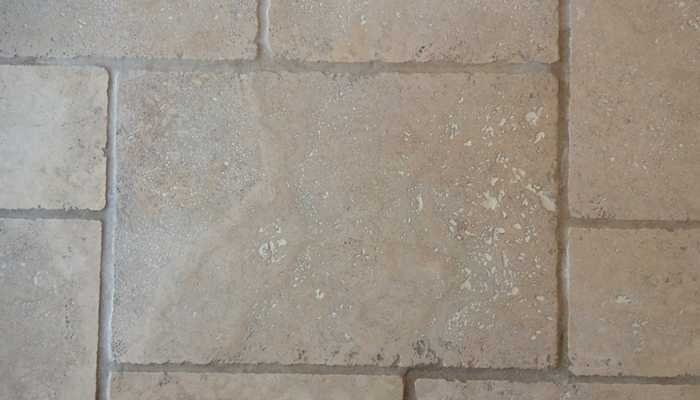
Physical surface wear needs selective Diamond Honing where scratches, etched patches or rough traffic lanes remain after deep cleaning. Progressive 400-grit, 800-grit, 1500-grit and 3000-grit abrasives refine only the areas and depth required to restore the intended satin finish. Because travertine is a porous sedimentary limestone with natural voids and variable density, unstable cavities may need filling before honing can produce an even surface plane.
Honing can remove shallow scratches, worn tracks and dissolved cloudy areas, but it cannot erase deep fissures or guarantee a mirror-like reflection across stone containing clustered cavities. The practical target is a smoother, more consistent finish that matches the original character rather than an artificial gloss.
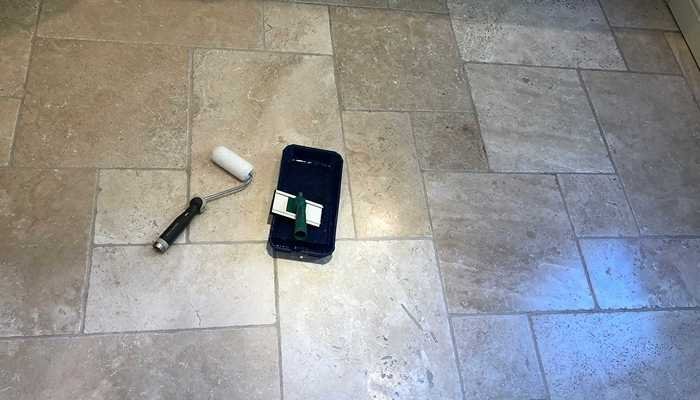
Failed or unstable cavities can be improved with a two-stage filling process. Weak material is removed and the opening prepared before a colour-matched filler is applied slightly proud of the surrounding tile. Final refinement then brings the repair back into the surface plane. Homeowners with isolated defects can review the limits of filling small holes in travertine safely, although widespread, deep or loose filling usually requires professional repair.
The finished appearance should be judged only when the stone and repairs are fully dry. Damp filler and freshly rinsed travertine can temporarily conceal colour differences. A restored floor should look cleaner, smoother and more coherent, but natural veining, deep damage, historic wear and inherent colour variation may remain visible.
Have We Restored Floors Like Yours in Surrey?
Travertine floors in Surrey often develop quite different wear patterns between quiet rooms and busy routes linking kitchens, entrances and gardens. Running a hand across the surface and viewing it under side light helps reveal whether the change is general finish wear, isolated scratching, missing fill or residue held within natural pits.
With nearly 30 years of experience across the country, Abbey Floor Care has restored honed and filled, tumbled, tumbled and filled, and polished travertine in residential, commercial and heritage settings. Surrey delivery is arranged through vetted specialists serving homes throughout the GU and KT areas, with Abbey Floor Care providing the assessment pathway rather than publishing individual contractor details.
On this Surrey kitchen floor I assessed, the dark marks were not ordinary surface dirt.
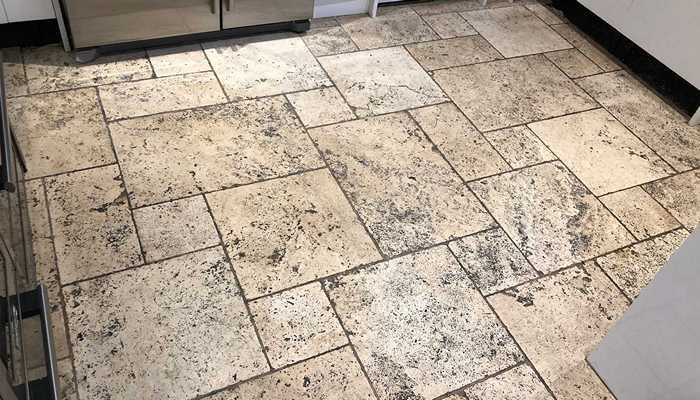
Once the failed coating was softened and the slurry extracted, several recessed pits and loose repairs became visible, allowing the cleaning, filling and honing stages to be specified separately.
In many Surrey properties we assess, traditional houses and later suburban homes include rear extensions connecting kitchens with patios. These layouts can create concentrated traffic routes where tracked-in garden grit contributes to dulling and scratches. Where older and newer bases meet, floor movement may also contribute to cracked grout or loose filling. The local housing pattern therefore influences what is inspected during the site visit rather than acting as a decorative location reference.
Filled-and-honed kitchen floors often need controlled cleaning, selective pit repair and refinement through the worn walking routes. Tumbled installations require a different approach because honing would permanently remove their aged edges and textured character. Completed work on a worn travertine kitchen floor in Richmond shows how the process is adapted to domestic traffic and the existing finish. The same diagnostic principle applies across Surrey, although every floor has a different history.
Vein-cut travertine needs additional attention because its linear pattern makes uneven refinement and filler colour more visible. The restoration sequence follows the direction and density of the cut, whilst the protection is selected around the existing finish and intended sheen. Further detail on restoring vein-cut travertine explains why one standard treatment cannot be applied to every installation. Controlled work preserves the visual flow rather than flattening its character.
Domestic steam mops are excluded from the maintenance approach because heat can soften a topical film and cause bond-break or film separation. Professional hot-water extraction is different: the contamination is removed immediately. Small claw-shaped arcs may indicate repeated pet movement, whilst broader straight scratches are more consistent with grit beneath furniture or regular foot traffic. Recognising that difference allows any refinement to remain proportionate.
Where to Learn More About Travertine Restoration
Homeowners researching travertine floor cleaning and restoration in Surrey may need a broader explanation before deciding which treatment their floor requires. Open cavities, worn filling, dark grout and changing sheen do not behave like ordinary surface dirt. Travertine contains structural voids formed during its geological development, and these natural features can trap contamination even where the denser surrounding stone remains sound and restorable.
The main travertine care, cleaning, repair and restoration guide explains the differences between contamination, etching, failed filler, surface wear and deteriorating sealers. Compare the floor only after it has dried, using normal room light and low-angle light, because wet stone and overhead lighting can conceal residue, scratches and uneven reflection. These observations provide useful context before arranging an assessment.
After restoration, remove loose grit before wet cleaning, use a pH-neutral stone cleaner and reseal at an appropriate interval. Avoid acidic cleaners because they dissolve calcium carbonate rather than safely removing soil.
Is It Time to Have Your Floor Assessed?
A professional assessment is appropriate when travertine floor cleaning no longer gives your Surrey floor an even result. Clear warning signs include dark pits or grout that return after drying, pale rough patches, failed or missing filler, peeling or tacky coatings, persistent residue and uncertainty about the existing sealer. Cracked, loose or deeply recessed grout also needs attention because damaged joints can hold contamination, admit moisture and weaken the finished appearance.
Use this sequence to record the condition before requesting advice:
- Check whether dark pits and grout lines return soon after the floor dries, and note any cracked, missing, loose or recessed grout joints.
- Run a fingertip across pale cloudy patches to see whether they remain rough.
- Look for missing filler, sharp cavity edges or loose material in busy routes.
- Check for peeling, tackiness, yellowing or cloudy separation in a surface coating.
- Place a few water drops on clean dry tiles and observe whether they bead or darken the stone.
- Record any bleach, acidic cleaner or domestic steam-mop use before requesting advice.
The water-drop test indicates only whether liquid resistance may have reduced. Rapid darkening does not identify the sealer type or prove that immediate resealing is required. Bleach, acidic products and steam-mop use should be disclosed because they can damage the surface, weaken protection or contribute to patchy discolouration.
Peeling edges, tacky areas, yellowing and cloudy gloss suggest a failing topical coating. Professional correction normally requires controlled removal, extraction and drying before a compatible protection system is selected. Grout repair may also be needed where joints are cracked, missing, contaminated or recessed, although repeated cracking can indicate movement beneath the floor that must be investigated before cosmetic renewal.
Photograph the floor only when dry. Include a full-room view, the main traffic route and a low-angle close-up with a coin for scale. Also provide details about room use, underfloor heating, previous coatings, cleaning products and when the symptoms first appeared.
Some defects can be corrected fully, while deep fissures, severe movement and extensive stone loss may require separate repair assessment. The complete travertine restoration resource helps distinguish cleaning, grout repair, stone repair, honing and sealing needs. A site assessment then determines which treatments are appropriate for the actual Surrey floor without promising that every mark will disappear.
Reviewed and updated for technical accuracy: 20/07/2026

David Allen — Abbey Floor Care
David Allen has worked with travertine floors for more than 30 years through Abbey Floor Care, assessing worn finishes, contaminated pits, failed filler and unsuitable coatings in homes across the UK. His approach to Surrey geo service work centres on identifying the existing finish before controlled cleaning, selective repair, refinement and compatible sealing are specified.
Recent Posts:
We work throughout the country, just some of our work counties:
Copyright © 2026 Abbey Floor Care. Tile And Natural Stone Cleaning Consultants FAQ - Privacy Policy - Terms And Conditions
Abbey Floor Care is a participant in the Amazon Services LLC Associates Programme, an affiliate advertising programme designed to provide a means for websites to earn advertising fees by linking to Amazon.co.uk. As an Amazon Associate, we earn from qualifying purchases.