Marble Floor Never Looks Clean Despite Proper Care
Last Updated on March 28, 2026 by David
Why your marble floor never looks quite right no matter how often you clean it
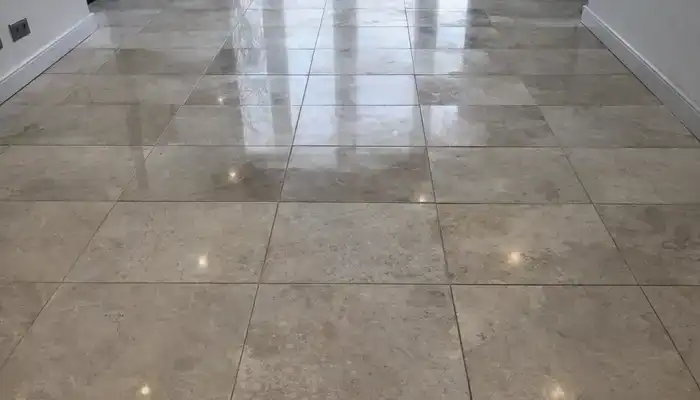
If your marble floor still looks dull, patchy, or cloudy after cleaning, the issue isn’t the cleaning. It’s the surface. What you’re seeing is a change in how the stone reflects light, not a layer of dirt sitting on top. Marble is made from calcium carbonate, and its dense calcite crystal structure produces a highly reflective finish that shows even the smallest disruption. Once that surface is altered, the floor looks uneven even when it’s perfectly clean.
In everyday UK homes — kitchens, hallways, bathrooms — marble is exposed to acids, grit, and moisture. Food spills, cleaning products, even tap water in hard water areas all interact with it. Marble is calcium carbonate formed by metamorphic recrystallisation — it reacts immediately with acids and achieves high mechanical polish due to its dense interlocking calcite crystal structure. So what looks like “dirt” is often acid etching or fine abrasion. Both physically change the surface.
Marble surface damage changes how light reflects, not how clean it is.
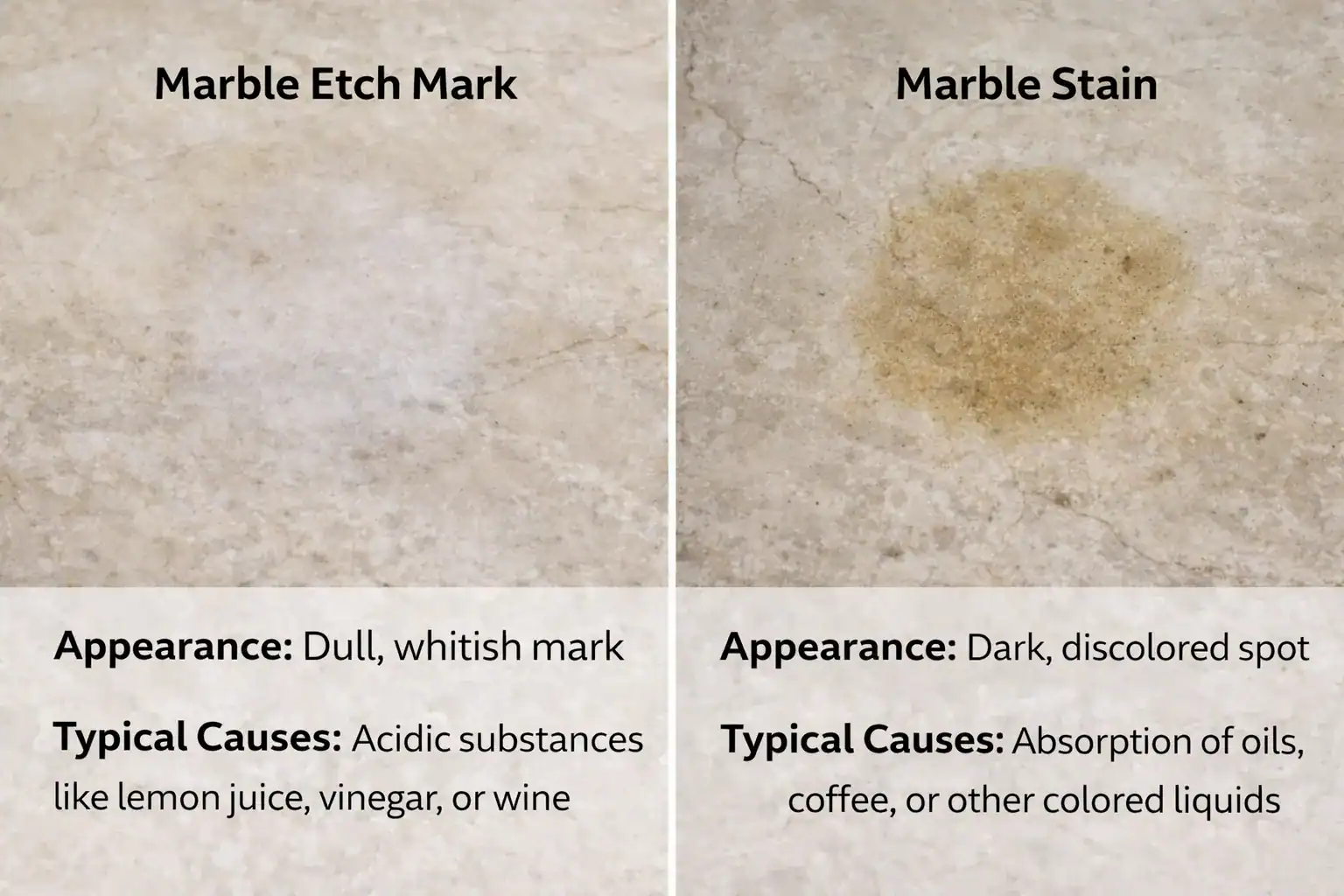
Acid etching is one of the most common causes. It’s a chemical reaction where acidic substances dissolve the top layer of the stone. You’ll see dull, flat patches — often around sinks, cooktops, or bathroom fittings. Cleaning won’t touch it. The correction is mechanical honing to remove the damaged surface and rebuild an even finish.
Micro-scratching matters just as much, though it’s often missed. Grit underfoot behaves like sandpaper, especially in busy areas such as entrance hallways. You’ll notice traffic lanes that look grey or hazy compared to surrounding areas. The fix is again mechanical — a controlled honing sequence using diamond abrasives (for example 400-grit to remove wear, then 800-grit to refine) before polishing restores clarity.
Water marks and mineral deposits add another layer of confusion. These aren’t stains in the usual sense — they’re residues left behind as water evaporates, particularly in UK hard water regions. You’ll see cloudy patches or rings that seem to return after cleaning. The correction is mechanical removal. Descaling chemicals will only create more etching.
What we often see in practice is a combination of all three. Light etching from cleaning products, micro-scratching from foot traffic, and residue build-up from previous treatments — all on the same floor. Each one disrupts light differently, so the surface ends up looking patchy and inconsistent.
Once you understand that, the approach changes. Cleaning reveals the condition of the stone; it doesn’t correct it. Remove the damaged surface layer — grinding if needed for lippage, then honing through progressive grits, then polishing to rebuild reflectivity — and the clarity comes back. In many cases, it looks better than when it was first installed. Properly flattened and refined surfaces usually do.
After that, maintenance becomes straightforward. A correctly honed and sealed surface doesn’t trap dirt in the same way, so it stays presentable with far less effort. Ongoing care matters — pH-neutral cleaning, removing grit before mopping, resealing at the right interval. The basics are covered in this safe marble cleaning guide, which shows how to avoid the mistakes that cause the damage in the first place.

Why marks seem to spread and sink deeper than the original spill
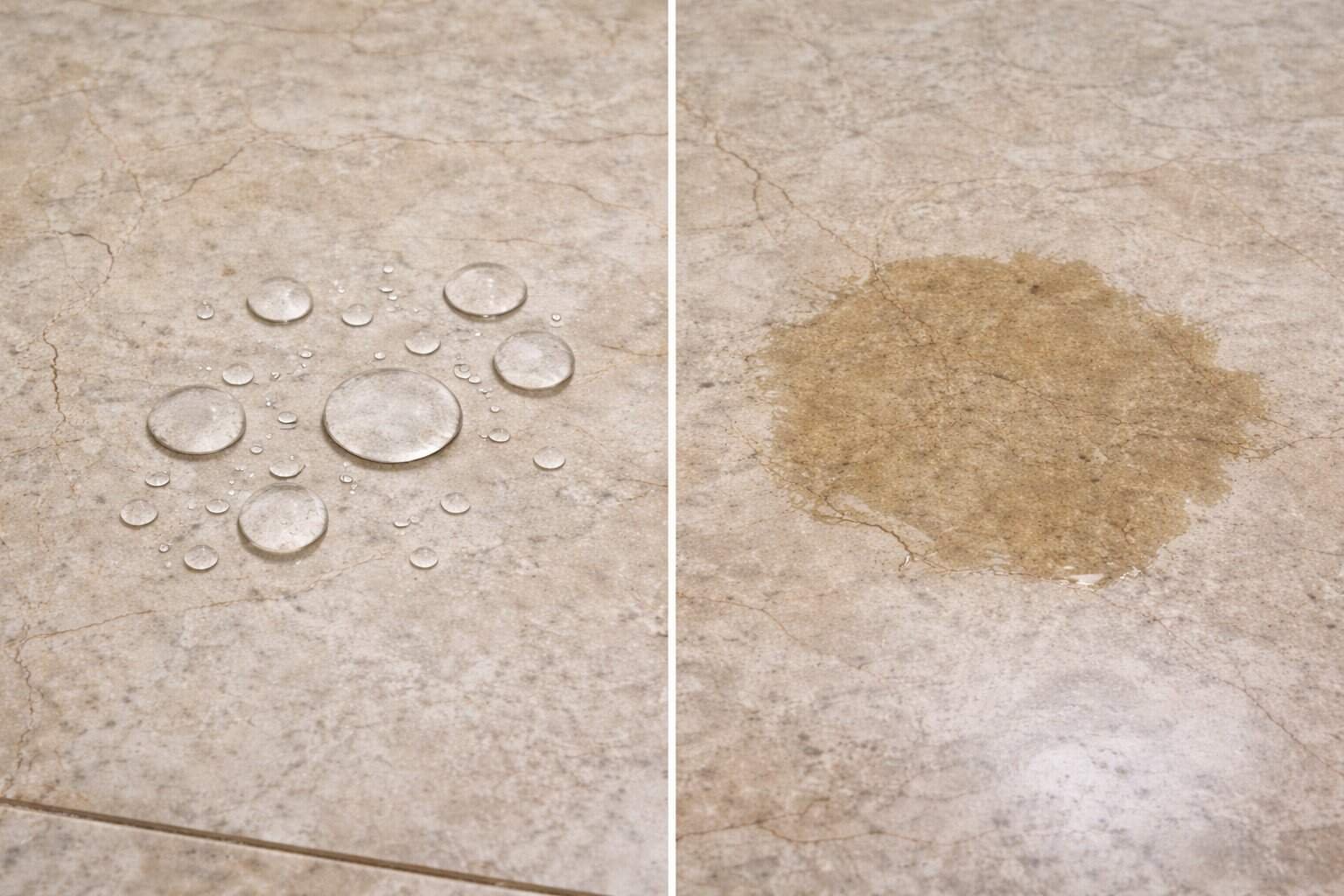
When a spill appears to grow or reappear after wiping, it hasn’t stayed on the surface. It’s moved into the stone. The mark often becomes larger than the original spill and can darken or soften at the edges over time. That’s because the liquid isn’t just sitting on top — it’s being drawn through the structure.
The mechanism is capillary action. Marble contains a micro-void network — tiny pathways between crystals — that allow liquids to travel sideways as well as downward. Once a spill enters these pathways, it spreads beyond what you can see at first, making the stain appear larger and harder to remove.
Quick wiping still matters. But if the liquid has already entered the structure, the mark may linger or expand slightly before stabilising. Sealing slows this movement. It doesn’t stop it. That’s the key point.
Why some areas look shiny while others stay dull and flat
Trying to polish out dull areas without addressing the cause usually makes things worse. You end up exaggerating the difference. The issue isn’t that some areas need more cleaning — it’s that the surface condition varies across the floor. Light behaves differently depending on how smooth or worn each section is.
If you can see a clear reflection in some areas but not others, this is uneven surface refinement. The polished areas have retained their smooth finish; the worn areas have lost it through abrasion or etching. The correction is to bring everything back to the same level using a full diamond abrasive sequence so the reflection becomes consistent again.
If the floor has a soft, even look with no reflection at all, that’s a honed finish. It’s deliberate. A honed marble floor has a uniform satin appearance, while a polished one gives a mirror-like reflection under natural light. Mixing the two across one surface creates the patchiness most people struggle with.

Why the floor looks dirty again shortly after cleaning
If your marble looks clean when wet but dull again when dry, you’re not seeing new dirt. You’re seeing residue and surface damage reappear as the moisture evaporates. Water temporarily masks the uneven surface.
If your floor re-soils quickly after mopping, it’s usually a residue build-up cycle. Cleaning products that aren’t fully removed leave a thin film. That film attracts dirt. And the cycle repeats — faster each time.
If traffic lanes stay dull no matter what you do, it’s micro-scratching, not soil. Fine abrasion scatters light, creating that greyed appearance. Remove the residue and correct the surface, and the difference is immediate. And lasting.
Why normal cleaning never fully fixes the problem
If repeated cleaning changes nothing, the issue isn’t on the surface anymore. It’s within the stone. What you’re seeing is physical damage or embedded contamination. Cleaning won’t remove either.
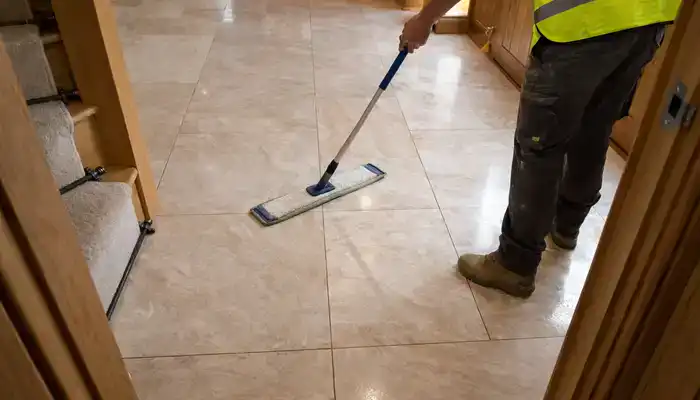
Professional cleaning works differently. It combines pH-neutral chemistry with mechanical agitation and full wet vacuum extraction. Residues are broken down and removed completely, not pushed around. That prepares the surface — but it doesn’t repair etching or scratches.
The real change happens afterwards. Once the damaged layer is mechanically refined and the finish rebuilt, the floor improves dramatically. And more importantly, it becomes easier to maintain. Cleaning alone can’t deliver that because it doesn’t alter the surface structure.
Why sealing doesn’t stop damage or keep the floor looking perfect
If your marble still marks easily after sealing, the issue is expectation. Sealers slow absorption. They don’t prevent damage. They buy you time — nothing more.
An impregnating sealer penetrates the surface and fills microscopic spaces, reducing how quickly liquids can enter. But it reaches a saturation point. Once that’s reached, adding more product does nothing. And crucially, acid still reacts with the surface beneath the sealer.
That’s where confusion comes in. Sealing helps reduce staining, but it doesn’t stop etching or scratching. So dull patches can still develop. Used correctly, sealing supports a surface that’s easier to maintain. It doesn’t compensate for existing damage.
Why patches, lines, and uneven areas keep appearing across the floor
If lines, patches, or darker edges keep showing up, you’re usually dealing with multiple defects at once. Each one alters the finish in a different way. That’s why the pattern feels inconsistent.
Etching
If your marble has dull patches where spills occurred, this is acid etching — a chemical reaction dissolving the surface. You see flat, lifeless areas that don’t respond to cleaning. The correction is mechanical honing.
Lippage And Picture-Framing
If tiles show darker edges or uneven reflection, this is lippage — height variation between tiles. The machine rides the high points during polishing, leaving edges darker. That’s picture-framing. The correction is grinding to flatten before polishing.
Uneven Wear
If traffic areas look different from the rest, it’s wear. Not dirt. The surface has simply been abraded more in those zones. The correction is a full honing sequence to bring everything back to the same level.
Why the finish keeps fading in busy areas even with careful cleaning
Traffic wear is the main driver here. Even with good cleaning, polished areas lose clarity over time — especially in walkways and frequently used zones. It’s not a cleaning failure. It’s physical wear.
The mechanism is grit abrasion. Tiny particles carried on shoes act like abrasives, gradually scratching the surface and reducing reflectivity. It builds slowly. Almost unnoticed at first.
Then one day the contrast is obvious. High-traffic areas look tired; protected areas still shine. Correct the surface properly, control grit, and the improvement holds far longer.
When cleaning has reached its limit and the floor still looks wrong
If cleaning isn’t changing the appearance, it’s time to stop. Continuing often delays the real fix — and can make the finish worse. At this stage, the issue isn’t removable contamination. It’s structural.
Mechanical honing is the solution. It removes a controlled layer of stone using diamond abrasives, starting with coarser grits such as 400 or 800 depending on the damage, then refining step by step. Etching and wear can’t be cleaned away. The stone itself has changed.
Once corrected, the result is clear. The floor regains a consistent finish and responds properly to cleaning. Maintenance becomes predictable again.
Use this simple check:
- Clean and dry the floor fully
- Compare dull areas to unaffected areas in natural light
- If the difference remains, the surface needs correction — not more cleaning

Where to go next depending on what your floor is doing
The next step depends entirely on what the floor is actually doing. Not what product you pick up first. Diagnosis comes before method.
If it looks dirty but improves when wet, focus on residue removal and cleaning method. If you see dull patches or uneven reflection, the surface needs mechanical correction. If spills are leaving marks, sealing and response time matter more. A full overview sits here: marble care, cleaning, repair and restoration explained.
Get the diagnosis right, and everything else follows. The floor can be brought back to a consistent, practical finish — one that actually works in everyday use.


David Allen — Abbey Floor Care
David Allen has spent over 30 years restoring marble floors across the UK, diagnosing issues like etching, wear, and uneven finishes before applying the correct mechanical processes. His work at Abbey Floor Care focuses on understanding how marble behaves so the right solution is applied first time. This hub reflects that experience, helping homeowners recognise problems early and avoid costly mistakes.
Recent Posts:
We work throughout the country, just some of our work counties:
Copyright © 2025 Abbey Floor Care. Tile And Natural Stone Cleaning Consultants FAQ - Privacy Policy - Terms And Conditions
Abbey Floor Care is a participant in the Amazon Services LLC Associates Programme, an affiliate advertising programme designed to provide a means for websites to earn advertising fees by linking to Amazon.co.uk. As an Amazon Associate, we earn from qualifying purchases.