Slate Floor Problems Start Below The Surface
Last Updated on June 6, 2026 by David
- Recognise fading, flaking, dullness and dark grout
- Understand why slate origin changes floor behaviour
- Check why marks and moisture sit below the surface
- Compare smooth, rough and heavily textured slate
- Read dirt, traffic lanes and stubborn surface marks
- Understand why ordinary cleaning may not change the floor
- Spot old coatings and patchy sealer build-up
- Separate flaking, fading and white deposits
- Set care expectations for older treated slate floors
- Know when slate problems need professional assessment
- Choose the right slate guidance next
Why slate floors need to be understood before they can be cleaned, sealed or restored
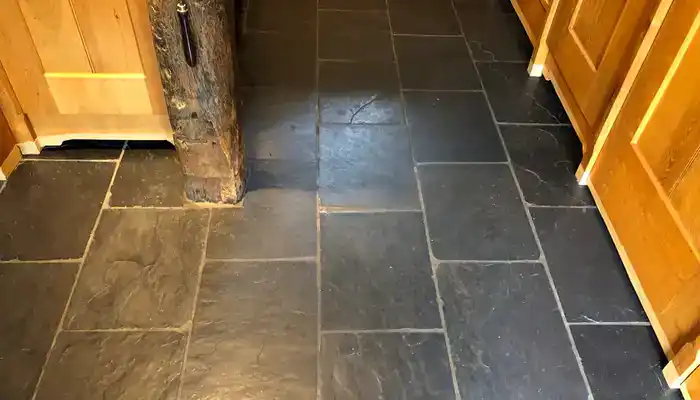
If your slate shows fading, dull patches, dark grout, white deposits, flaking edges or uneven colour, the visible issue may not be ordinary dirt. Footfall, old coatings, trapped water and the stone’s natural layers can all alter the floor at the same time. That overlap makes slate hard to judge by sight alone, especially in UK kitchens, hallways, boot rooms and period cottages where wear, damp air and previous treatments often sit together.
Visible slate problems usually appear as a pattern rather than one isolated mark. Pale pathways may follow busy walkways, darker borders may sit near tile edges, and low areas in the textured finish may stay grey after mopping. In my experience, those clues often point to traffic abrasion, coating accumulation, edge build-up, recessed areas and surface dulling working together, not simply poor cleaning.

Colour loss means the surface has been worn by foot traffic, taking some pigment with it. The homeowner sees colour fading, pale pathways, a chalky appearance and visual degradation where loose grit has caused microscopic breakdown in high traffic areas. The usual professional route is to judge whether the remaining mineral pigment can respond to an enhancement requirement, or whether the condition has moved into wider restoration assessment.
Riven surface texture is the mechanically split profile created as slate follows natural cleavage during production. The homeowner sees ridges, troughs, rough textured slate and low points that catch soil below normal mop contact. This textured finish creates both a cleaning challenge and a sealing consideration, because protection needs to work with the surface rather than hide or flatten its character.
Sealer build-up means old protective material has gathered on the surface instead of wearing evenly. The homeowner sees coating accumulation, topical excess, application residue, finish unevenness and darker edge build-up, especially in recessed areas. Professional assessment identifies whether the floor is showing old acrylic coating, wax residues, degraded topical protection or a worn internal barrier before any new treatment is considered.
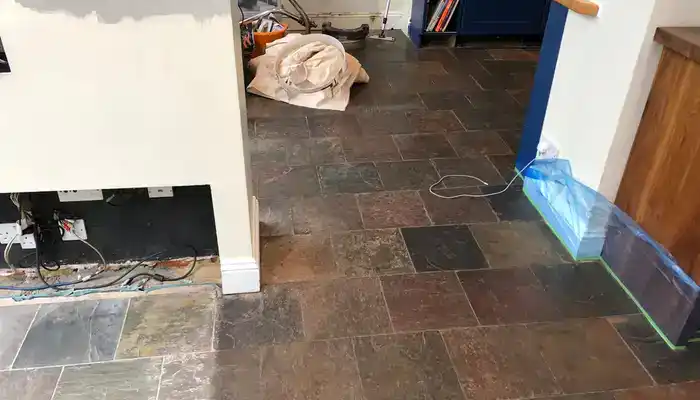
Delamination means slate layers are separating along weak mineral planes. The homeowner sees flaking, lamination loss, lifting edges or small pieces shedding from the surface. The correction category is local stabilisation, repair or replacement where layer separation, foliation failure and structural breakdown have moved beyond maintenance.
Moisture behaviour often changes how every other slate problem looks. High moisture levels, trapped water, vapour movement and substrate moisture can leave chalky residue, create an efflorescence trigger and cause sealer failure if sealing happens too early. A drying period or drying assistance may be needed before the floor can be judged reliably, because damp slate can make coatings, colour and surface deposits look worse than they are.
White deposits need to be read differently from grey wear or dark staining. Efflorescence is the white chalky dusting that appears when mineral salts move with moisture and form surface deposits during evaporation. The homeowner sees haze near grout, wetrooms, damp edges or recently rinsed areas, while professional correction focuses on moisture diagnosis, drying control and breathable protection rather than trapping salts beneath another coating.
Origin also controls how confidently a floor can be assessed. Welsh origin material usually has high density, low porosity and a hard surface that acts as a UK benchmark, while Indian origin and Chinese origin slates may be softer, more porous and more variable. Heritage slate provenance matters because traditional slate, domestic import material and variable quality batches do not absorb, wear or respond to sealers in identical ways.
Wrong assumptions can cause avoidable damage on a slate floor. Strong acidic products, aggressive chemistry, bleach, steam cleaning and harsh pads may cause surface damage, sealer breakdown, surface peeling, moisture penetration, flaking risk or permanent colour change. Slate is a fine-grained metamorphic rock that cleaves along natural planes — its layered structure prevents mechanical polishing and limits restoration to cleaning and sealing, and it also makes the stone sensitive to aggressive cleaning chemistry.
Problem recognition gives the slate hub its role. This page does not teach a treatment sequence; it separates material behaviour from cleaning failure, sealing failure, moisture movement, colour reduction and structural characteristic. The right route becomes clearer once the floor’s visible symptoms are tied to the physical cause rather than treated as generic dirt.
Why slate from different places does not always behave the same way
Slate that looks similar across a room may behave differently because quarry origin changes hardness, porosity and colour response. Welsh slate is usually denser and less absorbent, while Indian slate and Chinese slate often show higher porosity, softer material and quality variation. Those differences affect drying, sealing response, surface wear and the way the floor ages under domestic traffic.
Geological formation creates the layered structure that gives slate its character. Mineral planes allow the stone to split into sheets, but that same structural characteristic also creates delamination risk where cleavage separation develops at weak boundaries. Heritage slate provenance therefore matters, because traditional slate with a hard surface and low porosity responds differently from softer domestic import material with greater absorption risk.
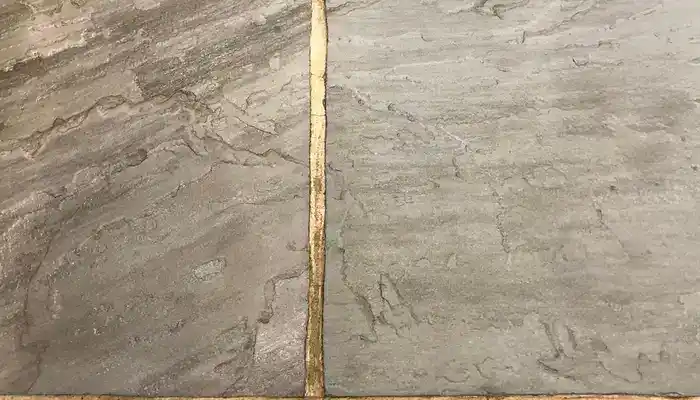
Origin-aware assessment prevents one generic slate route from being applied to every floor. A dense Welsh origin floor may need a different sealer matching decision from Indian origin material with higher porosity or Chinese origin tiles with variable quality. The diagnostic route is explored further in Problems With Slate Floors Start Inside The Stone, where quarry behaviour and visible change stay within the diagnosis topic.
Why some slate traps marks, moisture and dull patches below the surface
Repeated scrubbing of a dull slate patch can make the floor harder to read, because the mark may be sitting in texture, coating residue or moisture rather than loose surface soil. Low points, grout lines and old floor construction can hold water, soil and dissolved contamination below normal mop contact. The result is a patch that returns or darkens even after the surface appears clean.
Moisture entrapment describes trapped water, high moisture levels and vapour movement below or within the floor system. The homeowner sees chalky residue, slow-drying dark areas, haze near grout or coating cloudiness after sealing too early. Professional assessment looks at substrate moisture, drying period and sealer failure risk before the floor is directed towards cleaning or sealing guidance.
Slate must be read before it is treated.
Residue lock-in develops when surface contamination, degraded sealer and detergent traces collect in textured recesses. The homeowner sees a dull finish, powder formation, residue build-up and cleaning difficulty even after routine maintenance. Cleaning limits and tired-looking floors are discussed further in Why Slate Floors Can Still Look Tired After Cleaning, where maintenance signs are separated from material failure.
Why one slate floor can look smooth while another looks rough, uneven or heavily textured
Surface texture changes how slate reflects light, holds soil and responds to protection. A fine-honed slate floor has a smooth, consistent surface that diffuses light evenly, while an impregnating sealer leaves the natural riven texture unchanged, and a topical sealer adds a low surface sheen. That distinction matters because a rough floor and a smoother floor can both be sound while looking completely different.
Riven slate keeps the mechanically split, textured finish formed along natural cleavage. The homeowner sees natural colour variation, rough textured slate, deep grooves and surface texture that makes dirt more visible in low points. Smooth slate shows footfall damage differently because surface wear creates a flatter dull plane across busy walkways.
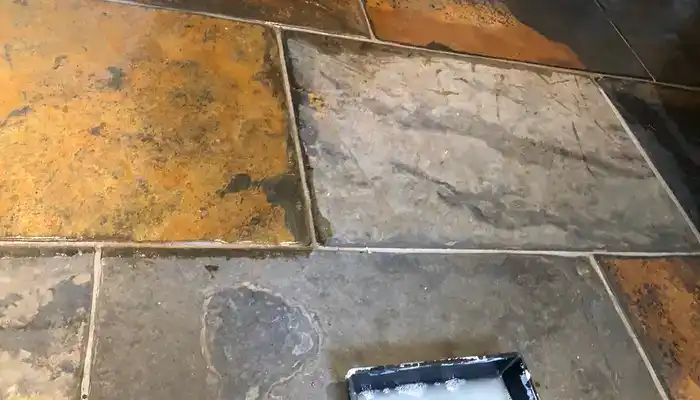
Finish misdiagnosis can permanently change the character of the floor. Riven slate should not be treated as a surface to flatten unless the intended result is a different floor character. Impregnating sealers maintain a natural finish, while topical sealers are used where a colour-enhanced or low-sheen finish is required.
Why dirt settles into some slate floors instead of wiping away cleanly
If your slate looks dirty again soon after mopping, soil may be sitting in the floor’s texture rather than on the surface. Riven texture, grout joints, old coatings and high traffic areas create places where organic soil, cloudy water, soap residue and loose grit can settle. A flat mop may simply move that contamination around without lifting it fully from recessed areas.
Traffic lane abrasion creates pale pathways and surface dulling where busy walkways carry repeated footfall damage. The homeowner sees chalky appearance, colour reduction and visual degradation as grit causes microscopic breakdown of the surface. That is not simple dirt; it is surface wear that changes how the stone reflects light and holds protection.
Dark grout often records contaminated wash water rather than a separate joint defect. Dirty water, detergent traces, mop water and repeated rinsing problems collect in grout joints and textured surfaces, leaving sticky film or dulling across the tile surface. Professional cleaning pages can cover slurry extraction, wet vacuum control and residue removal in detail, but this hub keeps the focus on why the soil returns.
Why ordinary cleaning may not change how a slate floor looks
Slate that stays flat, grey or tired after mopping may have changed beyond surface soil. Dullness can come from degraded sealer, powder formation, surface contamination, traffic wear, residue build-up or protective layer loss. Stronger household cleaning may only add detergent residue or disturb a failing coating without restoring colour depth.
Sealer failure means the protective layer no longer reduces absorption or supports a stable appearance. The homeowner sees rapid re-soiling, surface peeling, colour patchiness, water darkening and a dull finish that returns after cleaning. Professional assessment identifies whether the failure sits in an acrylic coating, wax system, impregnating protection or topical protection before routing the floor further.
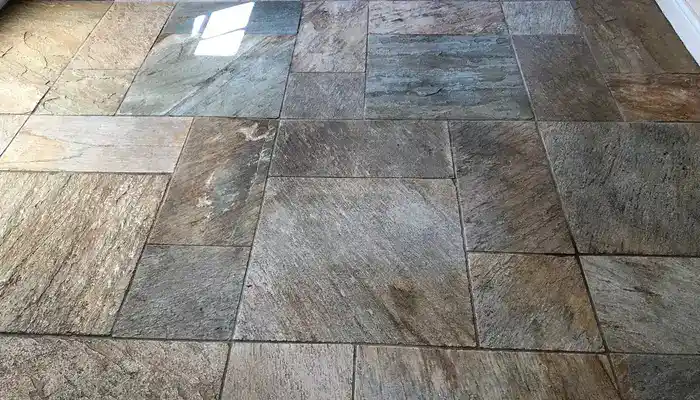
Cleaning chemistry affects slate because extremes of pH can change colour or damage protection. Finish-safe, pH-balanced routine maintenance uses mild surfactants and residue-free daily cleaning, while aggressive products may leave residue, strip sealant or cause permanent colour change. Practical maintenance boundaries are covered in Why Slate Floors Can Still Look Tired After Cleaning, where cleaning advice stays within its own topic.
Why old coatings can make slate look patchy, sealed-in or harder to judge
Old coatings can make a slate floor look darker, cloudier or more uneven than the stone underneath really is. Coating accumulation often collects as edge build-up, recessed areas, topical excess and application residue. The homeowner sees finish unevenness, darker tile borders, cloudy patches or sticky areas that make the floor difficult to judge.
Acrylic topical sealer forms a surface film that may begin with a satin finish but often shows lower durability in traffic lanes. Wax system treatments create a traditional finish, mid-lustre and heritage appearance, yet periodic maintenance and renewal requirement become important as wax application ages. Topical urethane sealer creates a high-durability urethane coating with wear resistance where a wet-look finish or gloss sheen has been chosen, but the dry substrate requirement remains critical.
Build-up treatment is a correction category, not a hub instruction. Solvent action, acrylic removal, wax dissolution, chemical penetration, coating stripping and sealer removal belong on dedicated treatment pages because they depend on the floor’s condition. The broader method route is handled in A Simple Guide To Cleaning And Sealing A Small Slate Floor, while this section explains why old coating history can hide the true slate surface.
Why slate floors split, flake, fade or develop traffic wear over time
If your slate is flaking, splitting, fading or showing white deposits, the symptoms need separating before the cause is assumed. Flaking surface, peeling layers and lamination loss may point to layer separation, while pale walkways may point to surface wear. White chalky dusting usually points towards mineral salts carried by moisture movement.
Spalling is surface breakdown where moisture stress, heat exposure, steam cleaning, seal failure or a weakened surface leads to flaking surface and peeling layers. The homeowner sees loose fragments, roughened riven texture, layer separation or localised surface instability. Professional correction starts with identifying whether the cause is moisture, heat damage, coating degradation or structural breakdown.
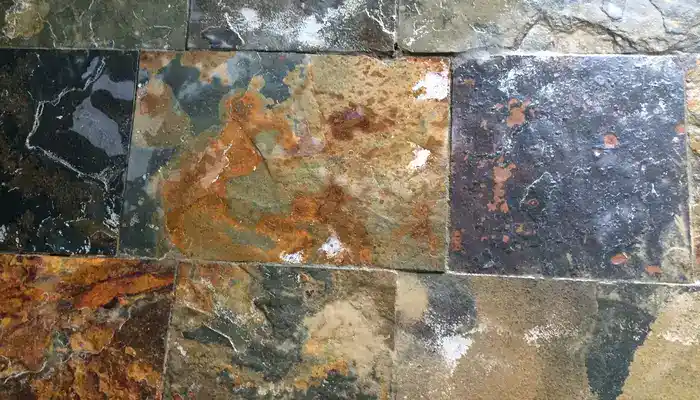
Efflorescence completes the moisture story because mineral salts can migrate through grout and form surface deposits during evaporation. The homeowner sees haze, chalky white marks, wetroom deposits or residue that returns after wiping and drying. Professional correction belongs in moisture diagnosis and breathable protection decisions, not in sealing the deposits beneath another layer.
Filler collapse is factory filler failure in honed-filled tiles. The homeowner sees filler loss, void exposure, aesthetic degradation or small holes where the old filler has failed. The correction category is local cleaning and refilling before protection where structural compromise is not active, while flaking and repair thresholds are explored further in Slate Floor Flaking? What’s Causing It (And How Professionals Repair It).
Why slate needs a care routine that fits its age, finish and past treatment
Generic slate care often fails because the floor’s age, finish, traffic level and old treatment history control what maintenance can achieve. A dense traditional slate hallway, a softer domestic import kitchen and a wet room floor can all need different expectations. The same mop routine may leave one floor stable and another patchy, dull or slow to dry.
Moisture-controlled mopping reduces over wetting on porous slate and textured surfaces. A well-wrung mop, wringer bucket, clean rinse water and controlled drying reduce cloudy water, detergent traces and residue build-up. pH-neutral stone cleaner supports pH balance, routine maintenance, daily cleaning and a safe formulation without relying on aggressive chemistry.
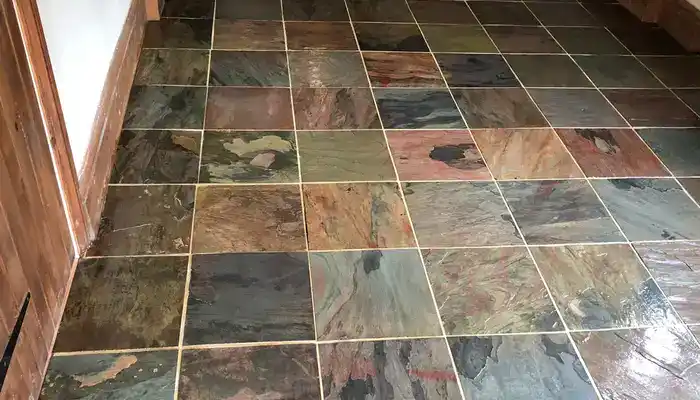
Sealer maintenance is a normal performance issue rather than automatic product failure. Impregnating sealer gives penetrating protection, pore sealing, absorption reduction, invisible protection and a breathable internal barrier with a natural appearance. Colour-enhancing impregnator adds mineral pigment activation, colour deepening, visual richness and breathable protection where riven slate application can still respond.
Long-term judgement benefits from slate case study evidence because real floors show how previous treatments affect outcomes. The Slate Floor Cleaning Service Restored This Matlock Floor case study shows how riven surface texture, old coatings and maintenance handover shape a finished result. Case evidence supports diagnosis without turning this hub into a treatment manual.
When slate floor problems are normal ageing and when they need professional assessment
Delamination, trapped water, coating accumulation and traffic wear need a different response from normal dullness after a busy week. Normal ageing usually appears as gradual surface dulling or mild colour variation, while assessment-level problems return quickly, spread, flake, darken or leave deposits. The threshold is behaviour that repeats after sensible routine maintenance.
Diagnostic separation works best when the visible signs are grouped by behaviour rather than guessed from colour alone. Loose dirt that returns slowly points towards maintenance, water that soaks in points towards sealing guidance, cloudy edge build-up points towards coating history, flaking points towards structural assessment, and white deposits point towards moisture movement. Those categories help the homeowner choose the right next page without giving procedural instructions.
- Temporary surface soil improves and stays improved after routine maintenance.
- Water darkening or loss of beading suggests worn protection.
- Cloudy film, sticky edges or darker borders suggest coating accumulation.
- Flaking, splitting or filler loss suggests repair-level assessment.
- White deposits, damp patches or returning haze suggest moisture movement.
Professional assessment becomes more important when several signs appear together. Persistent colour reduction, high traffic areas, grout contamination, sealer failure and layer separation indicate a wider condition rather than one isolated mark. Structural and economic repair thresholds are kept separate in Is it Cheaper to Repair or Replace Slate Floor Tiles, where repair and replacement decisions are handled in their own context.
Where to go next for slate cleaning, sealing, restoration and case study guidance
The next slate page should match the actual concern: cleaning limits, colour fading, wet-look response, flaking, repair decisions or real floor evidence. This hub keeps the explanation at material level so the reader can choose the correct route before reading a narrower page. That separation protects the page from drifting into process instruction.
Cleaning and sealing pages take over where the homeowner needs treatment-specific detail. Slurry extraction, riven surface contamination control, wet vacuum residue removal and redeposition prevention belong in method pages rather than in the hub. The practical route is A Simple Guide To Cleaning And Sealing A Small Slate Floor, while colour enhancement and wet-look expectations are kept in Achieving the Signature Wet Look on Natural Slate Flooring.
Case study evidence helps connect the diagnosis to floors with different origins and histories. Indian origin, Welsh origin and Brazilian Black Slate can differ in higher porosity, low porosity, sealed slate behaviour, wet rooms, dry areas and contamination patterns. Examples such as Indian Slate Cleaning Barnes, Slate Cleaning Corris Gwynedd and Brazilian Slate Cleaning Abergavenny show how origin, finish and previous treatment alter the professional route.
BIO_PARAGRAPH: David Allen has worked with slate and natural stone floors across the UK for over 30 years through Abbey Floor Care. His practical experience with material behaviour, restoration sequencing and long-term floor care informs the diagnostic guidance published under the Abbey Floor Care name.
Recent Posts:
We work throughout the country, just some of our work counties:
Copyright © 2026 Abbey Floor Care. Tile And Natural Stone Cleaning Consultants FAQ - Privacy Policy - Terms And Conditions
Abbey Floor Care is a participant in the Amazon Services LLC Associates Programme, an affiliate advertising programme designed to provide a means for websites to earn advertising fees by linking to Amazon.co.uk. As an Amazon Associate, we earn from qualifying purchases.