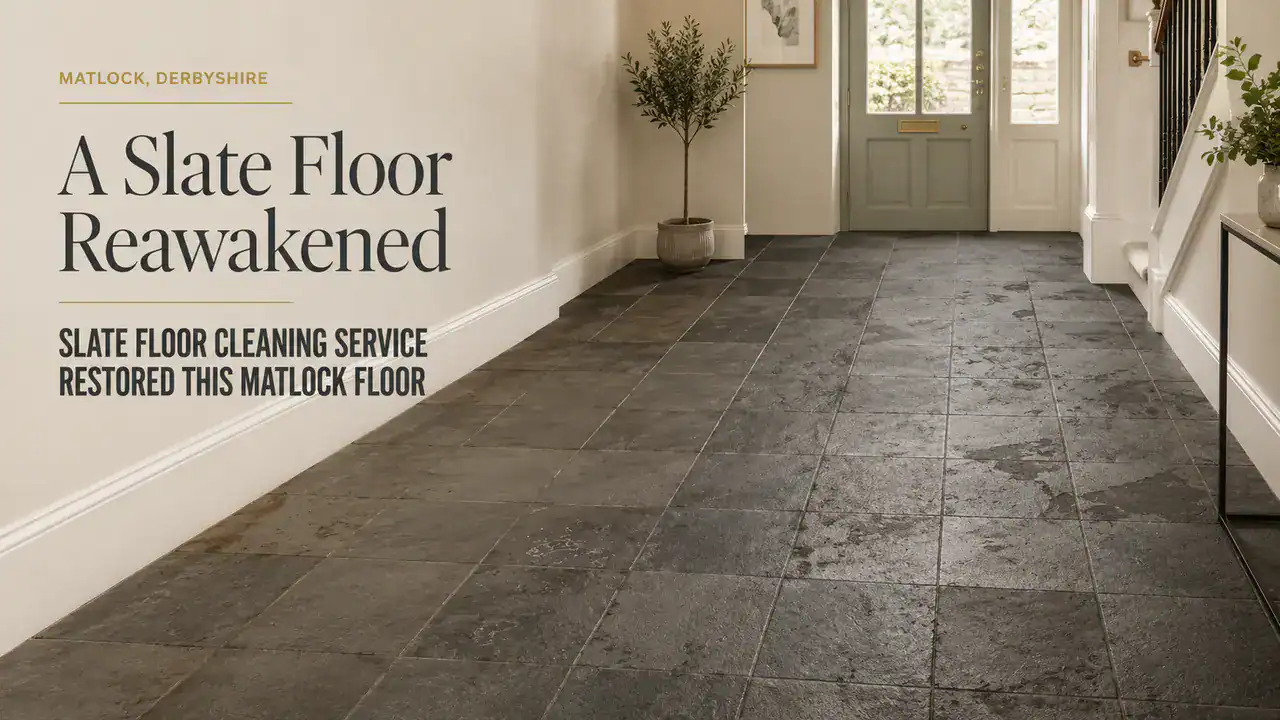
Slate Floor Cleaning Service Restored This Matlock Floor
Last Updated on June 4, 2026 by David
When a heavily soiled slate floor looked flat and had lost its original definition
If your slate floor looks flat, dark and lifeless even after repeated mopping, the visible problem has usually moved beyond everyday dirt. The Matlock kitchen and dining floor had reached that point. The surface looked dull, the natural colour variation had faded back, and the grout lines made the whole installation look older and heavier than it really was.
The homeowner had already tried to keep the floor presentable, including using a steam cleaner for a period. It gave short-lived improvement, but the dark areas kept returning, with patchy surface contamination and cleaning difficulty across the textured finish.

The riven surface made the floor especially awkward to clean because the natural ridges, troughs and textured areas held onto dirty water. That surface character is part of slate’s appeal, but once the finish becomes tired, the floor can start to look permanently marked even straight after washing.
Lost grout in the kitchen area added to the problem by leaving small vulnerable gaps where dirty wash water could settle. Dark grout lines, localised grout loss and heavy soiling worked together, pulling down the appearance of the whole floor rather than leaving one neat, obvious fault.

Matlock sits within the DE4 postcode district and the Derbyshire Dales, a town that grew from a Victorian spa and hydropathy centre after the railway arrived in 1849. That expansion left a stock of stone-built homes, guest houses and villas where slate floors still appear in kitchens, hallways, boot rooms and service areas — surfaces chosen for their durability and washability in exactly the kind of busy domestic setting this floor represented. The conservation areas around Old Matlock, Matlock Bank and the former spa quarter give many properties a strong period character, and with it the kind of floor that repays careful restoration rather than replacement.
The visible condition was judged from long practical experience with domestic slate floors, not treated as a simple cleaning complaint. David Allen’s stone restoration work with Abbey Floor Care spans more than 30 years, and that experience matters on floors where soil, worn protection, grout condition and surface texture all influence the final result.
The Matlock floor did not need to be turned into a different surface to look significantly better. It needed definition recovered, the grout appearance improved, and the surface made responsive to cleaning again while preserving the natural riven character of the slate.
Why repeated mopping could not stop the slate and grout looking dirty again
Old protection breaking down was the main reason the Matlock slate looked dirty again soon after mopping. The failing surface layer allowed contamination to sit in recessed areas and grout joints, so clean water could move soil around without removing the residue properly.
Sealer failure means the protective layer has stopped controlling moisture and soil at the surface. The homeowner sees quick re-soiling, dull patches and dirty grout after washing, and the correction is controlled restoration followed by suitable sealing rather than stronger household cleaning.
Mopping cannot remove grime once the surface is holding it.
Riven slate has a mechanically split surface formed along natural cleavage, so its ridges and troughs create a real cleaning challenge. Slate is a fine-grained metamorphic rock that cleaves along natural planes — its layered structure prevents mechanical polishing and limits restoration to cleaning and sealing, while also making it sensitive to aggressive cleaning chemistry.
Possible flaking or loose edges were treated with realistic expectations rather than hidden behind a promise of perfection. Layer separation is where weak mineral planes begin to lift or break away; the homeowner sees flaking, small loose pieces or surface instability, and the correction is careful stabilisation or local repair where the structure allows it.
How deep cleaning, pressure rinsing, grout repair and sealing worked together as one restoration
Cleaning a riven slate floor without dealing with rinsing, grout gaps and protection can leave it open to rapid re-soiling. In Matlock, the cleaning, pressure rinse, grout repair and sealing were treated as one connected workflow rather than separate jobs.
Deep cleaning released the embedded organic soil using a slate cleaner, dwell time and machine agitation across the textured surface. The machine helped reach the deep grooves and recessed areas that a mop could not contact evenly, while the cleaning stage prepared the floor for proper residue removal rather than simply spreading dirty solution around.

Controlled pressure rinsing and capture removed the slurry before it could dry back into the riven surface. That mattered. Slurry extraction, wet vacuum recovery and contamination control prevent dissolved residue from settling back into the same texture that made the floor difficult to maintain. More detail on the wider restoration sequence is covered in professional slate floor restoration techniques, where cleaning, repair and protection are treated as linked decisions.

Local grout repair closed the missing joint areas before sealing locked in the improved condition. The impregnating sealer reduced absorption within the slate, and the surface sealer added a low sheen that made the riven floor easier to maintain than cleaning alone could have achieved.
After restoration, the slate finally responded properly to normal cleaning
The practical measure of success was not just that the slate looked better, but that normal cleaning finally worked again. Before restoration, the floor stayed flat, dark and dirty-looking because contamination and tired protection kept affecting the surface after every wash.
The restored finish looked significantly better and, in many cases like this, better than when first installed because the right sealer activated the remaining natural colour and protected the surface correctly. Before restoration, the grout pulled the appearance down; after restoration, the tile definition and low-sheen finish gave the floor a cleaner, more settled appearance.

The maintenance handover focused on keeping grit off the floor before wet mopping and using a pH-neutral stone cleaner rather than steam cleaning, which can soften coatings and drive moisture into textured areas. A professionally restored and correctly sealed floor is significantly easier to clean and maintain than a worn or incorrectly treated floor.
Where this slate restoration fits within long-term floor care and maintenance
A heavily soiled slate floor often needs to be understood as a long-term care problem, not a one-off cleaning problem. The Matlock project showed how cleaning, grout repair and protection had to be planned together because the old surface no longer supported simple maintenance.
Correct ongoing maintenance — pH-neutral cleaning, grit removal before wet mopping, and resealing at the right interval — is the single most important factor in extending the floor’s life. Steam cleaners should be avoided because heat and moisture can weaken the protective layer and restart the same cleaning difficulty. Broader guidance on slate behaviour, sealing choices and long-term care is available in slate floors in UK homes, which sets this case study within the wider restoration and maintenance system.
Experienced assessment also prevents over-promising where structural conditions limit correction. The right outcome is a floor that looks significantly better, preserves its natural texture and stays easier to maintain after professional restoration.

David Allen — Abbey Floor Care
David Allen has restored slate and stone floors across the UK for more than 30 years with Abbey Floor Care. This Matlock, Derbyshire case study documents how heavy soiling, lost grout and failed surface protection were corrected through deep cleaning, pressure rinse recovery, local grout repair and sealing.
Recent Posts:
We work throughout the country, just some of our work counties:
Copyright © 2026 Abbey Floor Care. Tile And Natural Stone Cleaning Consultants FAQ - Privacy Policy - Terms And Conditions
Abbey Floor Care is a participant in the Amazon Services LLC Associates Programme, an affiliate advertising programme designed to provide a means for websites to earn advertising fees by linking to Amazon.co.uk. As an Amazon Associate, we earn from qualifying purchases.