
Slate Floor Restoration: Recognising When Cleaning Isn’t Enough
Last Updated on July 2, 2026 by David
When a worn slate floor needs more than ordinary cleaning
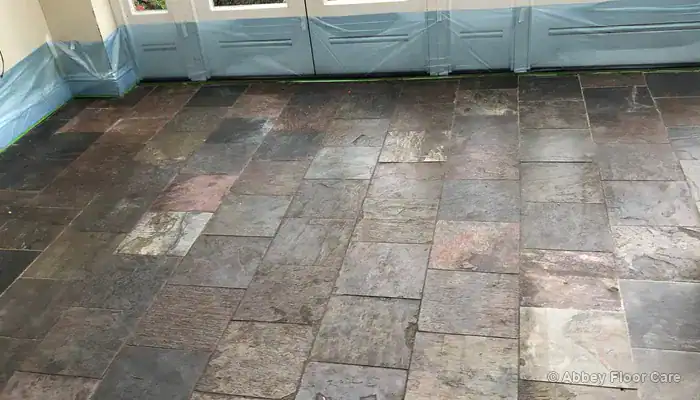
If your slate floor looks worn, dull, scratched, stained, or patchy even after normal cleaning, the problem has usually moved beyond surface dirt. Ordinary mopping can lift loose soil from the top of the floor, but it can’t reach what’s underneath — colour that has faded unevenly, old residue left behind by previous products, or small patches of surface damage that have quietly built up over years.
Slate restoration becomes relevant when the floor no longer responds evenly to safe routine cleaning. A floor in a busy UK kitchen, hallway, boot room or bathroom may still be sound, but the visible condition can show that the existing protection has failed, the surface has worn in busy walkways, or old treatments are sitting in recessed areas rather than protecting the tile.
Dull wear that remains after mopping
If your slate has flat grey patches that stay visible after careful cleaning, the surface is not simply dirty. The floor may look tired because the original depth has been reduced in high traffic areas, especially where loose grit has been walked across the same route every day.
Dull wear often appears first through doorways, in front of sinks, beside kitchen islands and along main routes between rooms. These pale pathways can have a chalky appearance, and the surrounding areas may still look richer because they have had less footfall damage.
Colour fading on slate is a visible change in the way the surface reflects light and holds tone. The homeowner sees colour reduction rather than an obvious stain, so stronger cleaning can be tempting, but the first clue is usually that the floor looks clean and lifeless at the same time.
Scratched traffic areas and loose grit marks
If your floor shows fine scratches, dull trails or pale scuffed sections in the same walking routes, the pattern usually follows daily movement through the room. Shoes, pet claws, grit and dragged furniture can leave small marks that collect until the floor looks uneven rather than simply used.
Traffic wear can make a robust slate floor look neglected even when the tiles remain structurally sound. The practical detail to notice is whether the marks sit in repeated lines, arcs or pathways, because random marks and regular footfall patterns usually point to different levels of restoration work.
Scratch removal on riven floors is limited by the natural textured finish because the aim is to preserve the surface character, not flatten it. A fine-honed slate floor has a smooth, consistent surface that diffuses light evenly, while an impregnating sealer leaves the natural riven texture unchanged, and a topical sealer adds a low surface sheen.
Patchy stains, building residues and failed protection
If your slate has dark patches, white staining, paint residues, mineral deposits or embedded contamination after renovation work, the floor needs assessment before any sealer is applied. Renovation contamination can leave building material trapped across the tile surface, and the finished floor may look worse after sealing if surface preparation is incomplete.
Failed protection often shows as uneven sheen, water marks, cloudy areas or sections that darken faster than the rest of the floor. Hard water in UK homes can leave chalky white marks around wet areas, and over-wetting during mopping can shorten sealer lifespan when sitting water is repeatedly left in the textured surface.
Grout discolouration can also make the whole floor look dirtier than it is. Dirty water, detergent traces and cloudy mop water settle into grout joints, so a slate floor may appear neglected even where the tiles themselves need only controlled deep cleaning and resealing.
Old coatings around edges and recessed areas
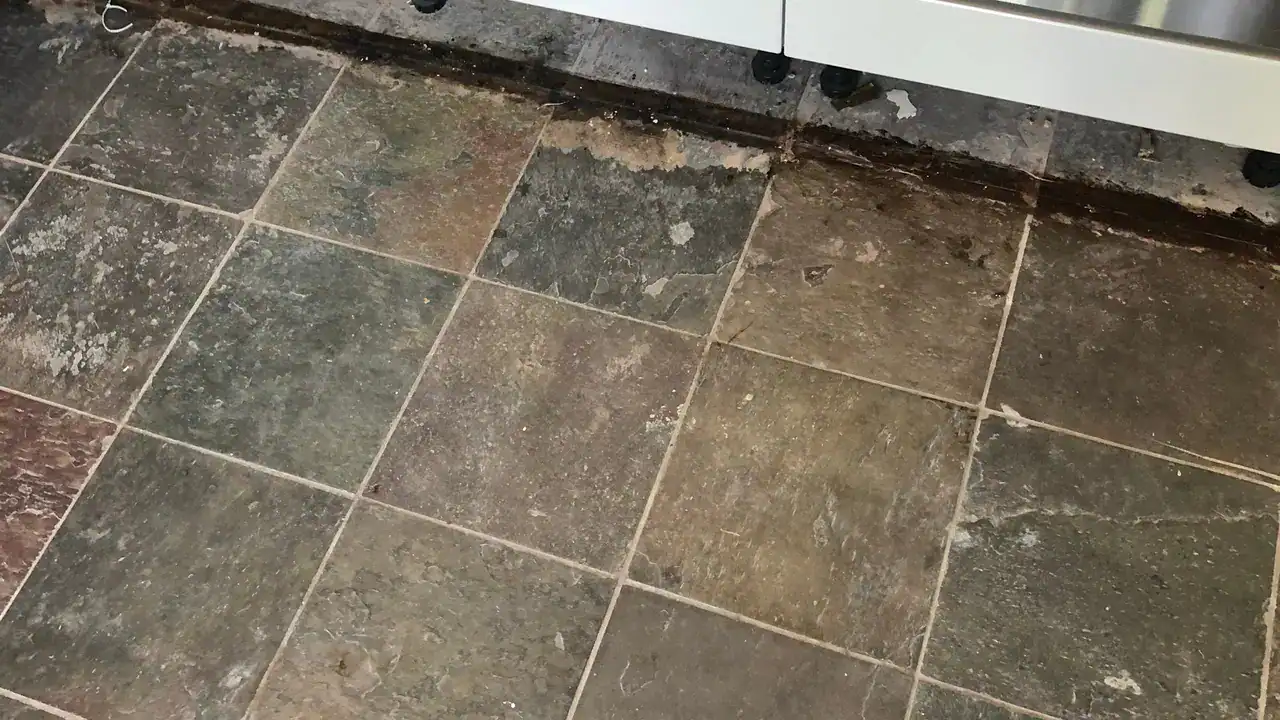
If your floor has darker borders, sticky edges or patchy low-sheen areas, old coating accumulation may be affecting the finish. Edge build-up is common where previous products were applied heavily, where mops pushed residue into room edges, or where old acrylic coating has survived in low-wear zones.
Sealer build-up is visible when topical excess collects in recessed areas and creates finish unevenness across the floor. Application residue can make some tiles look shiny, some look dull and some look dirty even after cleaning, so the floor loses its natural variation and starts to look blotchy.
Residue lock-in is the practical sign that cleaning alone is unlikely to restore the floor. The surface may feel slightly tacky, look cloudy in certain lights or show darker patches around furniture lines, which means the old finish must be addressed as part of the restoration route.
Minor damage that changes the restoration route
If your slate has chips, small cracks, flaking edges or open holes in honed-filled tiles, the floor may still be restorable, but it needs more than cleaning. Filler collapse is factory filler failure in honed-filled tiles; the homeowner sees filler loss, void exposure or small holes, and the correction is cleaning out failed material before refilling and sealing.
Delamination is layer separation within the slate itself; the homeowner sees flaking, lifting edges or thin sheets breaking away, and the correction is stabilisation or replacement where the tile has suffered structural breakdown. Slate forms in layers, so this visible condition should be treated as a repair decision rather than a reason to scrub harder.
Efflorescence is white chalky dusting caused by mineral salts left behind as moisture evaporates; the homeowner sees haze, pale deposits or repeated white marking near grout or wetrooms, and the correction is moisture assessment, careful residue removal and thorough drying before sealing. Hard-water mineral deposits can look similar, so the restoration decision depends on what the marks do after testing.
Correct ongoing maintenance extends the floor’s life by removing grit before wet mopping, using pH-neutral cleaning and resealing at the right interval. A professionally restored and correctly sealed floor is significantly easier to clean and maintain than a worn or incorrectly treated floor, and practical routines are covered in how to clean slate floors when they stay dull. Steam cleaning should be avoided because heat can soften protective layers, drive moisture into the surface and cause coating degradation on vulnerable floors.
Why the wrong restoration method can make slate damage worse
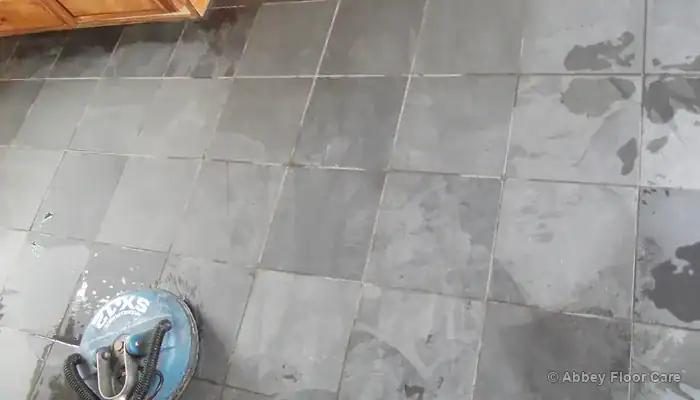
Rushing into stripping, scrubbing, sanding, or sealing can turn a manageable slate problem into visible surface damage. Slate forms in mineral planes, and that layered structure means weak boundaries, cleavage separation and flaking risk must be tested before aggressive work begins; problems with slate floors that fade unevenly show why colour loss and surface damage should not be guessed at. Slate is a fine-grained metamorphic rock that cleaves along natural planes — its layered structure prevents mechanical polishing and limits restoration to cleaning and sealing, and makes it sensitive to aggressive cleaning chemistry.
Test the floor first, because slate damage can worsen when the treatment is guessed.
Wrong stripping can soften old coatings without removing them fully, allowing dissolved residue to spread into recessed areas. A solvent-based stripper relies on solvent action, acrylic removal, wax dissolution and controlled chemical penetration, so coating stripping must be followed by residue removal rather than left to dry back into the surface.
What professionals need before restoring a slate floor properly
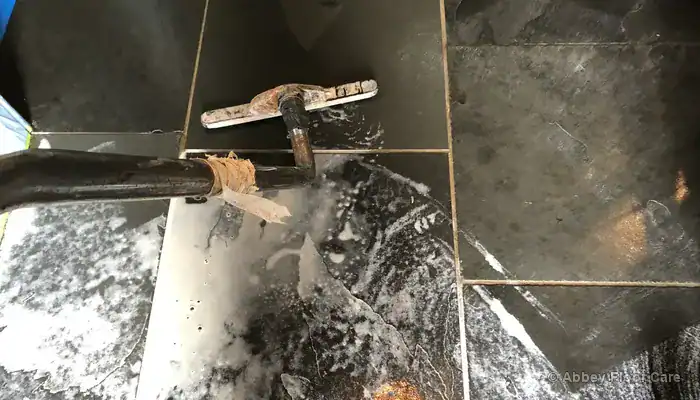
A wet vacuum or slurry extractor is not just cleaning equipment; it helps remove loosened soil, residue, and rinse water before they dry back into the slate. Slurry extraction on a riven surface controls residue removal, redeposition prevention and contamination control after agitation, which is why a wet vacuum is central to professional work.
Professional preparation uses matched tools rather than one aggressive method for every floor. A low-speed rotary machine, polypropylene brush, nylon detail brush, microfibre cloths, repair materials, test sealers and a solvent-based stripper are selected according to the floor’s existing coating, edge build-up, recessed areas and dry condition.
Correct equipment produces a uniform matte appearance before sealing because softened contamination is removed instead of spread. Incomplete work leaves dirty solution in the surface texture, while controlled extraction, fresh water rinsing and drying checks make the restored floor simpler to care for and ready for the correct protective sealant.
How to know which slate restoration process your floor needs
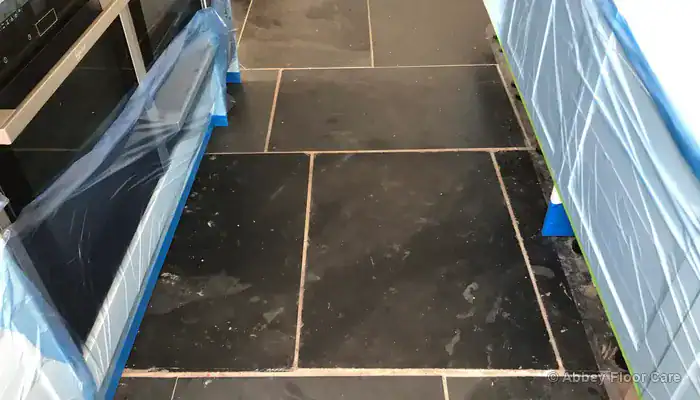
If one slate floor needs deep cleaning while another needs sealer removal, repair, honing, or sealing, the difference is the condition of the floor, not the name of the stone. Professional assessment moves from visible symptom to restoration route so the process fits the floor rather than forcing every tile through the same treatment.
Diagnostic checks separate surface preparation from deeper correction. Building residues, white staining, paint marks, mineral deposits and embedded contamination point towards renovation contamination and controlled stain removal, while failed coatings point towards sealer removal, rinse control and drying before any new finish is applied.
- Check whether water beads up, soaks in or darkens high-traffic areas.
- Inspect edges, grout joints and recessed texture for old coating or residue.
- Test small areas before stripping, repair filling, sealing or aftercare planning.
- Match the route to the result required: matte finish, wet-look finish or low surface sheen.
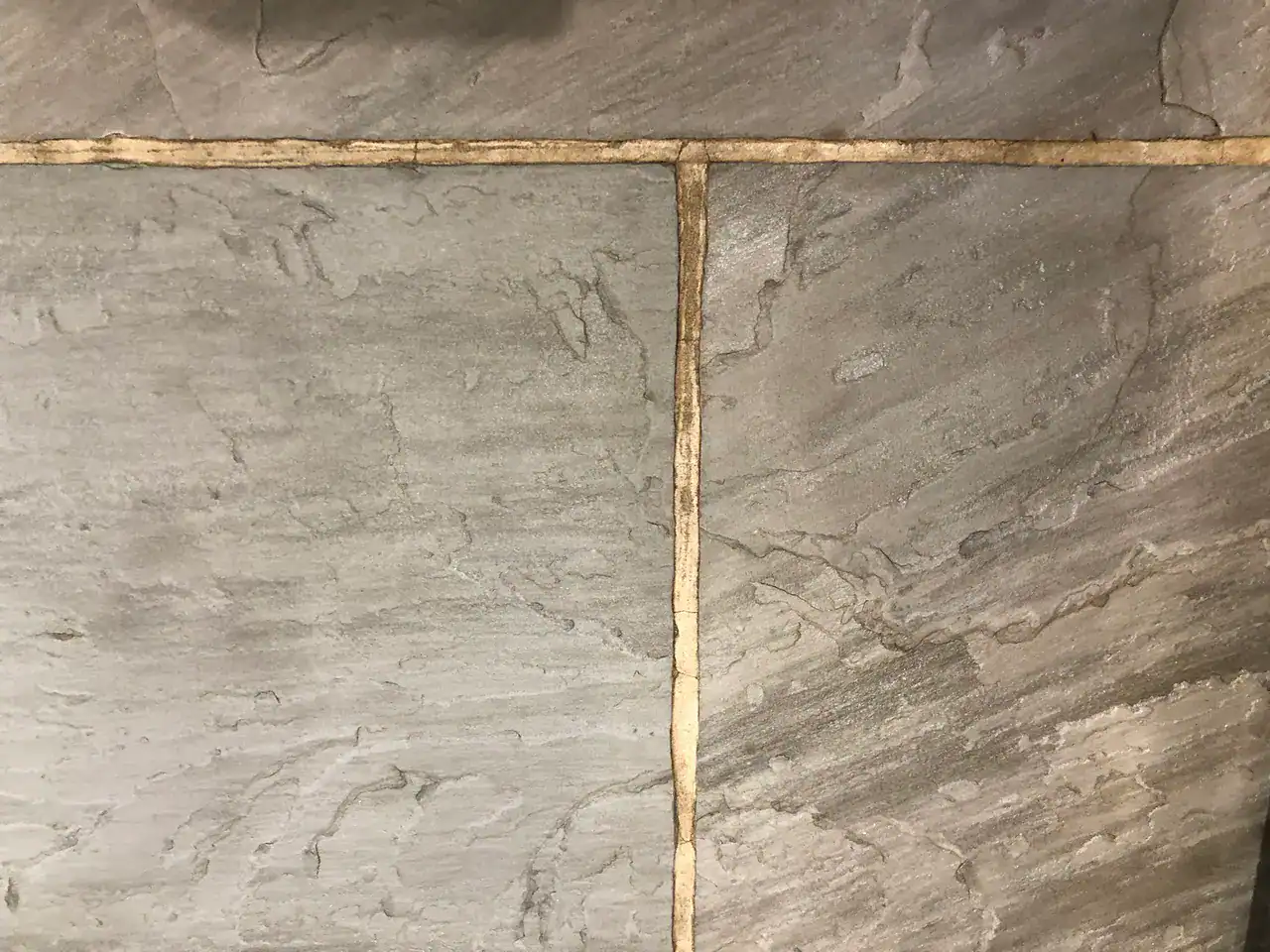
Outcome planning protects the floor after the intervention. A tailored maintenance handover explains pH-neutral cleaning, grit removal before wet mopping and the resealing interval, while wider slate behaviour is set out in slate floors in UK homes. Correct restoration will look significantly better than before intervention, and in many cases better than when first installed because the right sealer activates the stone’s natural colour.
Where to go next for complete slate floor care guidance
Broader slate floor care guidance helps readers compare restoration with cleaning, sealing, repair, and long-term maintenance before choosing their next step. A floor with old coating, grout repairs, tile replacement questions, wet-look finish goals or water resistance concerns may need more than one article to make the right decision.
Slate care works best when each topic is kept in its proper place. Restoration deals with the full corrective route, while routine cleaning, repair decisions and sealing choices need their own details, and the wider route map is available in complete slate floor care guidance. Correct ongoing maintenance is the single most important factor in extending the floor’s life because pH-neutral cleaning, grit removal and timely resealing preserve the restored surface.
Products we recommend for slate maintenance: cleaning products: Fila Pro Floor Cleaner, Lithofin Easy Care. Equipment: Vileda H2PrO Spin Mop System.
BIO_PARAGRAPH: David Allen has restored slate floors across the UK for over 30 years through Abbey Floor Care, including worn riven floors affected by old coatings, traffic wear and failed sealing. His slate restoration method focuses on careful assessment, controlled residue removal, appropriate repair and the right sealer choice for the floor condition.
If you would like to apply to become the contractor for this area, please use the contact form.
Copyright © Abbey Floor Care.
We are proud to be your local stone floor cleaning, polishing, and restoration specialists for homes and commercial properties in Central Scotland.
With years of experience working with all types of stone floors, our friendly and professional stone floor cleaning services can’t be beaten on price or service.
FAQ - Privacy Policy - Terms And Conditions
Abbey Floor Care is a participant in the Amazon Services LLC Associates Programme, an affiliate advertising programme designed to provide a means for websites to earn advertising fees by linking to Amazon.co.uk. As an Amazon Associate, we earn from qualifying purchases.