Slate Floor Cleaning Saved A Sound Corris Floor
Last Updated on June 16, 2026 by David
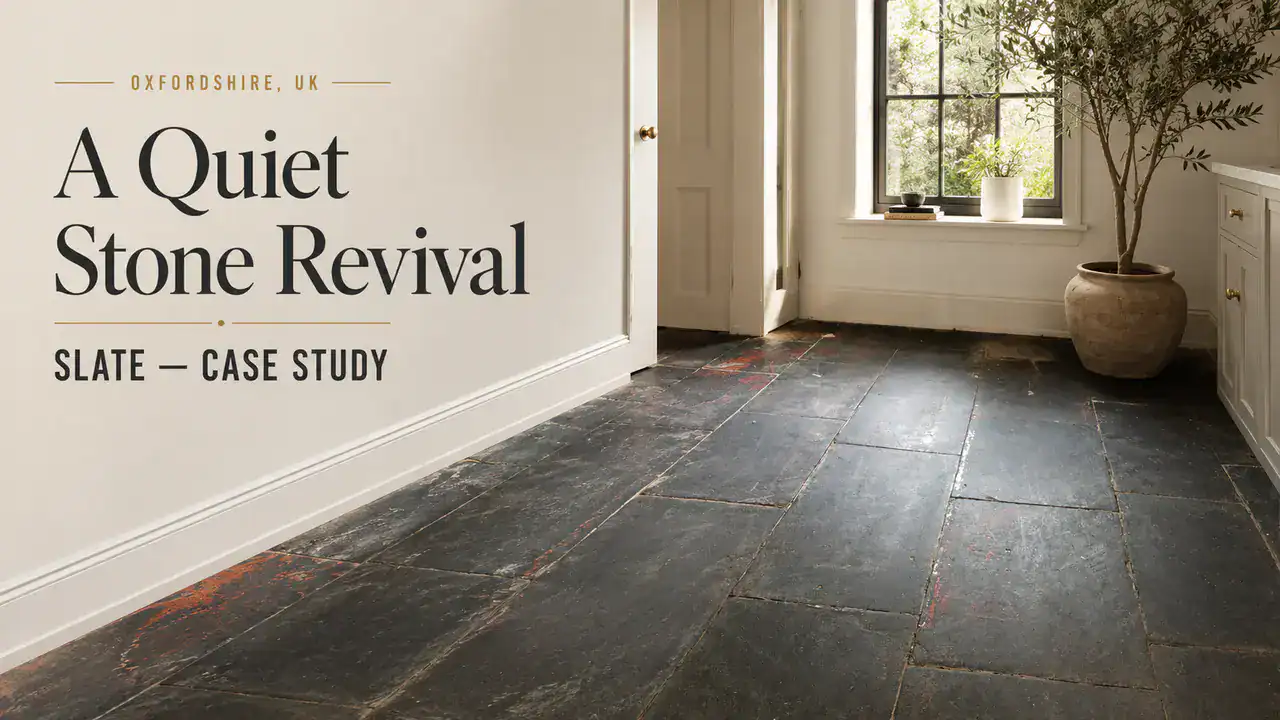
Slate floor cleaning without damaging the surface was the key concern on this Corris project. Old wax, paint, cement and lime residues were masking a sound 1850s floor; they were not proof that the slate had failed. The work had to remove the residue, protect the riven character, repair open joints, and bring back a cleanable finish without flattening the original surface.
Old wax, paint, cement and lime residues were hiding the Welsh Slate floor in Corris
Visible Residues Across The Old Floor
If your slate floor is hidden beneath old wax, paint spots, cement marks and lime residue, the original surface can look much worse than it really is. That was the position in this Corris home. The floor still held the character of traditional slate, but years of building work and earlier treatments had left visible marks across the tile faces and joints.
Welsh slate in this property had a strong local connection. The house dated from the 1850s and used stone from the Corris mining area. Its welsh origin, high density, hard surface and low porosity gave the old floor a durable base, while its role as a UK benchmark and quality standard helped explain why so much original traditional slate was still in place.

The Corris location added useful context because the property sat in a village shaped by slate quarrying and stone-built homes. This was not a modern decorative floor. It was part of the building’s fabric, with older slabs, later additions near the fireplace, and a small kitchen extension all creating visible changes in level, texture and wear pattern.
Red Wax And Older Surface Treatments
The red wax residue showed that the floor once had a traditional finish with a warmer mid-lustre appearance. That older wax application had not worn away evenly. Some areas still held colour, whilst other sections had become dull, patchy and harder to read.
The wax system mattered because periodic maintenance and renewal requirement had built up a heritage appearance in some zones while leaving other areas visually tired. Red Cardinal residue was not treated as a modern coating problem alone. It was part of the floor’s history and helped show the finish the homeowner remembered.

The homeowner wanted the original finish brought back without turning the floor into a generic modern surface. That made appearance, surface character and cleanability equally important, because a floor can regain colour and still look wrong if the historic texture is stripped away.
How The House Layout Affected The Floor
Corris sits within the SY20 Machynlleth postcode district, where the housing stock is dominated by stone-built period cottages, terraced cottages and compact village houses, often with later kitchen, bathroom or rear living-space alterations. In these homes, slate floors are most often found through porches, entrance halls, kitchens, dining kitchens, living rooms and older ground-floor circulation areas. Many layouts are narrow and practical rather than grand, so the same slate route may carry foot traffic from the front door, garden access, kitchen use and daily family movement. Where rear extensions or reconfigured kitchens have been added, older slate often meets newer finishes, creating changes in level, texture and wear pattern.
The main challenge for slate floors in Corris homes is that older stone-built structures, busy entrance routes and damp outdoor transitions can drive grit, moisture and soil deep into worn surface texture and open grout. In family kitchens and through-routes, this leaves slate looking flat, patchy and difficult to keep clean unless contamination is removed and the floor is sealed in a way that suits the original stone.
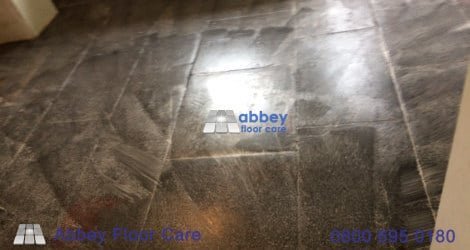
The mechanically split surface had natural cleavage and a textured finish, so every mark became more obvious once light caught the ridges and troughs. That riven surface texture created both a cleaning challenge and a sealing consideration. The same surface texture that gives slate its character also holds old residue in uneven areas.
Why The Floor Looked Tired Rather Than Ruined
The homeowner’s problem was not a floor that had lost all value or identity. What we often see here is residue lock-in across slate tiles, old pointing loss between slabs, patchy coating accumulation around edges and a surface that no longer responds well to normal mopping.
Sealer build-up at edges had left coating accumulation, recessed areas and topical excess that produced finish unevenness and application residue. Some areas looked darker. Others looked flatter. So the floor read as tired, even though the underlying slate flooring still had strong historic character.
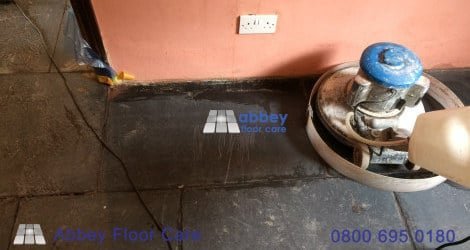
The entry condition also explained why a normal slate cleaner, sponge mop or mild detergent would not have changed the result. Loose soil can be removed with a dust mop, soft broom and clean water, but old wax, paint and cement residue sit within the porous surface texture and need professional restoration rather than routine slate floor cleaner use.
Why the floor looked tired even though the original slate was still sound
A slate floor can still be sound even when residue, dullness and open grout lines make it look neglected. Here, the riven surface had trapped contamination in its ridges and troughs, while missing joints allowed dirty water to settle where the old floor needed local repair.
Sound slate can still look tired when residue sits in the texture and grout gaps.
The open joints needed slate pointing because old pointing, missing joints and slate slabs on an old floor can allow moisture rise to influence the sealing decision. A breathable product and flexible product were used as a matching filler, then left to cure overnight so the re-done areas did not leave the floor open to rapid re-soiling.

Faded-looking slate is often linked to residue, worn sealers or surface wear rather than simple dirt. Similar colour-change problems are covered in why some slate floors look faded while others stay vibrant, and that diagnosis helped keep this project focused on restoration rather than repeated cleaning.
Cleaning, pressure rinsing and Slate Pointing without leaving the riven surface open to rapid re-soiling
Rushing a riven slate restoration can remove visible dirt while leaving dissolved residue ready to dry back into the low points. The gel cleaner was chosen for heavy build up because a longer dwell helped break down old sealer, wax and problem areas on the riven slate without relying on aggressive scrubbing.
The solvent-based stripper used solvent action to support acrylic removal, wax dissolution and coating stripping where old sealer removal was needed. Slate is a fine-grained metamorphic rock that cleaves along natural planes. Its layered structure prevents mechanical polishing and limits restoration to cleaning and sealing, and it makes the surface sensitive to aggressive cleaning chemistry.
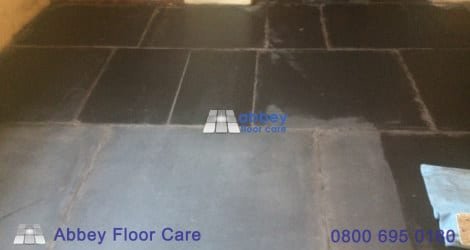
Wet vacuum recovery was used for slurry extraction because riven surface residue removal depends on redeposition prevention. In practical terms, the wet vacuum and pressurised rinse and capture process controlled contamination so dirty solution was lifted from the floor rather than spread through the grout and textured finish.
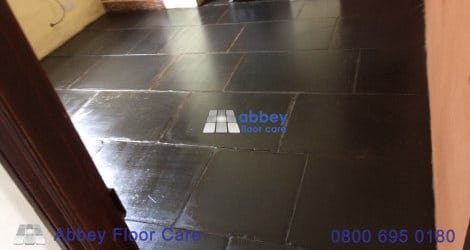
The final protection combined mineral activation, colour enhancement, impregnating protection and a breathable barrier with a controlled surface sheen. Impregnating sealers maintain a natural finish, while topical sealers are used where a colour-enhanced or low-sheen finish is required. A fine-honed slate floor has a smooth, consistent surface that diffuses light evenly; an impregnating sealer leaves the natural riven texture unchanged, and a topical sealer adds a low surface sheen.
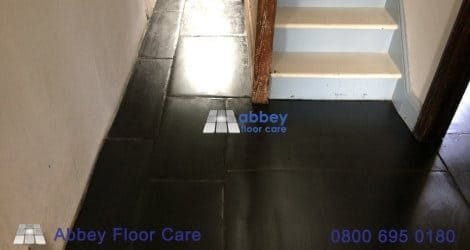
Correct ongoing maintenance keeps restored slate cleaner by removing grit before wet mopping and using a pH-neutral stone cleaner that leaves no sticky film. Steam cleaning should be avoided because heat can soften protective layers and force moisture into textured areas. Practical care routines are covered in how to clean slate floors when they stay dull, which keeps daily cleaning separate from this completed restoration.
Before and after: revived slate colours with the historic character still intact
Before restoration, the slate colours were masked by wax residue, cement marks, paint traces, open grout and sealer build-up. The floor looked flat and visually tired because coating accumulation, edge build-up and recessed areas interrupted the natural colour variation.
After restoration, the floor looked significantly better because mineral activation and pigment deepening returned visual richness without removing the old riven character. A professionally restored and correctly sealed floor is significantly easier to clean and maintain than a worn or incorrectly treated floor.
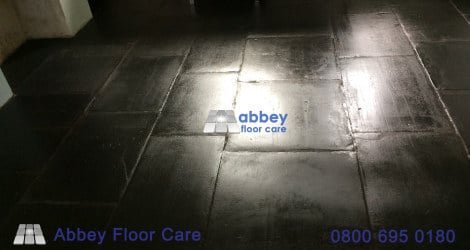
The finished kitchen retained its welsh slate heritage, visible tooling marks and varied surface tone while gaining a protected satin finish. Correct ongoing maintenance — pH-neutral cleaning, grit removal before wet mopping and resealing at the right interval — is the single most important factor in extending the floor’s life, and the tailored maintenance handover explained the right slate floor cleaner and water test to use.
How this Corris Slate Restoration links to wider guidance on protecting older slate floors
This Corris project shows how older slate restoration fits into the wider care of historic floors. The case proved that an old floor can regain clarity and become simpler to care for when cleaning, local joint repair and sealing are treated as one restoration sequence rather than separate quick fixes.
David Allen’s 25-year stone specialism helped keep the work centred on the floor’s origin, riven texture and old joints rather than pushing it towards unsuitable surface alteration. The same judgement applies to other natural slate types, including Vermont Slate. Testing confirms the surface response. Residue removal clears contamination. Clean water rinsing removes loosened soils. Sealants protect the cleaned slate. The correct protective sealant matches how the floor absorbs treatment.
The Corris floor now feeds into the wider material guidance because it shows how welsh slate, slate pointing, breathable protection and long-term maintenance work together on an old floor. Broader care decisions are covered in slate floors in UK homes, and this case study provides the real project evidence behind that guidance.
Products Used In This Guide

David Allen — Abbey Floor Care
David Allen has restored slate floors across the UK for over 30 years with Abbey Floor Care, including this Corris project where old wax, paint, cement, lime residue and missing grout were corrected on an 1850s floor. His work focuses on careful diagnosis, controlled residue removal and the right protection sequence so historic slate keeps its character while becoming easier to maintain.
Recent Posts:
We work throughout the country, just some of our work counties:
Copyright © 2026 Abbey Floor Care. Tile And Natural Stone Cleaning Consultants FAQ - Privacy Policy - Terms And Conditions
Abbey Floor Care is a participant in the Amazon Services LLC Associates Programme, an affiliate advertising programme designed to provide a means for websites to earn advertising fees by linking to Amazon.co.uk. As an Amazon Associate, we earn from qualifying purchases.