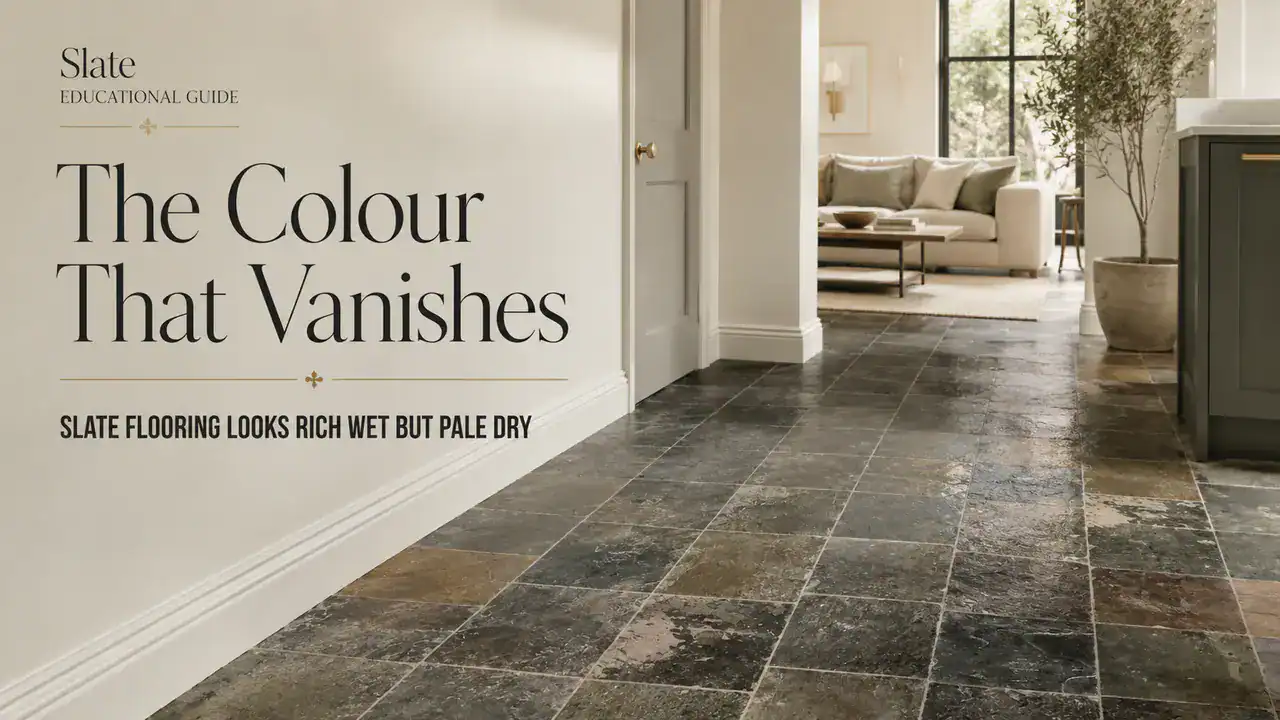
Slate Flooring Looks Rich Wet But Pale Dry
Last Updated on June 13, 2026 by David
Why slate looks rich when wet but pale, patchy or uneven when dry
The Wet Appearance Can Set The Wrong Expectation
If your slate looks richer after washing, rain or a damp mop, the floor is giving you a short-lived preview of colour depth rather than proof that it needs a shiny coating. Water darkens the face for a while, so darker tiles, lighter seams and textured hollows can look calmer until the surface dries again.
That temporary wet appearance can make the floor feel transformed because the colour looks fuller and the contrast between tiles seems stronger. The trouble starts when that brief effect becomes the standard for judging every dry finish, because wet depth and sealed dry appearance are not the same thing.
A natural dry finish can still look attractive without copying the freshly washed look exactly. In my experience, the most believable result gives better colour balance, more visual richness and a more settled surface, rather than making the floor look permanently soaked.
The Dry Appearance Shows What The Floor Is Really Doing
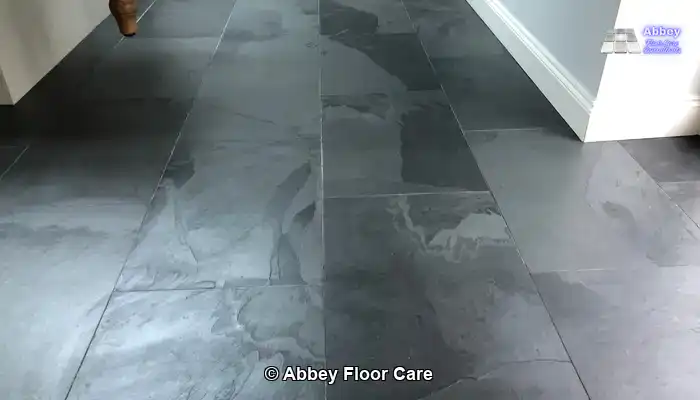
A pale dry surface can make slate look neglected even after careful washing. The dry face shows traffic dulling, old coating edges, detergent traces and uneven absorption more honestly than the wet face, so the floor may look worse dry even though it is not simply dirty.
The most common complaint is the uneven shift from darker damp colour to lighter dry colour. Some tiles hold depth well, some flatten quickly, and some show pale pathways through the busiest parts of kitchens, hallways and garden-room routes.
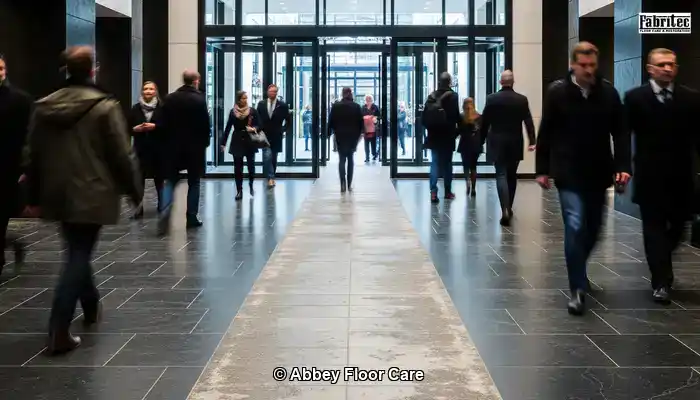
Traffic lanes can read as fading because loose grit and daily footfall gradually reduce surface depth. That visible colour reduction is not the same as soil sitting on top, so repeated scrubbing often changes very little. Sometimes it just leaves the floor looking more tired.
Patchiness Can Come From The Surface As Much As The Sealer
Patchy slate often looks as though the wrong product has already been applied. Some patches may be old topical excess, some may be exposed stone, and some may simply be areas where the textured finish catches light differently from the surrounding tiles.
A mechanically split slate face has ridges and troughs that hold moisture, soil and residue in different ways. That natural cleavage gives the floor its character, but it also means a coating or impregnating treatment can look uneven if the surface condition changes from tile to tile.
Brushed slate behaves slightly differently because the brushed finish softens the sharper high points while still leaving texture and grip. That smoother structure can feel pleasant under barefoot traffic in bathrooms and kitchens, especially with underfloor heating, but natural slate still remains a textured floor surface rather than a flat manufactured sheet.
Dark Slate Can Exaggerate Every Wrong Assumption
Black slate can make the wet-look question feel more urgent because darker tiles show pale bloom, old product marks and weak sealer response more clearly. Chinese slate tiles can vary in porosity and mineral salt content, so a sealed floor may show white bloom in one area while another area holds a darker, richer colour.
A dark tile that looks dramatic when damp may not need a heavy gloss coating to look good. It may need a breathable barrier, a carefully judged colour sealant or a more restrained wet-look finish that enhances the existing stone without making the surface look artificial.
Stone oil sometimes gets used by homeowners because it appears to enrich colour quickly. The difficulty is that quick darkening does not prove long-term protection, and it may complicate later sealing if the floor already contains residue, old coating accumulation or uneven absorbency.
The Right Expectation Is Controlled Richness, Not Permanent Wetness
A good slate finish should make the floor look significantly better than it did before intervention, and in many homes it looks better than when first installed because the correct sealer has finally been matched to the stone. New slate flooring is often left under-protected, over-coated or treated with a product that never suited the tile’s surface character.
A convincing finish keeps natural variation visible while reducing the distracting contrast between dull patches and richer areas. Slate flagstones rely on texture to hold visible character, riven slate floor tiles use thickness and grip to suit real foot traffic, and natural slate tiles gain appeal from colour variation, so the best result should support that character rather than cover it.
The dry result is the finish that matters because that is how the floor lives day to day. A wet-look ambition only becomes useful once it is separated from unrealistic gloss expectations, because the floor still has to be practical in kitchens, bathrooms, hallways and high-traffic areas.
Why some slate floors change colour more dramatically than others
Slate colour response varies because one floor can take on water, sealer and wear differently from another, even when both are sold as natural slate. Dense Welsh-origin tiles usually show high density and low porosity, while softer imported slate may darken faster because the surface accepts more liquid and shows a stronger colour change.
A mechanically split surface creates extra light variation because natural cleavage leaves small highs and lows across the tile. Brushed slate has a lightly riven texture with a smoother structure, so it may give a gentler response under the same sealer. The deeper explanation of why some slate stays vibrant while other floors fade is covered in why some slate looks faded while other slate stays vibrant. That difference matters because sealer choice should follow the floor’s behaviour, not the product label.
Why a slate floor can look sealed but still absorb moisture unevenly
A sealed-looking slate floor can still take in moisture where traffic, texture and worn areas have opened weak points in the surface. The shine or low sheen may survive around the edges, while busy walkways, grout joints and exposed ridges soak in water and darken first.
Uneven moisture absorption matters because a protective layer can be present without giving consistent protection. A breathable finish should allow moisture vapour to move while improving stain resistance, dirt resistance and long-term protection, but worn areas may need surface consolidation before the floor can behave evenly again.
A visual check on its own can mislead because old coating may sit above a porous surface. The floor needs enough inspection to show whether the protective barrier is continuous, whether the surface texture is open, and whether resealing would create a natural appearance or make patchy finish unevenness more obvious.
Why the same sealer can make one slate floor look natural and another look too dark
Sealer choice becomes risky when the homeowner expects every slate floor to darken evenly and naturally. A fine-honed slate floor has a smooth, consistent surface that diffuses light evenly, while an impregnating sealer leaves the natural riven texture unchanged, and a topical sealer adds a low surface sheen.
Natural protection keeps the surface closer to its dry appearance because penetrating protection reduces absorption without building a visible surface film. That invisible protection can suit floors where the natural colour already looks balanced.
Colour enhancement uses mineral activation, pigment deepening and impregnating protection to create greater visual richness while still allowing a breathable barrier. The same effect may look refined on one floor and too heavy on another because the stone’s porosity and texture control the final colour.
Surface coating can create a satin finish through acrylic coating, but lower durability and high-traffic limitation make topical protection risky where wear lanes are already obvious. The wrong surface film can darken weak areas too much and make the finish look artificial.
Why dirt, residues and old sealer make slate colour harder to judge
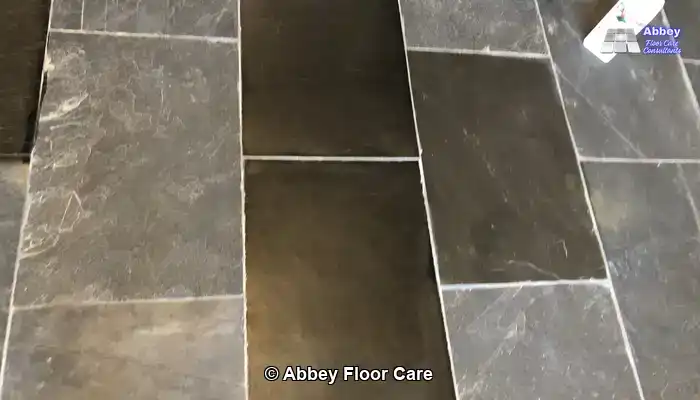
Residue and old sealer build-up can make a slate floor look as though it needs more sealer when the real problem is distorted colour. Soap residue creates a sticky film, cloudy water leaves detergent traces, and repeated mopping can drive dirty water into grout joints.
Coating accumulation often gathers as edge build-up and recessed-area residue because the textured face does not wear evenly. An old acrylic coating may leave topical excess in low points while traffic removes protection from the centre of the tile, creating finish unevenness before any new sealer is even considered.
Traffic film can hide the true slate colour until the surface is properly assessed. The interpretation matters because cleaning slate before old sealer traps dirt is a different issue from choosing a darker finish. A professionally restored and correctly sealed floor is significantly easier to clean and maintain than a worn or incorrectly treated floor.
Why cleaning must reveal the true slate before any sealing decision is made
Choosing a sealer before seeing the true clean slate increases the chance of locking in the wrong colour, residue or patch pattern. The floor must be clear enough to judge absorbency, coating residue and the natural response of the textured finish.
Cleaning as an interpretation stage is not the same as giving a step-by-step method. Slate is a fine-grained metamorphic rock that cleaves along natural planes; its layered structure prevents mechanical polishing and limits restoration to cleaning and sealing, while also making it sensitive to aggressive cleaning chemistry.
Correct cleaning reveals whether a breathable finish can give maintenance reduction and natural appearance, or whether old product has left a protective barrier that needs further attention. Practical routine care is covered in how to clean slate floors when they stay dull. Correct ongoing maintenance removes grit before wet mopping and uses pH-neutral cleaning so sealed slate keeps its colour more evenly.
Why colour-enhancing sealer is different from ordinary protection on slate
Colour-enhancing sealer changes how slate reflects light, so it affects appearance as well as protection. The treatment relies on mineral pigment activation, colour deepening and visual richness rather than simply making the floor cleaner or newer.
Colour enhancement changes light response; it does not make damaged slate new.
A micro-porous sealer is judged by more than colour because a breathable finish must support moisture vapour movement, stain resistance and long-term protection. A darker result can be attractive only when the floor has a dry substrate, a stable surface and an even sealer response.
A topical urethane sealer produces a stronger wet-look finish through a urethane coating, gloss sheen and wear resistance. That high-durability route still needs a clean dry surface because poor bonding can turn a dramatic finish into patchiness or peeling.
Why wet-look slate finishes fail, peel or turn patchy when the wrong product is used
Adding the wrong wet-look finish can leave slate more patchy, more artificial and harder to correct later. Peeling is sealer failure, which means the coating has lost bond with the surface; the homeowner sees flaking, dull islands or shiny edges, and correction requires the failed layer to be removed before any new finish is considered.
An acrylic topical sealer can create quick topical protection, but an acrylic coating has lower durability in high-traffic areas and often wears into visible lanes. A topical urethane sealer gives better wear resistance, yet it still fails where the dry substrate requirement is ignored or residue remains beneath the surface film.
Delamination is layer separation along natural slate planes; the homeowner sees flaking or lamination loss rather than simple coating peel, and adding more sealer cannot repair structural breakdown. The causes behind flaking are explained in slate floor flaking and professional repair. Setting realistic expectations matters because a finish can protect a stable surface, but it cannot glue weak mineral layers back into a sound tile.
Why sealed slate still needs sensible maintenance to keep its colour even
A sealed slate floor still changes in daily use because traffic, grit and washing habits affect how evenly the surface wears. High-traffic areas can develop pale pathways as loose grit causes microscopic breakdown, surface dulling and colour reduction across busy walkways.
The textured surface needs maintenance that removes abrasive particles before they are dragged over the tile. A well-wrung mop, clean rinse water and a residue-free pH-neutral stone cleaner help protect porous slate without over-wetting the riven face.
Steam cleaning should be avoided because heat damage can soften coatings, force moisture penetration and trigger sealer breakdown. Correct ongoing maintenance — pH-neutral cleaning, grit removal before wet mopping and resealing at the right interval — is the single most important factor in extending the floor’s life, and cleaning slate floors safely shows why finish-safe routines matter. The result is steadier colour and a floor that stays cleaner with less effort.
Why the water-drop test helps you decide whether slate needs resealing
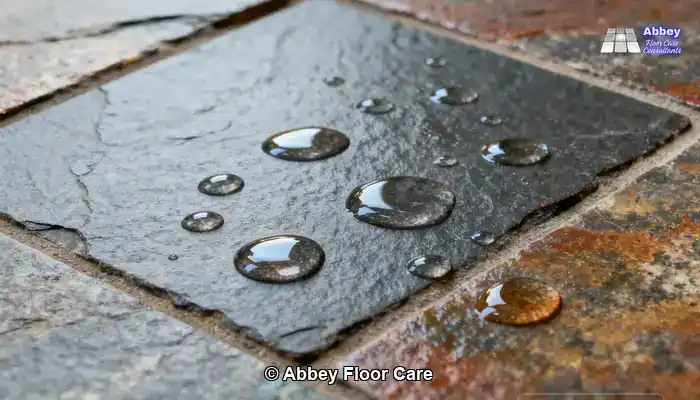
If you are unsure whether your slate needs resealing, the water-drop test gives a simple way to check how the surface is behaving. It helps because water beads on a useful protective layer, soaks in where the sealant has weakened, and darkens porous high-traffic areas first.
- Place small droplets on a busy walkway, an edge area and a quieter tile.
- Watch whether the droplets bead up or soak in during the same short observation period.
- Even beading suggests the protective layer still has useful cure sealability.
- Uneven darkening suggests moisture absorption and a reseal need may be developing.
The test does not choose a product by itself because colour enhancement and breathable protection still depend on the floor’s surface condition. A natural-looking protective barrier may be enough where water beads evenly, while uneven absorption suggests the slate needs closer assessment before a darker finish is applied.
Where to go next when your slate needs cleaning, sealing or colour correction
The next useful step depends on whether the floor needs cleaning, resealing, colour enhancement or help with old sealer failure. A floor with residue needs interpretation before sealing, while a floor with weak colour response may need pigment deepening through a breathable protective system.
Old surface film changes the route because acrylic coating, topical excess and urethane coating failures must be understood before a new wet-look finish is discussed. A floor with old sealer failure belongs in a different conversation from a clean floor that simply needs long-term protection.
Broader slate behaviour, UK floor construction and long-term care are brought together in slate floors in UK homes. Project evidence also helps homeowners understand how cleaning and sealing interact, and patchy slate colour corrected in Barnes shows why the surface must be read before the finish is chosen.

David Allen — Abbey Floor Care
David Allen has worked with slate floors and other natural stone surfaces for over 30 years through Abbey Floor Care. His experience with sealing, resealing and colour-response problems helps homeowners understand why natural slate can look rich when wet but uneven once dry, and why the correct finish depends on the floor’s texture, absorbency and existing coating history.
Recent Posts:
We work throughout the country, just some of our work counties:
Copyright © 2026 Abbey Floor Care. Tile And Natural Stone Cleaning Consultants FAQ - Privacy Policy - Terms And Conditions
Abbey Floor Care is a participant in the Amazon Services LLC Associates Programme, an affiliate advertising programme designed to provide a means for websites to earn advertising fees by linking to Amazon.co.uk. As an Amazon Associate, we earn from qualifying purchases.