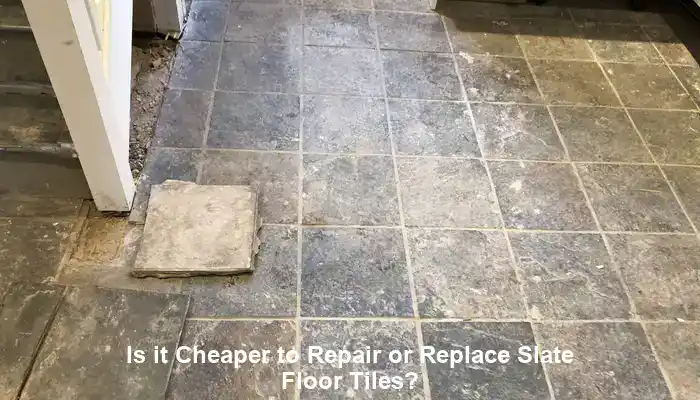
Slate Floor Repair Can Cost More Than Replacing
Last Updated on June 12, 2026 by David
Cracked slate tiles, chipped edges, loose pieces and missing pointing need a repair-or-replace decision based on stability, match and long-term behaviour, not headline cost alone. A local break, a hollow-sounding tile or an uneven patch may be repairable. But repeated movement, failed joints or a visible mismatch can make replacement the better-value route. The sensible starting point is to separate a contained defect from a floor that is beginning to lose reliability.
Use the sections below to judge whether the visible damage points towards local repair, careful assessment or wider replacement.
Should You Repair or Replace a Damaged Slate Floor?
If your slate floor has cracked tiles, chipped edges, loose pieces or missing pointing, the first question is not cost. It is whether the damage is local, or whether it is showing you the early signs of wider floor failure. A single broken corner in a kitchen doorway usually leads to a very different decision from several loose tiles across an older floor. The visible damage matters, of course, but the surrounding slate often gives the clearer answer.
A cracked slate tile can look worse than it is because the dark body of the stone makes pale fracture lines stand out. A contained crack, especially on one slate slab with sound edges and stable neighbouring tiles, usually sits in the repair category. Several cracks running through adjacent slate slabs, particularly where the floor feels hollow or uneven underfoot, raise a broader reliability question.
Chipped edges can be repairable when the break is small, the tile remains firm, and the surrounding surface still has the same general colour depth. Chipped edge slate on a busy domestic floor can still keep its rustic charm, rich texture and natural variation after repair, provided the damaged edge is not part of a continuing movement pattern. A chip that keeps crumbling after previous work is different. That is a warning sign.
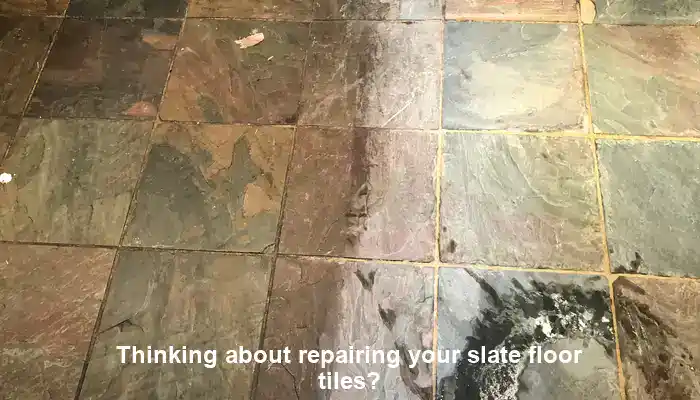
Loose slate tiles need closer judgement because they can feel minor at first and still cause practical trouble. A tile that clicks, rocks or lifts at one edge can often be dealt with locally if the rest of the floor remains secure. A group of loose pieces around a doorway, heated zone or damp wall suggests the problem may not be limited to the visible break.
Slate pointing matters on older floors because missing joints allow water, grit and movement to work into the spaces between slate slabs. Old pointing may be loose, sandy or missing altogether, and those open joints can make a stable old floor feel untidy before any tile actually breaks. A breathable product or flexible product is usually more suitable than a hard, brittle patch on an old floor, especially where there is no damp proof membrane and moisture rise has to be considered.
Uneven patches deserve attention because they can be normal riven character, old wear, or a sign that individual slabs have shifted. Slate slab lippage is a height difference between neighbouring stone tiles where one edge sits higher than the next. The homeowner usually notices it as a raised edge, a trip hazard or an area that catches the mop. Professional correction checks whether the slab is loose, whether pointing has failed, and whether local re-fixing, careful easing or wider replacement is the safer route.
Slate surface shaling becomes a repair concern when the top face feels rough, flaky or dusty rather than simply worn. Old shaling may make black slate look tired in traffic lanes, and the homeowner may see a rough texture that normal mopping never improves. That does not automatically mean replacement, but it does mean the repair decision should not be based on colour alone.
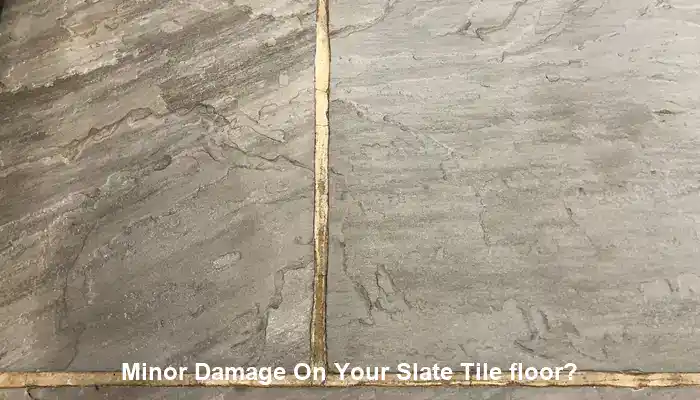
Previous repair patches can also push the decision one way or the other. Matching filler that has cured overnight and stayed firm may still be acceptable if the colour difference is modest and the tile remains stable. A patch that has broken away, trapped dirt or created a hard edge against softer old pointing suggests the earlier repair did not suit the floor.
Colour mismatch should be judged separately from structural failure. Natural slate tiles vary by source, finish and age, so replacement tiles rarely disappear completely into an older floor. Welsh origin slate often has a high density and low porosity, while many domestic import floors show more colour variation. In that situation, a good repair may preserve character better than a small replacement area that looks too new.
Surface wear can make a damaged area look worse than it is. Pale pathways, dulling and colour reduction in high traffic areas can sit beside a repair problem without being the repair problem itself. Correct ongoing maintenance — pH-neutral cleaning, grit removal before wet mopping, and resealing at the right interval — is the single most important factor in extending the floor’s life, and practical routines are covered in slate floor maintenance guidance. Avoid vinegar, lemon, bleach and limescale remover because acidic cleaners and harsh chemicals can strip sealant, cause colour change and leave permanent damage on natural stone.
A repairable slate floor usually has damage that stays in one area, tiles that remain firm around it, and a finish that can accept a sensible visual repair. A floor moving across several areas, losing joint material repeatedly, or showing ongoing flaking needs a broader assessment before money is spent. The floor will look cleaner, steadier and more cared for after the right professional intervention, and a correctly sealed surface will be simpler to maintain than a worn, open or badly patched one.
Why Cracks, Chips and Loose Slate Tiles Do Not Always Mean the Same Thing
Cracks, chips and loose slate tiles can look similar at first glance, but they often point to very different problems beneath or within the floor. A clean impact chip may only need a shaped repair. A loose tile may indicate adhesive failure, floor movement or ageing joints. Slate is a fine-grained metamorphic rock that cleaves along natural planes — its layered structure prevents mechanical polishing and limits restoration to cleaning and sealing, and makes it sensitive to aggressive cleaning chemistry.
Similar-looking slate damage does not always need the same repair.
Layered slate can separate along weak mineral planes, so flaking, lamination loss and surface breakdown must be judged honestly rather than hidden with filler. Slate surface shaling may leave slurry, rough texture and loose flakes after cleaning, while true layer separation calls for a more cautious repair conversation. A closer example of local repair decision-making appears in this slate floor repair case page. The useful question is whether the defect is contained, stable and visually manageable.
When a Slate Repair Is Low Risk, Uncertain or Likely to Fail
Choosing the wrong repair route can waste money, leave loose areas unresolved and make replacement patches stand out more than the original damage. Low-risk repair usually means one damaged tile, firm edges, stable grout and a surrounding floor that has not shifted. Chips, cracks and similar damage can often be moulded, shaped and cured with a waterproof, weatherproof two-part epoxy repair putty where adhesion is sound and a high quality finish is realistic.
Uncertain repair begins when movement, colour match or joint condition raises doubts. Borderline repair often involves slate pointing that has been re-done before, missing joints that keep opening, or replacement tiles that may not blend with the existing sealed floor. A fine-honed slate floor has a smooth, consistent surface that diffuses light evenly, while an impregnating sealer leaves the natural riven texture unchanged, and a topical sealer adds a low surface sheen.
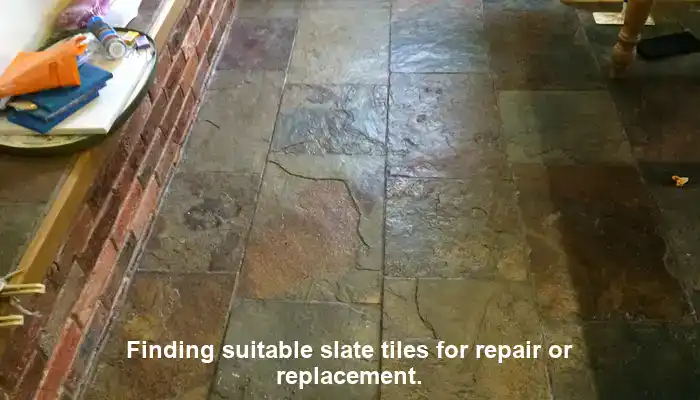
Likely failure becomes the fair judgement when instability is widespread or the surface keeps breaking down after previous work. Poor-value repair includes broad layer separation, repeated cracking, structural fissures affecting surface integrity, or lippage exceeding 2mm where levelling is not part of the agreed work. The floor may still improve dramatically, but a small patch should not be sold as a settled solution when the condition is moving beyond it.
How a Proper Repair Suitability Assessment Protects You From the Wrong Decision
A repair suitability assessment protects the homeowner by checking whether the damaged area, tile match, pointing and long-term stability support repair before replacement is considered. A suitable contractor should look at loose tiles, old pointing, grout stability, surrounding wear, damp areas and the likely behaviour of the repair after normal kitchen or hallway use. That assessment protects against buying neat-looking work that fails because the underlying condition was never considered.
Repair suitability also depends on how the slate was installed and how the floor is used. Newly laid concrete needs drying time and curing time because later movement can make tiles crack, weaken adhesives and disturb grout. Underfloor heating needs the lowest setting to be gradually increased over four weeks so adhesives and grout dry naturally around heated pipes. Damage from a rushed ramp-up may be repairable, but the cause must be understood before replacement is approved.
A responsible assessment should explain what will be repaired, what will remain visible, and what would make replacement more sensible. Impregnating sealers maintain a natural finish, while topical sealers are used where colour enhancement or a low-sheen finish is required. Wider behaviour, sealing choice and long-term care are explained in slate floor behaviour in UK homes. Clear judgement at this stage prevents unnecessary disruption and gives the homeowner a decision they can trust.
Where to Go Next Before Committing to Slate Pointing, Tile Repair or Replacement
Before committing to slate pointing, tile repair or replacement, the safest next step is to move from decision-making into more detailed method guidance. A homeowner should understand whether the work is about local repair, re-sealing, grout cleaning, old sealer removal or wider surface preparation before approving it. Detailed behaviour context sits in the slate floor care and behaviour hub. That wider view helps separate repair suitability from general flooring worries.
Method detail should answer the practical questions without turning the homeowner into the contractor. Removing grout may involve a specialist tool to cut out offending grout, fit replacement matching grout and protect the kitchen floor edges, while deep cleaning may use a rotary machine, brush agitation and wet vacuum extraction to control soiled residue. More detailed cleaning and sealing context is covered in cleaning and sealing a slate floor. A professionally restored and correctly sealed floor is much easier to clean and maintain than a worn or incorrectly treated floor.
Broader restoration questions should stay separate from the repair-or-replace decision. Sealer build-up, colour depth, old acrylic coating, wet-look finish and contamination in recessed areas may affect the final appearance, but they should not be allowed to blur a structural repair judgement. Colour and finish behaviour are explained in why some slate looks faded. The floor can regain clarity, richer natural colours and a more settled appearance when the correct intervention matches the condition.
Aftercare should be part of the decision before work starts. A pH-neutral stone cleaner with a residue-free, finish-safe formulation supports routine maintenance, while a well-wrung mop, clean water and grit removal reduce surface scratch, cloudy water and detergent traces. Flaking and moisture-related risks are covered in professional slate flaking repair guidance. Correct maintenance keeps the repaired area cleaner for longer and helps the floor return closer to its original condition without unnecessary replacement.

David Allen — Abbey Floor Care
David Allen has over 30 years of experience with Abbey Floor Care, helping homeowners judge whether damaged slate floors need repair, pointing, sealing or replacement. His buyer-guide work focuses on practical evaluation, including how to recognise local damage, unstable tiles, poor matching and the limits of patch repair before committing to the wrong work.
If you would like to apply to become the contractor for this area, please use the contact form.
Copyright © Abbey Floor Care.
We are proud to be your local stone floor cleaning, polishing, and restoration specialists for homes and commercial properties in Central Scotland.
With years of experience working with all types of stone floors, our friendly and professional stone floor cleaning services can’t be beaten on price or service.
FAQ - Privacy Policy - Terms And Conditions
Abbey Floor Care is a participant in the Amazon Services LLC Associates Programme, an affiliate advertising programme designed to provide a means for websites to earn advertising fees by linking to Amazon.co.uk. As an Amazon Associate, we earn from qualifying purchases.