Slate Floor Restoration in Abergavenny
Last Updated on July 1, 2026 by David
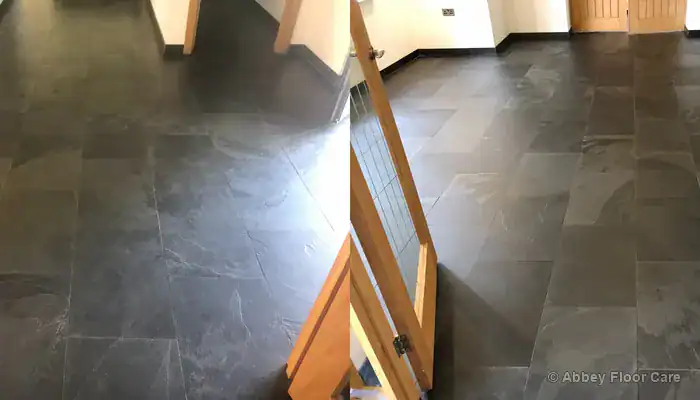
On this project in Abergavenny, a large, textured riven slate floor was constantly trapping dirt and requiring an exhausting cycle of stripping and rewaxing. We stepped in to remove the old coatings and replace them with a much longer-lasting, protective sealing system.
Why this wax-finished slate floor in Abergavenny became too frustrating to keep clean
The Homeowner’s Daily Struggle
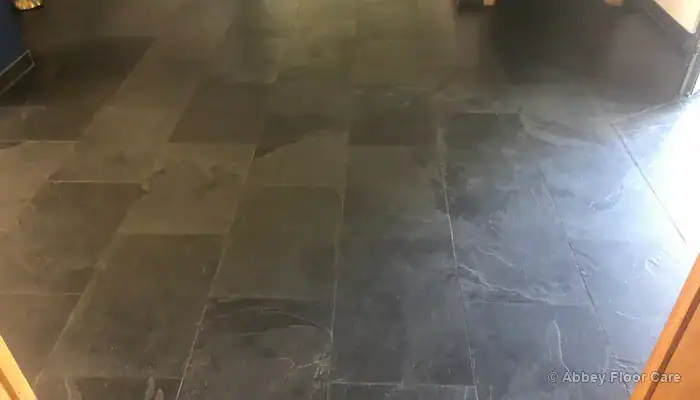
When a Brazilian slate floor only looks right immediately after a full strip and re-wax, it means your surface finish is no longer helping you with everyday cleaning. The homeowner in Abergavenny had hit this exact wall: the floor looked beautiful right after a major restoration, but normal family life quickly left it looking dull and demanding attention all over again.
Because the slate covered more than 1,500 square feet, this wasn’t a quick weekend project. Every renewal meant tackling a massive stretch of natural stone tiles, carefully managing edges, navigating everyday living zones, and dealing with the inevitable disruption of coating a large residential floor.
The household also includes two large dogs with free access to the garden. Having pets around means a floor finish has to work much harder than it would in a quiet, lightly used home. Muddy paws, loose grit, and wet weather all meant the floor needed constant cleaning between wax applications—especially since the textured riven surface caught and highlighted marks far more than a smooth floor ever would.
Abergavenny and the surrounding NP7 postcode area feature a beautiful mix of homes, from Victorian terraces and Edwardian semis to historic stone cottages and modern rear kitchen extensions. Slate is a fantastic, hard-wearing choice for these properties, which is why you frequently find it in transition spaces like entrance halls, boot rooms, utilities, and large open-plan kitchen-diners.
However, these layouts often channel heavy foot traffic, wet shoes, and pets through the exact same pathways. Over time, older subfloors or the joints between original rooms and new extensions can create uneven moisture conditions, leaving the slate looking dull, patchy, or soiled as traditional sealers break down.
Managing a Large Slate Floor
When a waxed floor spans several connecting rooms, the effort required to keep it presentable grows exponentially. A small entryway can be managed with a bit of patience, but a massive expanse of sealed slate becomes an exhausting chore the moment the finish begins to wear unevenly.
The issue here wasn’t the stone itself; the Brazilian slate remained an incredibly durable and practical choice for a busy home. The real problem was how much intensive upkeep the traditional wax finish demanded across a large area.
The natural riven texture added to the challenge. Because the stone is mechanically split along its natural layers during manufacturing, it features beautiful ridges and valleys. While this gives the slate its unique character, it also means your daily cleaning has to navigate a highly textured surface rather than a flat, smooth plane. The homeowner’s goal was purely practical: they wanted a floor that stayed clean for longer, responded beautifully to regular mopping, and didn’t require a disruptive restoration process every single year.
Breaking the Cycle of Hard Work
When stripping and re-waxing is the only way to make a floor look acceptable, your routine cleaning has stopped being maintenance and has simply become a way to delay the inevitable. That was the core issue we needed to solve. The homeowner didn’t want a different style of floor; they just wanted a beautiful surface they could care for without constant hassle.
When freshly applied, the old wax routine gave the slate a traditional, mid-lustre finish that suited the home well for a time. But when you factor in the sheer square footage of the floor and the daily tracking-in of garden soil by two large dogs, that yearly maintenance cycle simply became too much to handle.
This project is a classic example of what many homeowners experience across the UK. If you are trying to understand why your own floor is losing its lustre, reading about problems with faded slate floors can help clarify how colour, coating wear, and stone texture all interact. In this specific case, the soft wax finish itself had become the primary issue by trapping dirt instead of repelling it.
Because natural slate varies beautifully in its colour, thickness, and texture, a large floor will never look completely uniform like a synthetic material. Our goal was to preserve all the natural character of this Brazilian stone while replacing the high-maintenance finish with something far more manageable. A professionally restored and properly sealed floor is much simpler to clean than a worn or incorrectly treated one, which is why we chose a modern, protective approach for this home.
How old wax layers turn routine floor care into an annual chore
When you apply a fresh layer of wax over an old one, the sealer builds up and makes daily maintenance feel incredibly repetitive. On this floor, years of old coatings had accumulated heavily along the walls, in corners, and in the lower troughs of the stone, making the surface look patchy and uneven even after a thorough clean.
The wax had become a chore to remove, rather than a finish worth keeping.
While the old wax provided a classic, heritage look, its soft nature meant it easily trapped grit under the paws of the family’s dogs. This situation is quite different from deliberately choosing a specific aesthetic, which you can read about in our guide on wet-look slate finish choices. In this home, the priority wasn’t just a deeper colour—it was stopping a frustrating maintenance cycle that failed to provide reliable stain protection or an even sheen.
Our step-by-step process for stripping away old wax and preparing the slate

Applying a new sealer over old wax is a recipe for failure, as the new finish won’t be able to bond properly to the stone. To do this right, we needed to completely remove every trace of the old coating and extract all chemical residues before even thinking about a new sealer.
Here is how we handled the restoration process:
| Stage | What We Do | Why It Matters |
|---|---|---|
| 1. Protect | We carefully mask and protect the home’s sensitive oak skirting boards and surrounding walls. | Keeps your woodwork completely safe from any chemical or water splashes. |
| 2. Break Down | We apply a specialized sealer remover and agitate it across the floor using a heavy-duty rotary scrubbing machine. | Liquefies the years of stubborn, built-up wax trapped in the slate’s texture. |
| 3. Detail | We get down on the floor to scrub all tight corners, awkward tile edges, and deep grout lines by hand. | Ensures a deep, uniform clean in the intricate areas that large machines simply cannot reach. |
| 4. Extract | We deploy professional, pressurized rinse-and-capture machinery to flush and vacuum away the liquefied waste. | Removes the dirty slurry completely, leaving the stone perfectly clean and chemically neutral. |
| 5. Dry | The entire 1,500 square foot area is left to dry completely overnight before any sealing begins. | Guarantees there is absolutely no trapped moisture to interfere with the new protective coat. |
Slate is a fine-grained metamorphic rock that splits beautifully along natural planes, but its layered structure means it cannot be mechanically polished with diamonds like marble. Instead, its beauty relies entirely on deep cleaning and proper sealing, making it highly sensitive to harsh or incorrect chemicals.
Our approach on this project comes from over 30 years of hands-on stone restoration experience. While you can explore the general principles behind this work in our guide on cleaning and sealing slate floors, this specific project came down to a clear, practical plan: remove the failing wax, deep-clean the slate and grout, and apply a resilient sealer that could handle busy family life.
Making the slate floor simple to clean and easy to live with
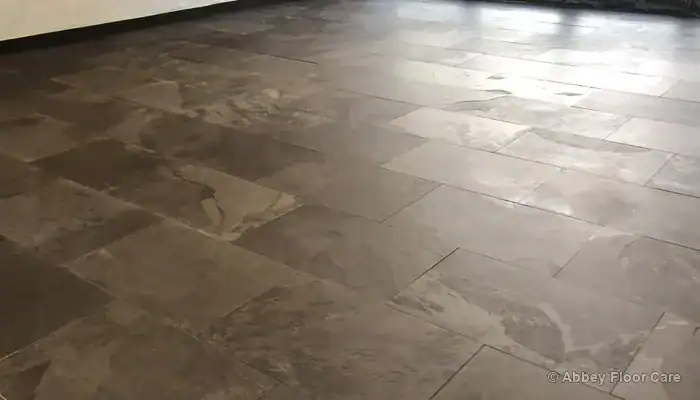
When your sealed slate responds beautifully to a simple mop, floor care stops feeling like an annual burden. To give this homeowner a floor that no longer relied on a yearly re-waxing cycle, we applied two coats of Cee-Tech urethane film-forming sealer.
Unlike an impregnating sealer that sinks into the stone and leaves the surface open, a high-performance topical sealer like Cee-Tech forms a tough, protective barrier. It fills the microscopic pores of the slate, creating a smooth, durable shield that evens out the finish into a uniform, low-sheen lustre without masking the stone’s gorgeous, natural riven texture.
This new urethane finish completely changed how the floor handles daily life. Because dirt and abrasive garden grit now sit on top of the tough protective film instead of grinding into the stone or grout lines, cleaning up after the dogs is incredibly straightforward.
The long-term life of your floor always comes down to simple, proper care: using a pH-neutral cleaner, sweeping up loose grit before you mop, and avoiding steam cleaners (which can soften protective coatings and force moisture into the stone). For a complete breakdown of these steps, you can read our slate floor cleaning maintenance advice.
The homeowner was absolutely delighted with the transformation because the floor is finally easy to live with. By following our tailored care advice—well-wrung damp mopping, clean water, and the correct cleaning products—this high-performance finish will keep its beautiful, natural look for years to come.
Practical advice for homeowners with sealed slate floors
Understanding how your slate should be cleaned and protected makes a massive difference in how it holds up over time. While this Abergavenny project highlights the benefits of moving away from a high-maintenance wax cycle, our guide on slate floors in UK homes dives deeper into how stone origin, texture, and sealer choices affect your long-term care routine.
It is worth noting that imported natural stones, like Brazilian Black or Brazilian Grey slate, can behave quite differently compared to dense, traditional Welsh slate. Differences in porosity change how a stone accepts moisture and sealers, which is why proper care always depends on your specific floor rather than a generic advice label.
If you would like to compare this project with similar homes we’ve restored, you can take a look at our case studies on slate cleaning and sealing in Priddy and slate floor care in Matlock. These real-world examples show exactly how things like old coatings, deep grout lines, hard water marks, and heavy garden traffic influence the way we clean and protect your stone.

David Allen — Abbey Floor Care
David Allen has been restoring and sealing natural stone floors across the UK for over 30 years with Abbey Floor Care. This Abergavenny case study highlights how a large Brazilian slate floor was successfully corrected by stripping away an onerous wax cycle and protecting it with a high-performance Cee-Tech urethane sealer.
Is your slate floor becoming a headache to keep clean?
If you find yourself stuck in a frustrating cycle of stripping and re-waxing just to make your stone look acceptable, we can help. We can safely remove failing old finishes and apply high-performance, long-lasting protective systems tailored to your home and lifestyle.
Recent Posts:
We work throughout the country, just some of our work counties:
Copyright © 2026 Abbey Floor Care. Tile And Natural Stone Cleaning Consultants FAQ - Privacy Policy - Terms And Conditions
Abbey Floor Care is a participant in the Amazon Services LLC Associates Programme, an affiliate advertising programme designed to provide a means for websites to earn advertising fees by linking to Amazon.co.uk. As an Amazon Associate, we earn from qualifying purchases.