
Dull Ceramic Tile Floors Can Hide More Than Residue
Last Updated on September 30, 2026 by David
Ceramic tile floors can look dull after cleaning when residue, darkened grout, textured recesses or genuine glaze damage change the way light reflects across the installation. The key is to establish whether the mark sits on the tile face, follows the grout, remains as a film, or persists as a physical defect once the surface is dry.
What Are These Unexplained Marks on Ceramic Tile?
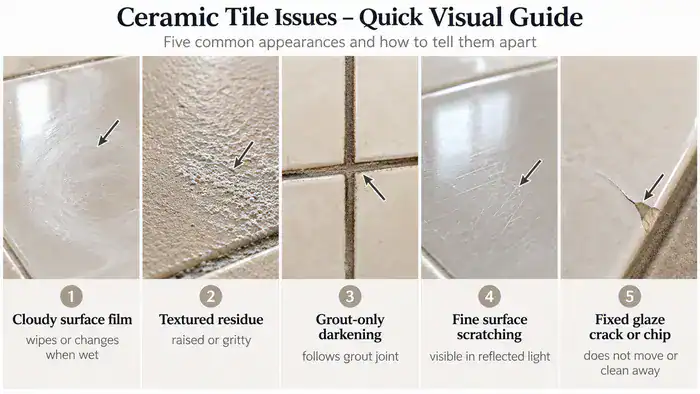
If your ceramic tile shows a mark that looks different from the surrounding surface, first compare it with the grout and nearby tiles under the same lighting. A cloudy patch may sit on the tile face, track along a joint or appear unevenly across several tiles. That initial location check helps separate likely contamination from a grout-related change or a possible defect in the permanent finish.
Surface film tends to create streaks, drying lines or broad cloudy patches that shift with the viewing angle. Detergent residue, a wax-like coating or accumulated cooking grease can leave a smooth tile slightly tacky, or make it appear clearer when wet and hazier once dry. Tiles near a cooker often collect oils beyond the original splash area. And a dry cloth may simply spread the film rather than reveal where it came from.
Textured surfaces produce a different pattern. Recesses retain small deposits whilst raised areas continue to catch the light normally. Grooves in anti-slip or stone-effect tiles can look darker in traffic lanes, entrances and wet rooms, even where the flatter parts of each tile remain clean. A matt ceramic surface may also show footprints, water marks and cloudy spots without any loss of material.
Grout-related discolouration follows the joint rather than the centre of the tile. As porous grout retains soil, moisture and cleaning residue, it can develop dark, patchy or yellowed lines; repeated around every tile, this framing can make the whole floor appear dull. In bathrooms, soap scum may sit across both grout and tile near shower areas, whilst hard-water deposits often leave pale marks following splash and evaporation patterns.
Physical damage stays tied to a particular tile or edge after the floor dries, even when the surrounding surface changes normally. A scratch may catch a fingernail, a chip may reveal a contrasting body colour, and a fine crack network can remain visible from every angle. A comparison with the ceramic and porcelain floor-care hub helps place these observations within the wider distinction between tile faces, grout joints and installation conditions.
The most useful description covers three points: where the mark sits, how it looks and feels, and whether adjacent grout or tiles show the same pattern. A mark that changes with light suggests a surface layer. One that follows joints points towards grout. A sharply localised mark should be assessed for glaze or body damage before another product alters the evidence.
Why Can the Same Dull Patch Have Different Causes?
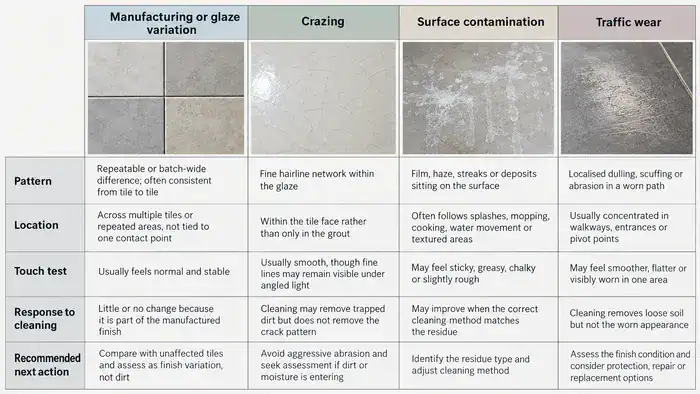
A dull patch on ceramic tile can result from glaze quality variation, deliberate or accidental crazing, or traffic-related wear. A broad difference across a full batch may reflect how the tile was manufactured or glazed, whereas a localised area with a sharp boundary more often relates to use, contamination or impact. Low-angle light is useful here because it lets you compare the boundary with nearby traffic patterns rather than assuming every sheen change is damage.
General finish variation gives a consistent matt, satin or slightly uneven appearance across several tiles from the same range. A non-reflective finish can show dust marks, smudges and cleaning-product film more readily than a glossy face, even though the surface remains intact. Installation residue can make this difference look more pronounced, which is why buyers considering budget-friendly ceramic tile flooring should distinguish the specified finish from dullness that develops later.
Glaze crazing failure creates a network of hairline cracks where the glaze and underlying body expand differently. Fine lines can collect dark dye or dirt, particularly near wet areas, because moisture ingress and repeated soiling make the pattern easier to see. A factory defect may resemble age-related stress, so the appropriate correction depends on assessment rather than a stronger cleaner; where crazing has compromised the tile, the affected tile is replaced.
Traffic wear produces a localised loss of clarity along walkways, door approaches or turning points, where grit and repeated footfall increase abrasion. A PEI wear rating describes the expected traffic resistance of a glazed surface, but it cannot establish the cause of a single dull patch. Scratches, impact damage and changed sheen along a high-load route present a different risk from a uniform matt finish. The wider installation pattern provides the missing context.
Can the Wrong Treatment Make Tile Damage Worse?
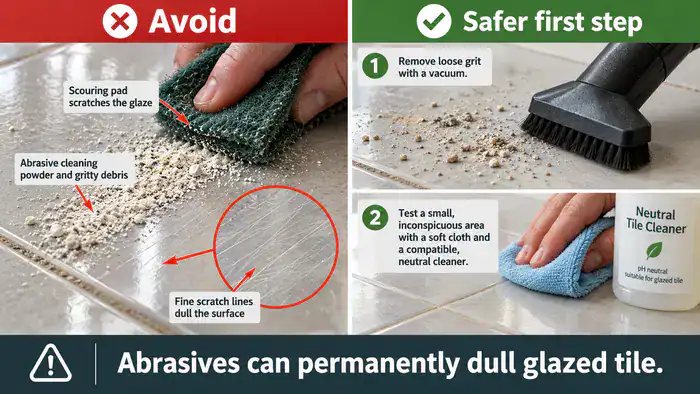
Scrubbing a ceramic tile mark before establishing the surface condition can make the damage more difficult to interpret. Abrasive grit contamination introduces loose dust, crumbs and small particles that act like sandpaper beneath a pad or mop, creating fine scratches across glazed surfaces. Vacuuming and careful sweeping therefore matter before any wet cleaning is considered.
Damage through the factory-fired glaze exposes a less protected ceramic body. Water ingress through damaged glaze can then penetrate scratched or chipped areas and encourage staining, mould or weakening beneath the durable surface. Historic lead-glazed ceramic tile has an additional chemical sensitivity, as older glaze formulations can react to acidic pH or aggressive alkaline products. Where traffic wear has worn through the glaze, the affected tile is replaced. The ceramic tile cleaner guidance helps distinguish compatibility questions from ordinary soil removal.
Abrasive contact through the factory glaze permanently damages the ceramic tile surface.
Suspected abrasion requires a glaze-damage assessment; moisture-associated darkening requires an ingress assessment; and loose grit calls for contamination control rather than repeated scrubbing. Acidic products can alter grout and sensitive historic finishes, whilst excess moisture can travel through an existing breach. A persistent mark should not be treated as routine dirt until its relationship with the surrounding glaze is understood.
How Does the Mark’s Location Reveal Its Cause?
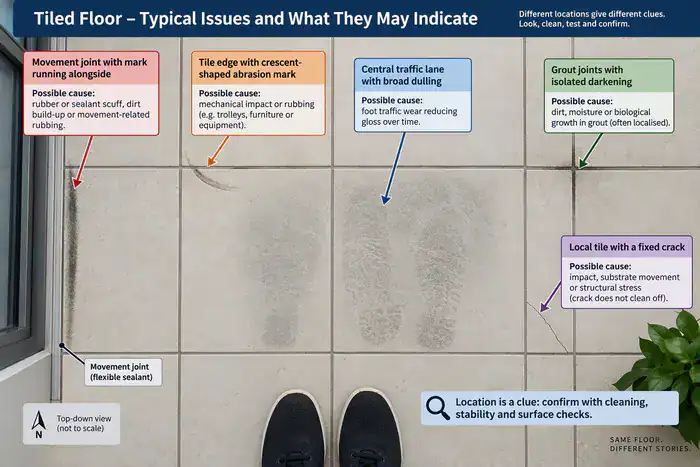
Tile movement joints and nearby load zones can provide useful context for a mark’s cause, although location remains a clue rather than proof. A line beside a joint, a crescent at a tile edge or a dull area beneath a heavily used route should be considered alongside the adjacent grout, tile stability and any visible change in level.
- Start with the grout-joint relationship: a mark following a joint may reflect porous grout, moisture movement or joint cracking rather than a dull tile face.
- Compare tile edges and corners: repeated edge marks or small chips may indicate impact damage, movement or a point load, rather than surface residue.
- Inspect movement areas: a tile movement joint should provide stress relief through perimeter isolation, a perimeter gap or flexible sealant. Where this fails, differential movement and shear stress can develop nearby.
- Check high-load zones: subfloor deflection can produce joist flex, substrate movement and grout cracking over timber joists, whilst over-boarding may alter the load-bearing response.
- Consider support beneath the tile: spot-dabbing adhesive voids leave hollow spots and uneven support, so a point load or impact can create a cavity underneath, tile cracking or a drummy sound.
These patterns link installation behaviour with the visible mark. Substrate movement can load a movement joint, whilst inadequate adhesive contact can leave one tile vulnerable beside otherwise sound neighbours. Underfloor heating can also increase thermal expansion, so movement details need consideration where a floor sits over a concrete screed or timber subfloor before appearance alone is used to determine the cause.
A mark at a joint does not prove structural failure, and a stable-looking tile does not rule out a hidden void. Professional assessment compares location with grout condition, edge alignment, movement provision and the way the floor responds under normal use.
What Is the Safest Next Step for This Tile? A Compatibility-Based Decision Tree
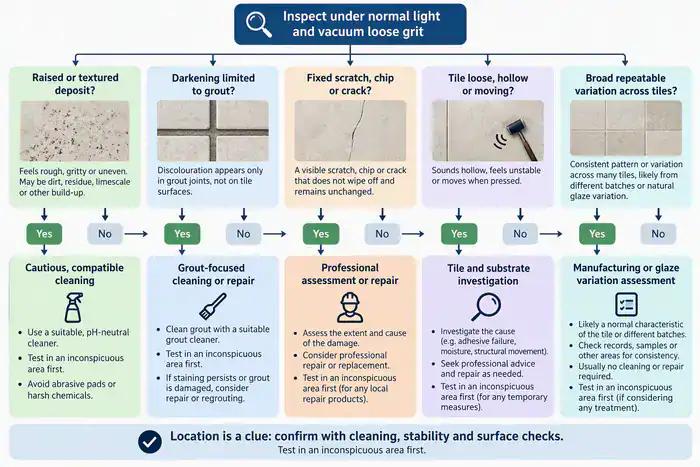
The safest approach is to classify the mark before taking action, comparing the visible surface, grout joints and tile stability under normal use. A surface film or textured deposit points towards contamination; darkening limited to joints points towards grout; a fixed scratch, chip or crack points towards glaze or ceramic body damage; and movement or a hollow sound points towards a loose or debonded tile.
Surface contamination needs a compatibility check before cleaning chemistry is chosen, whilst grout-related discolouration needs separate assessment because porous joints behave differently from glazed faces. Suspected glaze damage, water ingress or a loose tile should go straight to specialist diagnosis rather than experimentation, particularly where the installation includes a movement joint, timber subfloor or underfloor heating.
Ongoing maintenance should remove loose grit before wet mopping and use pH-neutral chemistry, helping both the glazed surface and grout remain easier to care for. Avoid detergent overuse, as residue accumulation can create a redeposition cycle. Readers needing broader compatibility guidance can use the ceramic and porcelain flooring guidance before cleaning, repair or specialist intervention.

David Allen — Abbey Floor Care
David Allen has more than 30 years of experience with Abbey Floor Care, diagnosing ceramic tile dullness caused by residue, grout changes, textured finishes and damaged glaze. His diagnostic work helps homeowners identify the specific condition before selecting cleaning, repair or replacement advice for ceramic tile floors across the UK.
Recent Posts:
We work throughout the country, just some of our work counties:
Copyright © 2026 Abbey Floor Care. Tile And Natural Stone Cleaning Consultants FAQ - Privacy Policy - Terms And Conditions
Abbey Floor Care is a participant in the Amazon Services LLC Associates Programme, an affiliate advertising programme designed to provide a means for websites to earn advertising fees by linking to Amazon.co.uk. As an Amazon Associate, we earn from qualifying purchases.