Victorian Tile Restoration Beneath Paint Spills
Last Updated on May 28, 2026 by David
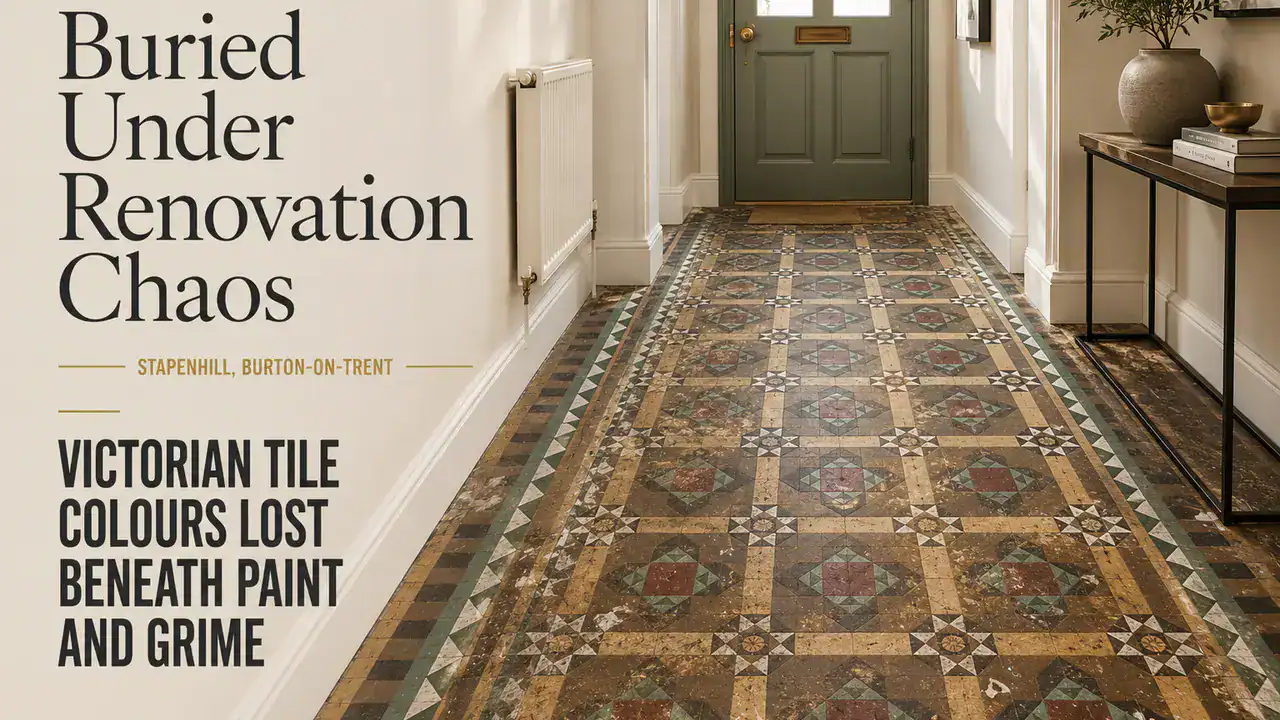
Paint splashes, hardened adhesive and years of trapped grime had left this Burton-on-Trent hallway looking as though the original victorian tiled floor had disappeared beneath renovation debris and old floor coverings. The surface had become dull, uneven and visually flat because layers of residue, carpet adhesive contamination and decades of foot traffic had obscured the original geometric layout, whilst long-term neglect allowed ingrained soiling to settle deep into the porous clay body of the tiles.
The video below shows how the original hallway appearance was recovered through controlled restoration and careful moisture management.
Why paint splashes and adhesive residue left this Burton-on-Trent Victorian tile hallway looking beyond saving
Paint Contamination Across The Original Entrance Surface
If your victorian tile hallway still looks patchy and stained after renovation work, the contamination is often embedded far deeper than the visible surface suggests. This Burton-on-Trent hallway had been uncovered beneath old carpet and later floor coverings during refurbishment, yet the original geometric design was barely recognisable because paint splashes, hardened adhesive and plaster contamination covered almost every exposed section of the floor.
Burton on Trent sits within East Staffordshire in the DE13 and DE14 postcode districts, where much of the older housing stock developed during the town’s rapid Victorian brewing expansion and later Edwardian growth. Large parts of the area are characterised by red-brick Victorian terraces, bay-fronted Edwardian semis and period villas, many of which still retain original tiled entrance halls, vestibules and pathways where geometric and encaustic floors were installed as both a decorative and hard-wearing feature. These floors are most commonly found in entrance hallways, porches and front vestibules, particularly in properties close to the historic town centre and former brewery districts. Interwar and post-war housing surrounds many of these earlier streets, but Burton on Trent still contains a substantial number of period homes where original decorative flooring survives beneath later coverings and coatings.

Paint and adhesive build-up had accumulated gradually over many years, leaving thick residue across both the hallway borders and the main walking route. Old carpet glue, dried paint splatters and failed surface coatings had bonded tightly to the unglazed clay surface, so ordinary household cleaners were never going to remove the contamination properly. What we often see in floors like this is repeated mopping spreading softened residue back across the tile face instead of extracting it fully, leaving a smeared residue film that becomes harder to remove over time.
Burton on Trent expanded rapidly during the nineteenth century as the brewing industry transformed the town into one of Britain’s major industrial centres, supported by the Trent water supply and the growing railway network. The wealth generated by the breweries drove large-scale Victorian and Edwardian residential development, which explains why decorative geometric and encaustic tiled floors remain such a common feature in many of the town’s older entrance halls and vestibules today.
Traffic Wear And Faded Geometric Patterns
Dull traffic lanes running through the centre of the hallway had become more prominent than the original decorative design itself. Decades of heavy foot traffic had worn the softer buff sections more aggressively than the darker clay colours, creating clear differential wear patterns that were immediately visible under natural light.
The encaustic dust-pressed tiles still retained their original clay slip pattern within the tile body, but much of the visual contrast had disappeared because ingrained grime and worn surface areas muted the geometric borders. Historic footfall through the entrance route had created uneven abrasion across the centre of the hallway, whilst the outer edges remained darker and more protected beneath old coverings and accumulated dirt.

Several sections also showed evidence of old sealer residue and wax accumulation where previous treatments had darkened the surface unevenly over time. Those ageing coatings trapped additional dirt across the porous clay structure, leaving the hallway with a sticky, lifeless appearance that no longer reflected the original period character. And once those layers begin holding fresh dirt on the surface instead of releasing it during cleaning, the floor becomes progressively harder to maintain properly.
Historic Construction And Vulnerable Clay Surfaces
Victorian encaustic and geometric tiles are fired clay products with a chemically stable surface, but they remain physically vulnerable to abrasion and incompatible with acidic cleaning methods. This hallway still retained its original hydraulic-pressed clay construction and historic tile face, which meant abrasive pads, harsh chemicals and aggressive mechanical cleaning could easily have caused permanent damage to the remaining pattern depth.
The floor also showed early signs of increased porosity where years of wear had opened the clay body enough for moisture and residue to penetrate more deeply into the surface. Dirt had become embedded within the worn tile face itself rather than simply sitting on top of the hallway, particularly around the threshold and the heavier traffic lanes. Original encaustic clay inlays remained more visible near the skirting boards, but the exposed central route had faded considerably because the softer pigments had worn more quickly than the denser black and red sections.
Historic tile fire skin loss was especially noticeable near the doorway, where years of grit abrasion, wet foot traffic and repeated cleaning had weakened the original fired surface. Abrasive pad wear across these vulnerable edges had already softened parts of the geometric border, so preserving what remained of the authentic period surface became a priority during restoration. Floors in this condition often appear beyond recovery to homeowners because the decorative layout is buried beneath contamination, failed coatings and decades of neglected maintenance.
Several nearby sections also showed old carpet gripper rod damage and hardened lino adhesive residue where previous floor coverings had been fixed directly through the original tiled surface. Similar conditions appear regularly throughout older entrance hallways featured in victorian tile cleaning and restoration projects, particularly where period floors have remained hidden beneath carpet for decades. A professionally restored and correctly sealed floor is considerably easier to maintain than a worn or incorrectly treated surface because dirt stays closer to the surface instead of becoming trapped inside damaged clay pores and old coatings.
Why excessive water could have caused lasting problems beneath these Victorian hallway tiles
Moisture trapped beneath historic victorian tiles can destabilise the floor if excessive water is introduced during cleaning. The permeable sub-floor beneath this hallway had been constructed without a damp proof membrane, which meant too much water could pass through the clay body and reactivate underlying dampness, trapped salts and movement beneath the floor.
Excess water can reactivate hidden moisture beneath historic clay tiles.
Historic clay tile over-saturation often leads to lifting, unstable bedding and salt efflorescence because moisture cannot disperse quickly through older permeable construction. Controlled slurry extraction and wet vacuum recovery were therefore essential throughout the cleaning process to stop dirty solution remaining beneath the floor surface. In my experience, this is one of the most overlooked aspects of victorian tile restoration. The relationship between moisture movement and breathable restoration methods is explained further in the right way to restore victorian tiles properly, particularly where older hallways still depend on vapour movement for natural drying.

How controlled paint and residue removal restored the original Victorian tile surface safely
Repeatedly scrubbing paint-contaminated victorian tiles often forces residue deeper into the clay instead of removing it. Controlled paint remover solvent softening was therefore used carefully across the hallway so hardened paint splashes and adhesive contamination could be loosened gradually before extraction.
Low-moisture cleaning helped keep the floor stable whilst softened coatings and ingrained dirt were lifted from the tile face. Wet vacuum extraction recovered the dirty slurry immediately after agitation so residue could not settle back into the porous surface or grout joints.
Aggressive abrasion was deliberately avoided because the remaining historic surface still contained original encaustic pattern depth and vulnerable clay inlays. The conservation approach focused on preserving original material and protecting the period integrity of the hallway rather than forcing an artificial appearance through harsh mechanical cleaning. The restoration process also included long-term maintenance guidance because correct ongoing care with pH-neutral victorian tile cleaning methods remains one of the most important factors in extending the life of historic flooring.
Why the original Victorian tile colours became visible again after the floor dried and sealed correctly
Vapour-open finishes allow restored victorian tiles to regain colour without trapping moisture beneath the surface. Once the hallway had dried fully, the original geometric borders and encaustic clay colours became visible again because decades of residue contamination and failed surface coatings had finally been removed from the tile face.
Breathable protection restored colour without creating an artificial glossy finish.
A restored Victorian tile floor should retain the appearance of its original fired matte surface with clear pattern definition and consistent colour. Where appropriate, a compatible topical finish can add a light protective sheen without changing the authentic period character. A breathable coating and compatible seal were selected carefully here so moisture release and vapour transmission could continue naturally through the historic flooring without creating a trapped damp barrier beneath the surface.

The final breathable impregnating sealer enriched the natural colour depth of the clay-based tiles whilst helping protect the hallway from future staining and dirt penetration. The floor regained clarity and looked dramatically different from its original condition, yet the low-sheen finish still preserved the authentic fired appearance rather than creating an artificial polished effect. Correct maintenance using pH-neutral detergents, regular grit removal before wet mopping and periodic resealing will help keep the surface easier to maintain whilst preserving the historic character long term.
Where to see more Victorian tile restoration projects with paint staining and trapped residue problems
Related Residue Contamination Projects
Restoration projects involving paint staining and embedded residue nearly always require moisture-aware cleaning decisions from the beginning. Similar floors affected by failed coatings, old sealers and ingrained contamination can be seen throughout the wider victorian tile cleaning hub, where different entrance hallways and vestibules demonstrate how breathable restoration methods help protect historic surfaces without trapping moisture beneath the floor.
Historic Flooring And Pattern Preservation
Mosaic pattern stabilisation, geometric border alignment and reclaimed tile integration become increasingly important where older floors contain missing sections or unstable bedding. Many of these projects also involve sympathetic restoration work using heritage-compatible mortar repairs and salvaged inserts so the original tessellated layouts can be preserved without losing the period patina that gives these floors their historic character.
Long-Term Maintenance And Moisture Control
Substrate instability, tile delamination and trapped damp problems usually worsen when impervious floor coverings or unsuitable coatings prevent moisture evaporation through traditional construction. Correct maintenance routines and breathable protective finishes help older hallways stay cleaner for longer whilst preserving the authentic appearance and vapour-open surface required by historic victorian tiled floors. Additional examples involving geometric borders, historic flooring and conservation-led restoration can also be found in victorian floor tile restoration case studies covering entrance hallways across the UK.

David Allen — Abbey Floor Care
David Allen has restored Victorian tile floors across the UK for more than 30 years, including this Burton-on-Trent hallway where paint contamination, adhesive residue and heavy traffic wear had obscured the original geometric design. His work at Abbey Floor Care focuses on conservation-led restoration methods that recover authentic colour and surface character whilst protecting historic clay flooring from unnecessary damage.
Recent Posts:
We work throughout the country, just some of our work counties:
Copyright © 2026 Abbey Floor Care. Tile And Natural Stone Cleaning Consultants FAQ - Privacy Policy - Terms And Conditions
Abbey Floor Care is a participant in the Amazon Services LLC Associates Programme, an affiliate advertising programme designed to provide a means for websites to earn advertising fees by linking to Amazon.co.uk. As an Amazon Associate, we earn from qualifying purchases.