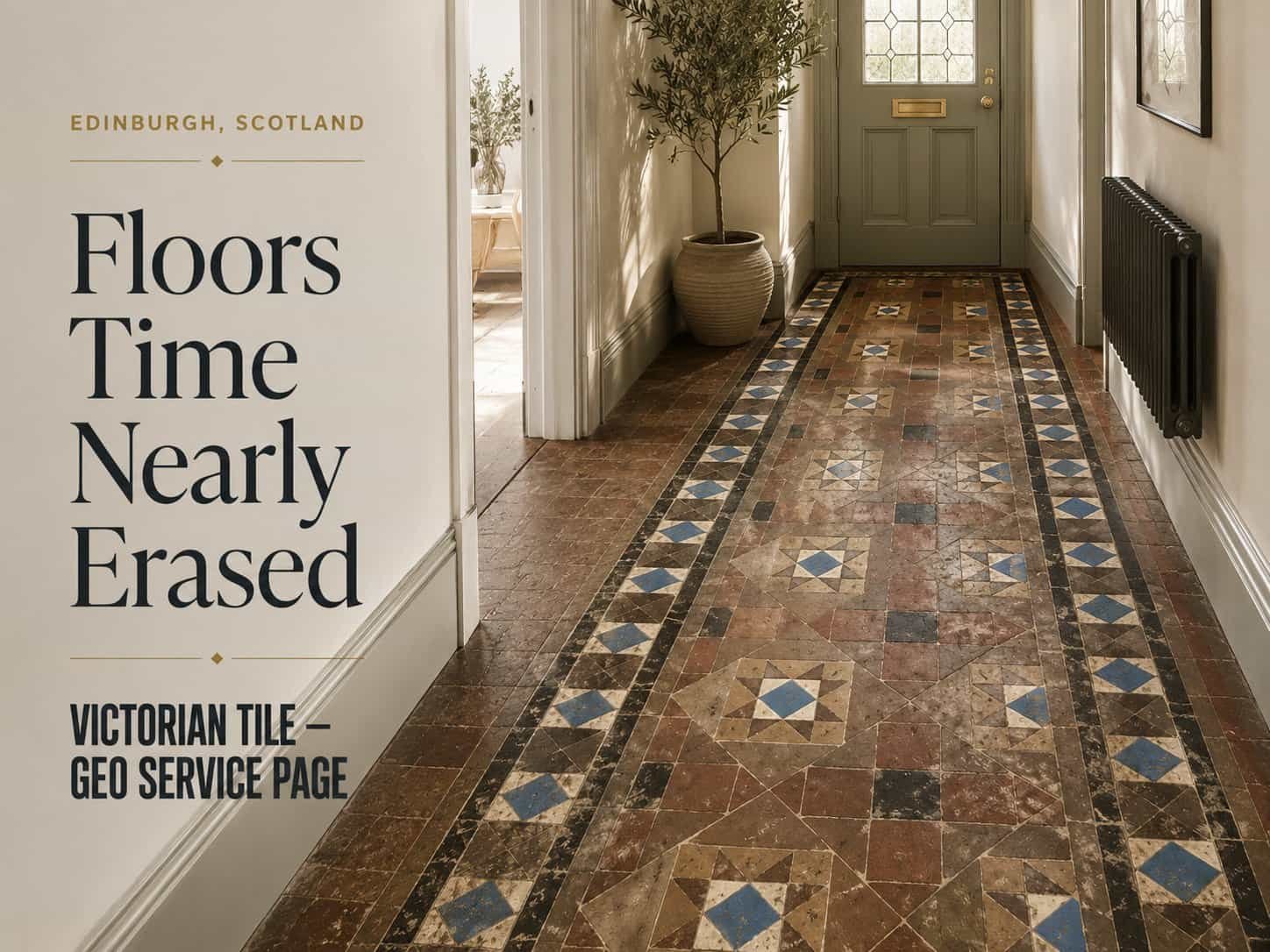
Victorian Tile Repair City Of Edinburgh Hides
Last Updated on May 30, 2026 by David
Victorian tile restoration in City Of Edinburgh focuses on original Minton and geometric floors where damage, coating failure, loose sections and hidden residue have started to affect period entrances, vestibules and hallways.
This page explains how the local restoration service assesses surviving original fabric, evaluates floor condition and routes homeowners through Abbey Floor Care for suitable next steps.
Victorian Tile Restoration Services For Historic Edinburgh Properties With Original Minton Floors
If your Victorian tile floor still looks dull, patchy or worn despite years of care, specialist restoration may be the next step. Original Minton, encaustic and geometric floors across Edinburgh often retain far more of their original design than first appears. Old coatings, carpet adhesive, waxes, ingrained dirt, broken grout and loose sections can conceal the true condition of the floor, making the visible surface a poor guide to what remains underneath.
City Of Edinburgh sits within one of Scotland’s most distinctive historic urban landscapes, with extensive areas of Georgian, Victorian and Edwardian housing protected through conservation designations in districts such as Marchmont, Morningside, Newington and the New Town. Much of the housing stock consists of sandstone tenements, Victorian terraces, traditional villas and later inter-war properties dating from the mid-19th century into the early 20th century within the City of Edinburgh council area and EH postcode districts. Victorian Tile floors are most often found in entrance vestibules, hallways, porches and ground-floor corridors, where decorative tiled surfaces were originally installed to cope with heavy daily use. Period flooring survives particularly well in tenement buildings and larger townhouses where many original architectural features remain intact. ([UNESCO World Heritage Centre][1])
Edinburgh expanded rapidly during the Georgian and Victorian eras as commercial growth, civic improvement projects and rising population levels drove large-scale residential development beyond the medieval Old Town. The construction of the New Town, followed by extensive Victorian tenement building between the 1860s and 1890s, created thousands of properties fitted with decorative entrance finishes and durable tiled floors. Many of those floors remain in use throughout the capital today. ([The Guardian][2])
Original hallway floors in Edinburgh commonly show darkened traffic routes, patchy colour, broken tesserae, missing border pieces, carpet gripper damage, surface whitening, hollow tiles and areas where old floor coverings have left stubborn adhesive shadows. These visible signs help indicate whether the floor requires localised repair, careful cleaning, tile bedding work or more extensive restoration before it can return to reliable everyday use.
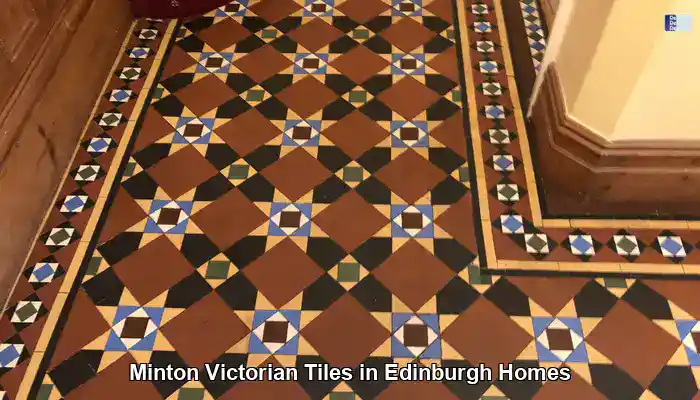
Patterned vestibules behind a storm door often carry the greatest build-up of soiling because grit, damp footwear and doorway draughts concentrate wear in the entrance area. In many cases the tile surface remains fundamentally sound, yet the floor continues to look grey, greasy or uneven after mopping because repeated household cleaning has gradually left additional residue within the tile pores and grout lines.
Tile porosity affects how quickly old floors absorb dirt, moisture and historic surface treatments. Porous clay, absorbed moisture, retained moisture and surface cavities can make an original floor appear far darker than its true colour. What we often see here is differential porosity response creating blotchy finishes, uneven absorption, inconsistent drying and patchy appearance across adjacent tiles.
Residue film accumulation is one of the most common reasons an original decorative scheme appears muted rather than lost. Waxes, acrylic sealers, previous treatments, adhesive, softened residue, grout lines, deep cleaning history, old coating and dirt retention can combine into a stubborn surface layer that masks colour, pattern depth and the finer geometric details.
Tile bed voiding is often suspected where a hallway contains hollow tiles, movement underfoot, loose sections, failed support, substrate gaps, lifting risk or local floor instability. Careful sound testing helps distinguish surface contamination from detached bedding, and any movement around cracked grout or raised tile edges should be recorded before restoration begins.
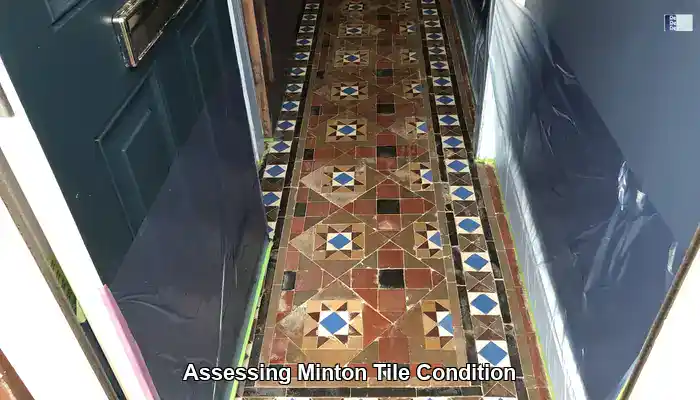
Service delivery in Edinburgh is arranged through Abbey Floor Care, with work carried out by a vetted contractor network. A site visit confirms the floor type, room use, moisture condition, damaged sections and likely restoration pathway. Homeowners facing similar coating, movement and colour-loss concerns can compare their floor with the Trinity Victorian tile restoration project, where original colours returned through careful testing and staged treatment.
Victorian tile restoration in Edinburgh is most appropriate where the goal is to retain original material, improve appearance, stabilise damaged areas and keep the historic fabric in service rather than replace it. Floors affected by missing tesserae, tile bedding problems, loose edges or decorative layer wear can often benefit from sympathetic repair, colour matching, reclaimed pieces and carefully controlled treatment that respects the integrity of the original floor.
Why Existing Coatings And Previous Repairs Must Be Assessed Before Victorian Tile Restoration
Historic coatings and earlier repairs frequently introduce risks that only become apparent during a restoration assessment. Old sealers, wax coatings, carpet glue, bitumen residue, cement patches and previous repair materials can trap dirt, moisture and surface contamination beneath a layer that simply looks dull from above.
Moisture-active subfloor behaviour is particularly important because many Edinburgh period floors sit over older permeable sub-floors where moisture can pass through and influence dampness, tile movement, bedding stability, baseline moisture readings and sealer selection. A crystalline salt bloom is the visible result of moisture migration, drying cycles, pore structure, salt activation, evaporation and moisture retention. The homeowner sees white surface deposits, whilst treatment focuses on removing the salts and managing the floor’s drying behaviour.
Assessment prevents avoidable damage to historic Victorian tiles.
Incorrect treatment can turn a recoverable floor into a damaged one. Victorian encaustic and geometric tiles are clay-fired at high temperatures. Their fired surface is chemically stable but physically vulnerable to abrasion and incompatible with acidic cleaning. Existing residues, damp edges and historic repairs should always be assessed before stripping, cleaning, sealing or tile fixing takes place.
How Conservation-Led Victorian Tile Restoration Protects Historic Floors In Edinburgh
Historic Victorian tiles are often damaged by well-intentioned modern cleaning methods. Rotary pressure, hard pads, steam, excessive water and unsuitable acidic cleaners can wear vulnerable edges, activate salts, loosen tiles and mark the original tile face.
Conservation-led restoration relies on controlled cleaning, wet vacuum extraction, solvent softening where appropriate, careful hand work and compatible repair materials. Heritage-compatible tile adhesive supports replacement tiles through sympathetic repair, historic fabric protection, compatible materials, original substrate awareness, moisture movement and long-term repair stability where broken or missing sections require attention.
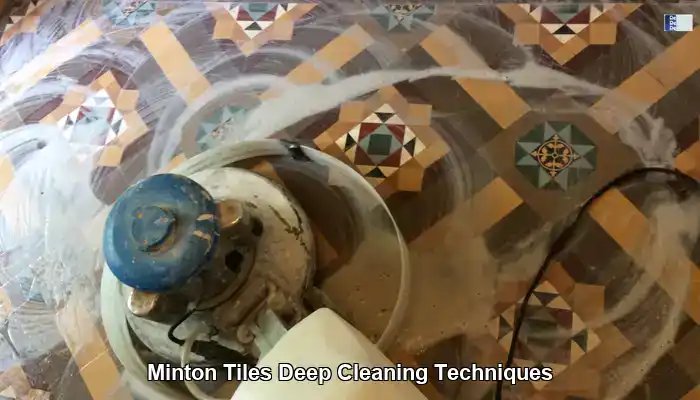
Moisture buffering capacity describes the way porous clay regulates moisture through vapour exchange, drying behaviour, absorbed moisture, subfloor interaction, humidity response, historic construction, floor breathability and retained moisture. A vapour-open sealing system provides breathable protection whilst allowing moisture release, vapour movement, moisture balance and compatible seal performance without blocking the natural evaporation pathway.
A restored Victorian tile floor reveals the original fired matte surface with clearer colour consistency and pattern definition. Where appropriate, a topically sealed finish can provide a slight protective sheen without compromising the character of the floor. Similar restoration principles are discussed in the safe Victorian floor tile restoration method, where controlled cleaning, structural stabilisation and breathable finishing are explored in greater detail.
What Changes After Victorian Tile Restoration Without Losing Period Character
Original character remains the defining feature of a successful Victorian tile restoration. The floor should look substantially improved after intervention because residue removal, repair, careful sealing and colour activation allow the geometric design to become visible again.
Authentic restoration preserves aged surface, authentic wear, historic appearance, original character, visual continuity, sympathetic restoration, heritage finish, aged colour tone and salvaged appearance. Slip-layer erosion is patterned surface loss caused by inlaid slip failure, traffic erosion, decorative layer breakdown and exposed body clay. The homeowner sees worn traffic routes, whilst restoration focuses on stabilising and presenting the surviving design honestly.
Unrealistic replacement-style expectations can sometimes lead to disappointment when a floor has actually been restored correctly. In my experience, a professionally restored and properly sealed floor is significantly easier to clean and maintain than one that has been poorly treated or left neglected, whilst period-appropriate patina, reclaimed tiles, colour continuity and geometric border alignment remain visible parts of the finished result.
Colour revival can be striking where old coatings and ingrained dirt have simply obscured the tile body rather than replaced lost material. Related examples of colour return are shown in restoring colour to faded Victorian mosaic tiles, where pigment depth, pore protection and breathable finishing are considered alongside realistic expectations of surface wear.
Victorian Tile Restoration Case Studies And Further Edinburgh Floor Care Guidance
If your Victorian tile floor shows similar damage, case study evidence often provides the clearest indication of what restoration can realistically achieve. Abbey Floor Care brings nearly 30 years of practical experience working with a wide range of victorian tile types across homes, hotels and period buildings throughout the UK.
Local proof helps homeowners assess whether their own Edinburgh hallway, vestibule, porch or corridor is showing the same recoverable issues found in other period properties. The Walsall Minton floor restoration case study demonstrates how loose areas, deep residue and original pattern retention can be addressed without erasing the age and character of the floor.
Correct ongoing maintenance extends the life of the floor because pH-neutral cleaning, grit removal before wet mopping and resealing at appropriate intervals help protect porous tiles, breathable finishes and floor breathability. Steam cleaners should be avoided, as heat and moisture can force water into grout, stain the floor, crack weakened areas and encourage efflorescence. Broader care guidance is available in the Victorian tile cleaning and restoration guide.
Further evidence can be valuable where old coatings, no DPM, trapped moisture, rising damp or surface coating failure have contributed to whitening or peeling. The risks associated with surface films are explored in the high-gloss sealer risk guide, helping homeowners understand when breathable protection may be more appropriate than a shiny topical finish.

David Allen — Abbey Floor Care
David Allen has worked with Victorian and Minton tile restoration for 30 years through Abbey Floor Care, focusing on the assessment, repair and finishing of period floors in UK homes. His guidance for this City Of Edinburgh geo service page reflects practical experience with original clay tile surfaces, moisture-sensitive subfloors, coating removal and sympathetic repair.
Recent Posts:
We work throughout the country, just some of our work counties:
Copyright © 2026 Abbey Floor Care. Tile And Natural Stone Cleaning Consultants FAQ - Privacy Policy - Terms And Conditions
Abbey Floor Care is a participant in the Amazon Services LLC Associates Programme, an affiliate advertising programme designed to provide a means for websites to earn advertising fees by linking to Amazon.co.uk. As an Amazon Associate, we earn from qualifying purchases.