Carpet Hid This Victorian Tile Restoration
Last Updated on May 20, 2026 by David
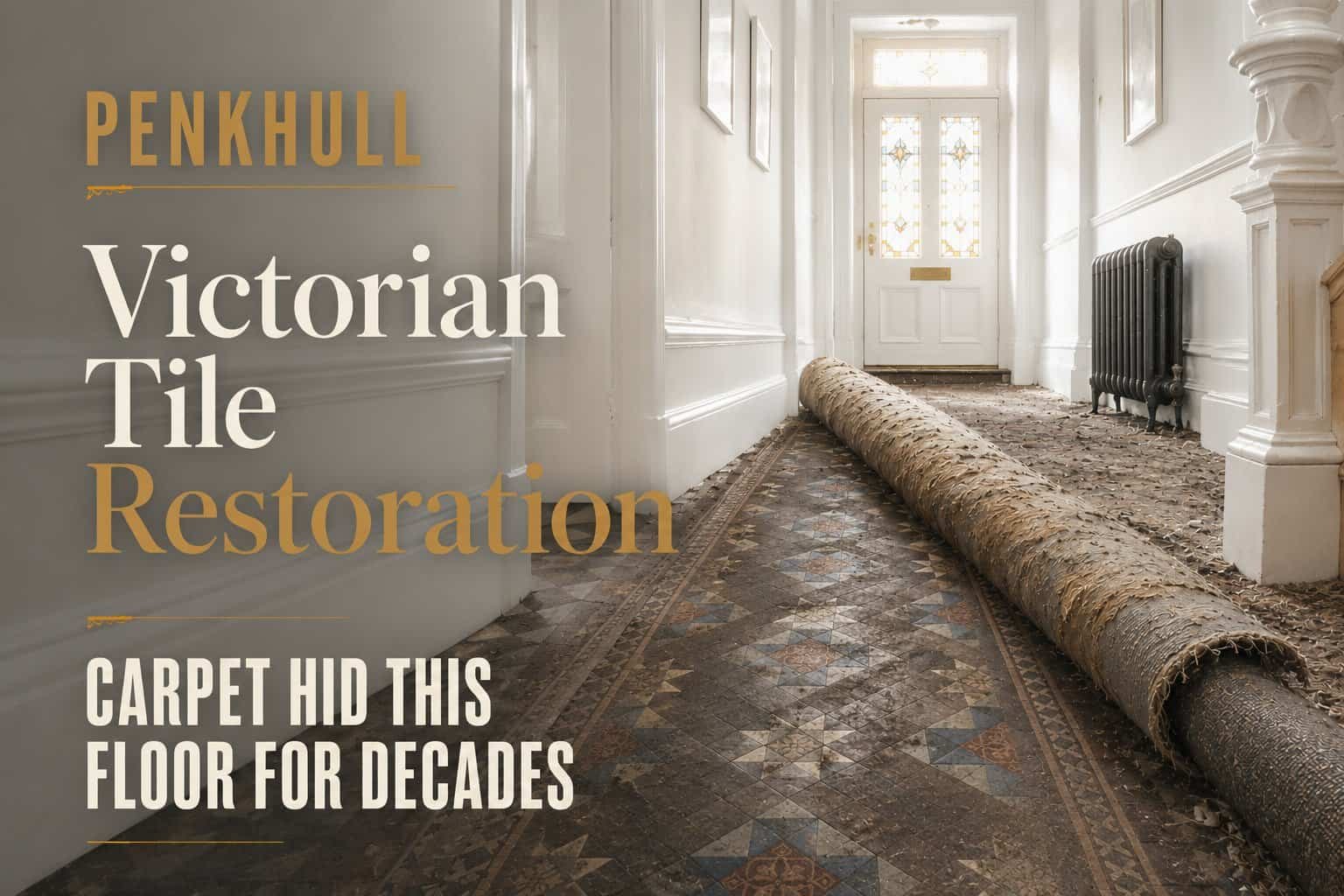
Victorian tile restoration in this Penkhull hallway began after decades of carpet concealed what was happening underneath. Once the covering came up, the original Minton and Victorian floor revealed hidden movement, trapped residue, darkened joints, and colour that had been flattened beneath years of being sealed away from air and light.
This short video shows the Penkhull hallway before and during restoration, with the full project detail explained below.
Initial Condition Assessment
If your victorian tile floor has been hidden beneath carpet for years, the first issue is rarely the visible dirt. What we often see instead is a floor carrying the evidence of everything that has happened underneath the covering. In Penkhull, the homeowner uncovered a dark, uneven hallway floor rather than the decorative entrance feature originally designed to greet visitors.
Once the carpet was removed, the original geometric and encaustic tiled hallway showed flat colour, dull patches, and areas where the surface looked tired rather than simply dusty. The pattern itself had survived well, but the floor had absorbed residue from old coverings, domestic cleaning products, and years of trapped moisture sitting beneath an impervious layer.
Penkhull sits within the City of Stoke-on-Trent in the ST4 postcode area and is known for its large concentration of late Victorian and Edwardian terraced housing, alongside larger villas and inter-war suburban development around Trent Valley Road and Prince’s Road. Original Victorian tile floors are most commonly found in entrance hallways, vestibules, porches, and front reception areas where geometric and encaustic patterns were used to create a durable decorative first impression. Much of the housing stock dates from the rapid expansion of the Potteries during the mid to late 19th century, with solid-wall terraces and period properties still forming a major part of the area’s character today. Penkhull also retains a strong heritage identity through its older street layouts, historic workers’ housing, and surviving period architectural details linked to Stoke-on-Trent’s industrial growth.
During the 19th century, Penkhull expanded quickly as the pottery industry, railway links, and associated engineering trades drove major population growth across Stoke-on-Trent. Families connected to manufacturers such as Spode and Minton helped shape the area’s housing stock, which explains why so many local hallways and entrance passages still retain original Victorian geometric and encaustic tiled floors today.
The Visible Problem State
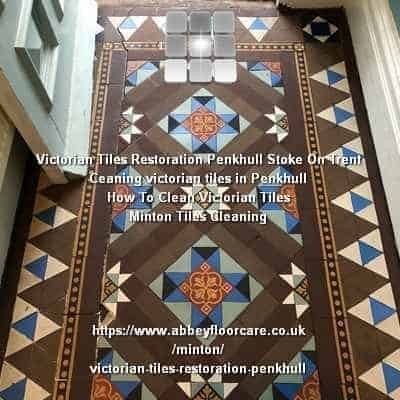
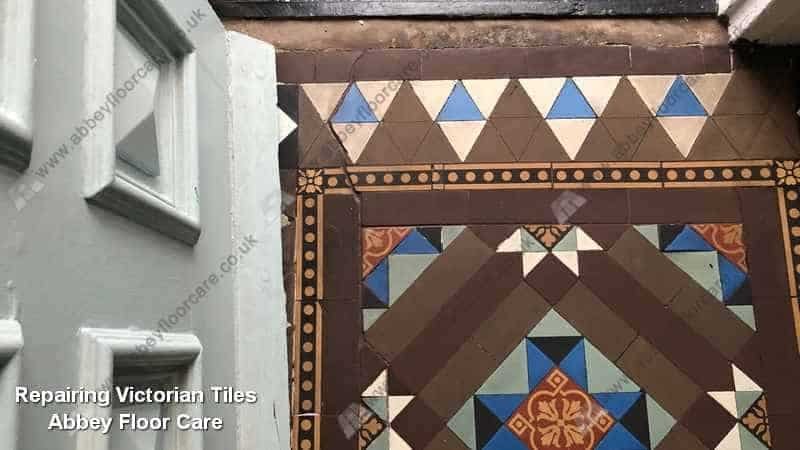
Darkened joints across the Penkhull hallway showed where old coatings, trapped dirt, and wash residue had settled into the gaps between tiles over many years. And the floor was not presenting one single issue. There were several clues appearing together: muted colour, dull patches, edge staining, and isolated areas where tiles had started to move slightly underfoot.
The clay tile surface reacted unevenly because some areas had retained more contamination than others whilst the floor sat under carpet. That difference matters on a period floor. It was never being assessed as a perfectly flat modern surface, but as an original hallway carrying old coverings, possible adhesive residue, historic moisture exposure, and natural colour variation across the installation.
The Penkhull project shared similarities with the Minton tile floor restoration in Ovington, where old coatings, carpet-related contamination, loose tiles, and colour recovery shaped the work. Both projects involved original patterned floors that needed careful restoration evidence rather than a generic cleaning claim. The Penkhull hallway, however, had its own pattern layout, movement history, residue build-up, and moisture behaviour.
Once the main covering had gone, the original patterns were still clearly there. The colour simply sat beneath years of contamination that had dulled the surface and muted the contrast between the geometric sections. Nothing artificial needed to be created here. The character of the floor already existed within the original layout, borders, and surviving Minton-style detailing.

Homeowner Concern And Project Evidence
The homeowner wanted the entrance hall to feel clean and welcoming again without stripping away the history that made the floor worth preserving in the first place. Although the hallway had been neglected for years, the surviving pattern lines, original surface, and remaining colour all pointed towards a floor that justified careful restoration from the first inspection through to the final result.
Movement within the hallway could be felt before it was properly seen. That is often significant with old tiled floors because loose sections, lifting edges, and unstable bedding can leave the surface looking worse after repeated mopping, particularly where moisture moves through permeable sub-floors and no effective damp-proof layer exists beneath the installation.
Carpet and floor coverings frequently leave behind glue residue, gripper damage, staining, and dark shadow marks on older tiled surfaces. The Penkhull hallway showed the same kind of concealed-floor evidence discussed in the Trinity Edinburgh Victorian tile restoration case study, where impervious coverings and traditional hallway construction affected what could safely be achieved. Crucially, the visible surface rarely tells the whole story until the floor is uncovered and properly assessed.
Victorian encaustic and geometric tiles are clay-fired at high temperature, which makes the fired surface chemically stable but still physically vulnerable to abrasion and unsuitable for acidic cleaning methods. That mattered here because worn fire skin, vulnerable edges, trapped residue, and historic colour variation all had to be recognised as existing floor conditions rather than treated as simple surface dirt.
The original tile face remained a fired matte surface, not something that needed polishing away. A properly restored Victorian tile floor should still retain that matte character, whilst any appropriate topical protection adds only a restrained protective sheen without changing the period appearance of the floor itself.
Loose Victorian hallway tiles and dark grout lines kept returning after ordinary cleaning
Dark grout lines and slight movement nearly always point towards problems sitting below the visible surface. In the Penkhull hallway, dirty liquid had settled into grout joints, weakened bedding areas, gaps, and deteriorated sections, so repeated mopping only made the floor appear cleaner for a short time before the same dark lines reappeared.
Loose tiles also confirmed that parts of the old floor system had become unstable rather than merely dirty on top. Water could pass through vulnerable joints, increase dampness within the permeable sub-floor beneath, and leave isolated tiles moving, lifting, or sounding hollow where the structure was no longer dry or secure enough for sealing.
Dark joints and loose tiles usually come from the floor system, not dirt alone.
The same relationship between movement, trapped residue, and traditional floor behaviour appears in the Walsall Minton floor restoration. That comparison helps explain why the Penkhull hallway needed to be treated as a full restoration project rather than a quick surface clean. The visible symptom was dark grout. The underlying issue sat within contamination trapped inside a moving floor structure.
Careful Victorian tile restoration used repeated light cleaning instead of aggressive stripping
Aggressive stripping methods can leave an old Victorian tile floor wetter for longer, slower to stabilise, and much harder to dry safely before sealing. In Penkhull, the hallway was therefore cleaned through repeated controlled passes rather than one heavy application of water and chemical strength.
Light repeated cleaning allowed softened residue, waxes, old coatings, and contaminated solution to release gradually from the tile pores. Wet vacuum extraction then removed slurry, rinse water, loosened soiling, and dirty fluid after each pass, helping reduce the risk of over-wetting, salt mobilisation, or further disturbance within weakened bedding areas.
Heavy wet stripping would have increased the likelihood of excess moisture penetrating the floor and delaying dry-down before sealing. Similar colour-recovery principles are explored in restoring colour and pigment to faded Victorian mosaic tiles. In this Penkhull project, the improvement came from controlled extraction, gradual residue removal, and patience. Not force.
Restored Victorian hallway tiles in Penkhull became a feature again without losing their age
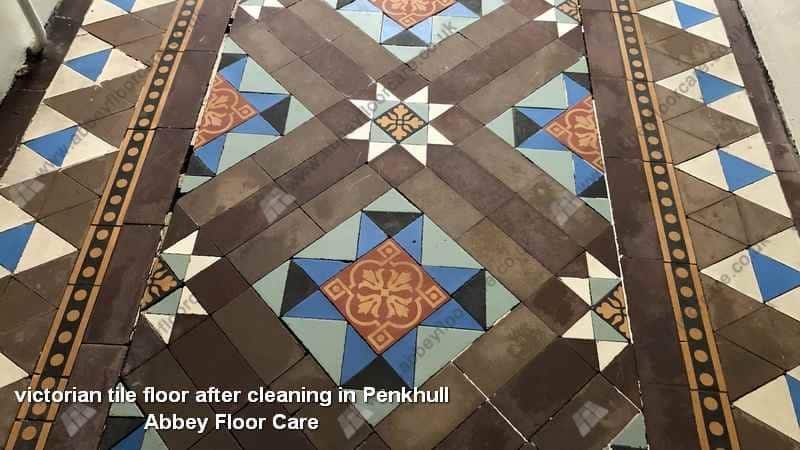
If your restored Victorian hallway looks cleaner but still shows age, that is often exactly the correct outcome for an original period floor. The Penkhull hallway looked significantly improved after restoration, with stronger colour, clearer pattern definition, and a more even matte appearance that still respected the natural signs of age and use.
Colour enhancement came from a breathable impregnating sealer that entered the tile pores, improved protection, and was buffed away from the surface without leaving behind a heavy topical coating. The hallway also became easier to maintain because dirt and residue were no longer binding so aggressively into open contamination sitting across the surface.
Proper maintenance extends the life of Victorian tiles by removing grit before wet mopping, using pH-neutral cleaning products, and resealing at sensible intervals. Steam cleaners are best avoided because heat and moisture can force water into grout lines, cracks, staining, and areas vulnerable to efflorescence. Broader maintenance guidance is covered in the Victorian and Minton tile cleaning hub, which provides wider care advice beyond this Penkhull case study.

More Victorian tile restoration projects showing period hallway floors brought back carefully
Related Victorian tile restoration projects help homeowners compare similar floors without turning this case study into broad generic advice. The Penkhull hallway documents one completed sequence of work: carpet removal, residue discovery, loose tile correction, repeated cleaning, drying, sealing, and final inspection.
Other completed projects also show how original Minton and Victorian floors can recover clarity whilst still retaining their period character. The Burton on Trent Victorian clay tile restoration records another period floor where residue removal, moisture management, and colour recovery shaped the final result. Together, these projects support the same evidence-led principle: restoration should improve the floor dramatically without erasing the history visible within the original surface.
The Penkhull project also reinforces why detailed maintenance guidance belongs within the material hub rather than becoming a separate sales pitch inside the case study itself. The Victorian and Minton tile cleaning hub covers wider topics including residue build-up, moisture behaviour, grout lines, and safe routine care. This Penkhull hallway remains the proof example: a hidden Staffordshire entrance floor was carefully brought back into use and made far easier to maintain.

David Allen — Abbey Floor Care
David Allen of Abbey Floor Care has restored Victorian and encaustic tile floors for over 30 years. In this Penkhull case study, he documented how a carpet-covered hallway with loose areas, dark joints, and trapped residue was corrected while preserving the original period character.
Recent Posts:
We work throughout the country, just some of our work counties:
Copyright © 2026 Abbey Floor Care. Tile And Natural Stone Cleaning Consultants FAQ - Privacy Policy - Terms And Conditions
Abbey Floor Care is a participant in the Amazon Services LLC Associates Programme, an affiliate advertising programme designed to provide a means for websites to earn advertising fees by linking to Amazon.co.uk. As an Amazon Associate, we earn from qualifying purchases.