Victorian Tile Cleaning Revealed? What Dirt Was Hiding
Last Updated on June 1, 2026 by David
Why This Historic Tutbury Floor Looked Tired Despite Remaining Structurally Sound
What The Homeowner Saw On Arrival
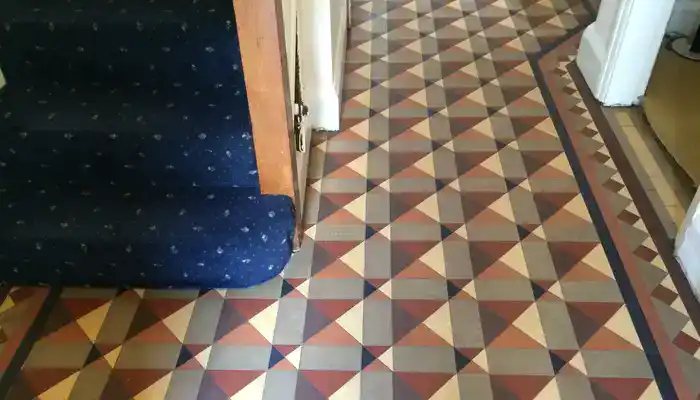
This Tutbury Victorian tile floor looked increasingly flat and lifeless despite remaining structurally sound. The homeowner had reached the stage where routine cleaning no longer seemed to make any difference, and the hallway appeared permanently dull no matter how often it was washed.
The entrance floor was an important feature of the property. Like many period homes across Staffordshire, the hallway retained its original geometric layout, with contrasting colours arranged in a decorative pattern typical of early twentieth-century installations. Much of that visual appeal, however, had gradually disappeared beneath decades of accumulated contamination.
The most noticeable issue was the loss of colour contrast. Areas that should have shown clear distinctions between individual tiles appeared muted and uniform instead. The floor lacked depth, the pattern felt visually compressed, and large sections looked grey rather than displaying their original tones.
Surface dirt alone could not account for the appearance. Earlier cleaning had removed everyday soil, yet the floor continued to look tired. The homeowner explained that freshly cleaned areas often appeared slightly improved whilst damp, only to return to the same dull condition once fully dry.
Traffic lanes through the centre of the hallway were particularly obvious. Decades of footfall had left some areas looking darker than others, creating uneven visual patches that distracted from the original design. The floor appeared neglected despite being regularly maintained.
The History Of The Hallway Floor
The floor had remained in place for approximately eighty years and had survived several changes of ownership. During that time the property experienced the usual cycles of decoration, changing tastes, and different cleaning approaches, all of which left subtle traces on the surface.
Many floors of this age spend periods hidden beneath carpets or other coverings. Whilst this installation had remained largely visible, evidence suggested that a variety of maintenance products had been applied over the years. Those treatments influenced how dirt accumulated and contributed to the increasingly patchy appearance seen by the homeowner.
The geometric design itself remained remarkably intact. Borders were complete, the principal pattern was still clearly legible, and there was no widespread loss of material. This presented a common restoration dilemma. The floor looked significantly older than its true condition warranted.
Original fired clay flooring often ages visually long before it ages structurally. As contamination becomes embedded within the surface and older maintenance products attract airborne dirt, the appearance gradually changes. The result is a floor that seems worn out even though the underlying installation remains largely sound.
The hallway also reflected the realities of a busy family home. Years of wet footwear, tracked-in soil, dust, and everyday household activity had slowly altered the visual character of the surface. Those changes happened so gradually that it became difficult for the homeowner to identify exactly when the decline had begun.
Visible Condition Before Any Treatment
The condition of the floor before cleaning revealed several layers of visual deterioration. Darkened patches interrupted the pattern, colours lacked clarity, and the surface appeared inconsistent across different areas of the hallway.
Some sections looked noticeably darker than neighbouring tiles despite being made from the same materials. Other areas displayed a cloudy appearance that softened the sharpness of the geometric layout. Taken together, these issues created the impression that the floor had reached the end of its useful life.
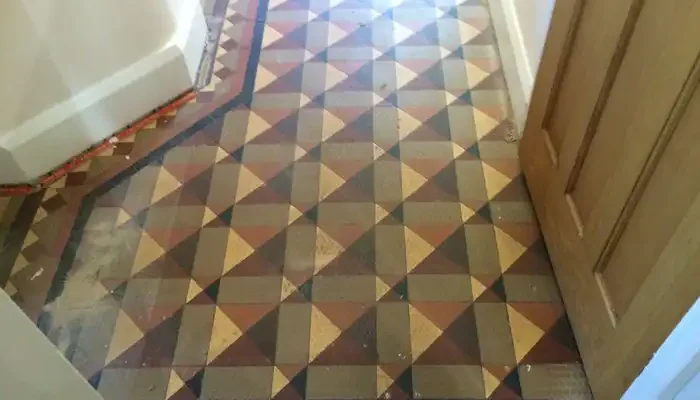
Closer inspection showed that the floor remained stable underfoot. There were no significant areas of movement, no widespread lifting, and no indication that major reconstruction work would be required. The concerns were almost entirely cosmetic rather than structural.
The homeowner’s objective was straightforward. They wanted to know whether the floor could recover its original character without producing an artificial result that felt out of place within a period property. Preserving authenticity mattered as much as improving appearance.
Visual flatness was the defining characteristic of the floor at this stage. Decorative details were still present but difficult to appreciate. The colours remained beneath the contamination, yet they no longer contributed meaningfully to the overall appearance of the hallway.
The project therefore began with a floor that looked considerably older than its actual condition suggested. Before any diagnosis, treatment decisions, or cleaning strategy could be developed, the first task was understanding exactly what the homeowner was seeing and why the floor looked so different from its original state.
Why Dirt Kept Building Up Even Though The Floor Had Been Cleaned Before
Dirt that repeatedly returns after cleaning is usually being held below the visible surface. In this hallway, years of embedded soil, old coating residues, and traces of historic contamination had accumulated within the absorbent clay structure rather than remaining on top where ordinary cleaning could remove them.
Deep residue survives ordinary cleaning methods because contamination becomes trapped within the floor and gradually reappears as the surface dries.
The floor’s ability to absorb moisture had allowed dirt, adhesive residues, and aged surface treatments to settle below the visible face of the tiles. Older permeable construction also meant moisture could move naturally through the floor, carrying contaminants back towards the surface over time. What we often see here is a cycle where the floor appears cleaner initially, only for underlying contamination to become visible again as drying takes place. A similar pattern was identified in this Victorian tile cleaning project in Derby, where apparent cleaning failure was actually caused by deeper contamination remaining within the floor.
Why Multiple Gentle Cleaning Passes Were Safer Than One Aggressive Treatment
Repeatedly applying aggressive cleaning methods to historic Victorian tiles often creates more risk than reward. In Tutbury, the objective was to remove contamination progressively rather than attempting to strip decades of residue in a single operation.
Aggressive cleaning would have prioritised speed. Strong mechanical action, excessive water, or harsh abrasion could have disturbed vulnerable surface areas whilst doing little to manage moisture within the floor structure.
Controlled multi-pass cleaning allowed residues to be softened, loosened, and extracted gradually. Solvent treatment targeted stubborn contamination, whilst repeated cleaning cycles lifted dirt in stages. Dirty cleaning slurry was removed after each phase so contamination left the floor rather than being redistributed across the surface.
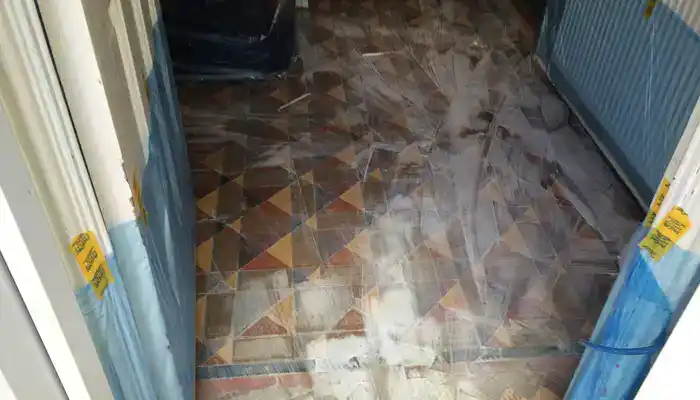
Moisture management guided every decision throughout the process. Removing contamination safely mattered far more than completing the work quickly, particularly on an older floor where excessive water could introduce unnecessary risks.
How The Original Colours Returned Without Making The Floor Look New
Colour recovery on historic Victorian tiles often appears authentic rather than dramatic. Once the accumulated contamination had been removed, the most noticeable change was the return of visual definition across the geometric pattern.
Before cleaning the colours appeared compressed and muted. Decorative contrasts were difficult to distinguish, and much of the pattern blended into a generally dull surface.
After cleaning the original tones became visible again. Borders appeared clearer, colour differences regained definition, and the layout once again contributed to the character of the hallway without looking artificially restored.
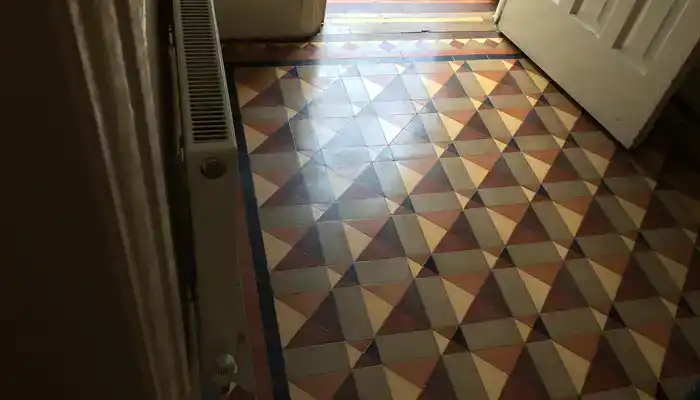
A restored Victorian tile floor shows the original fired matte surface with consistent colour and pattern, whilst a topically sealed surface—where appropriate—adds a slight protective sheen without altering the period character. The completed floor retained its age, history, and natural wear whilst presenting a cleaner, more coherent appearance.
Where To Learn More About Caring For Historic Victorian Tile Floors
Professional Victorian tile care depends on understanding why contamination builds up in the first place. This project demonstrated that apparent wear, colour loss, and persistent dullness often stem from accumulated residues rather than irreversible deterioration.
Historic clay floors also require cleaning methods that respect natural moisture movement. Older installations frequently behave differently from modern floors, which means excessive water, unsuitable coatings, and inappropriate maintenance products can create additional problems instead of solving existing ones.
Long-term success depends on balancing cleanliness, protection, and breathability. Readers who would like broader guidance on maintenance, contamination management, and conservation-focused care can find additional information within the main Victorian tile cleaning resource hub, which explores related projects and maintenance considerations in greater detail.

David Allen — Abbey Floor Care
David Allen has spent more than 30 years restoring victorian tile floors across the UK through Abbey Floor Care, including projects in Tutbury, Staffordshire. This case study documents a real restoration visit where on-site assessment shaped every decision. His work focuses on accurate diagnosis, sympathetic repair and preserving the original character of period flooring.
Recent Posts:
We work throughout the country, just some of our work counties:
Copyright © 2026 Abbey Floor Care. Tile And Natural Stone Cleaning Consultants FAQ - Privacy Policy - Terms And Conditions
Abbey Floor Care is a participant in the Amazon Services LLC Associates Programme, an affiliate advertising programme designed to provide a means for websites to earn advertising fees by linking to Amazon.co.uk. As an Amazon Associate, we earn from qualifying purchases.