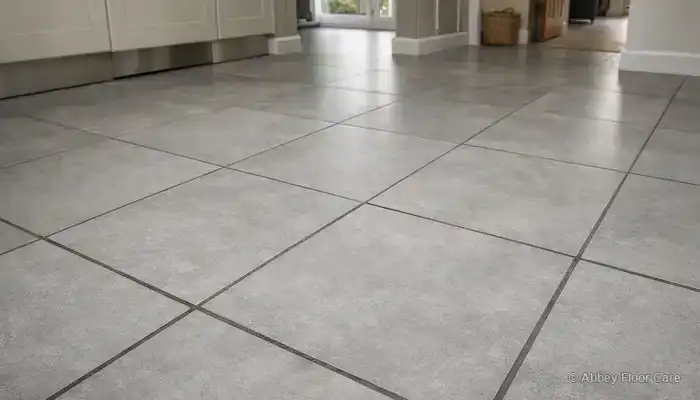
Why Ceramic Tile Flooring Darkens In Busy Areas
Last Updated on September 29, 2026 by David
Choosing between ceramic and porcelain floor tiles can become difficult once dullness, darkening or marks start to appear. The tile face, grout and installation conditions can all create similar-looking issues, but for very different reasons.
Use the sections below to work out what your ceramic tile flooring is showing.
Why ceramic and porcelain floor problems can look alike
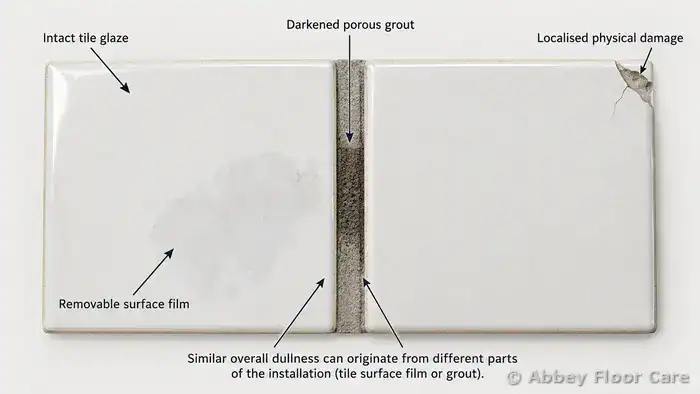
If your ceramic or porcelain floor shows dullness or darkening, compare the tile face and grout under the same lighting before deciding that the whole floor is damaged. A clean-looking tile next to a dark joint can make the installation look generally tired, whilst a mark on the tile face may simply be a characteristic of the finish. An undisturbed area of the same floor usually gives the most reliable visual reference.
The factory-fired tile surface will normally remain stable even when the floor appears uneven in colour or sheen. Ceramic flooring commonly has a hard kiln-fired finish, whilst porcelain combines a dense body with a polished, satin, matt or textured surface finish. So a cloudy appearance does not automatically mean the tile body has changed. Installation residue, hard-water marks and traffic patterns can each alter the way the surface looks.
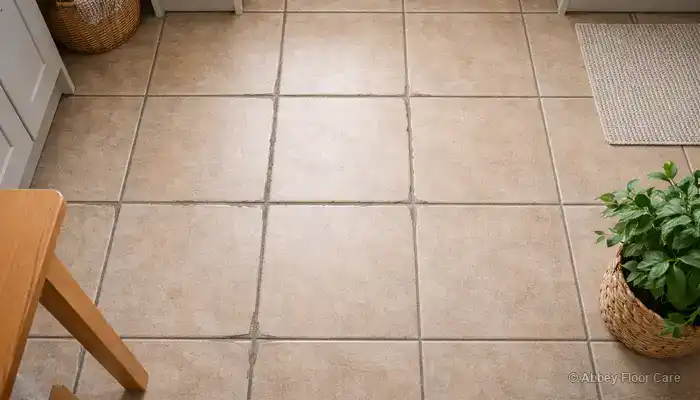
Grout discolouration creates a separate visual issue because the joint can change independently of the surrounding tile. Darkening, patchy colour and a persistent outline around each tile usually point to soil retained in the joint rather than staining within a glazed face. This is particularly common in kitchens, entrances and bathrooms, where moisture, tracked-in soil and household cleaning products repeatedly meet the grout.
Natural glazing variation can also make neighbouring tiles look inconsistent. Ceramic and porcelain ranges may show small differences in tone, sheen or texture because they are manufactured in batches and to differing quality standards. On modern UK large-format rectified porcelain, these changes can be more noticeable because narrow, straight joints create a wide uninterrupted visual field.
Fine crazing in the glaze is another condition to recognise. A hairline network of cracks across the decorative surface can result from thermal expansion mismatch between the glaze and tile body. It allows moisture ingress and dirt trapping, which may produce dark lines. What the homeowner sees may be black dye absorption or a web-like pattern rather than a removable film; that points to a factory glaze defect or later stress, not ordinary surface soil.
More than one of these conditions can be present at once. That is why a floor may have a clear tile face in one area, dark joints elsewhere and fine lines in another location. A mark confined to grout is different from fine glaze crazing. Polymer grout haze is a thin residue film left across otherwise intact tile faces after grouting; homeowners may see it as a broad, cloudy or uneven dullness rather than a change in the tile itself. Correction requires a suitable residue-removal approach, tested first on an inconspicuous area, rather than treating it as permanent tile damage. Readers comparing these appearances can use the ceramic and porcelain tile care guidance to focus the initial diagnosis on where the visible issue sits, rather than assuming every problem belongs to the tile itself.
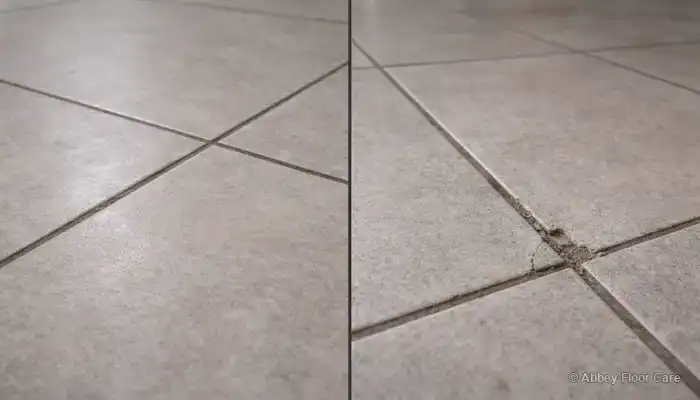
Why textured tile grooves and cementitious grout porosity make some areas hold residue more than others
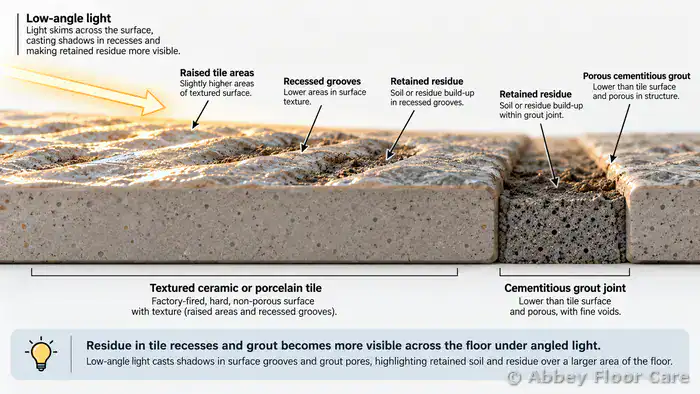
Textured grooves and grout joints retain visible residue in different ways. Looking across the floor at a low angle often makes it clear why one area appears darker than another. Raised tile faces may look clean, whilst recessed grooves hold surface dirt and grout channels remain shaded even after the surrounding face has improved.
Textured tile grooves form sheltered areas where crumbs, grit and cleaning-product film can sit beyond normal mop contact. Anti-slip porcelain in UK wet rooms often has deeper relief to provide surface grip, but that same relief can retain moisture, soil and residue. Matt ceramic can behave similarly, as its non-reflective finish makes small cloudy marks and footprints more obvious.
Porous grout joints provide a separate route for contamination. Their cementitious structure contains capillary voids, allowing material to enter and darken the joint from within, even where the adjacent glazed tile remains non-porous. This is why grout staining can persist beside a tile face that is still sound and water-resistant.
Installation unevenness can make both effects look worse. Tile lippage is a vertical offset between neighbouring tiles that creates height variation and shadowed edges, whilst uneven joints interrupt an otherwise flush surface and may snag a mop. Homeowners may notice retained dirt appearing heavier along a raised edge, as well as snagging during mopping. Cleaning can remove retained material, but it cannot level the tiles; where alignment is poor, correction requires assessment of the installation and mechanical machine impact also becomes a consideration. The ceramic tile floor cleaning service guidance helps separate retained material in surface relief from a tile face that has genuinely changed.
Which finish makes wear easier to notice on factory-fired glaze?
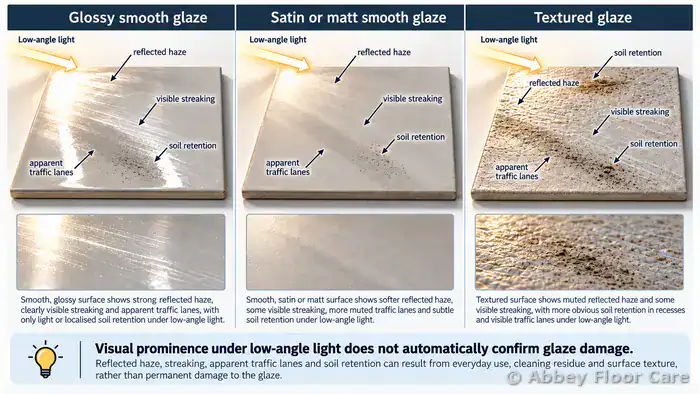
Scrubbing every visible traffic lane can be a mistake if reflected light is being read as glaze damage. View the ceramic tile from several angles before giving the appearance a damage label. If a mark changes as the light moves, it may belong to the finish or a surface film rather than the permanent surface.
Reflective finishes amplify haze, water spots and traffic patterns because light reflects from a consistent plane. A thin residue can therefore appear as a broad dull patch, especially by a doorway or kitchen work triangle. In direct light the mark may look sharply defined; under oblique light, streaking may appear and then disappear as the viewing angle changes.
Satin finishes soften reflection and generally make small variations less noticeable, although uneven residue can still break up the intended appearance. Matt finishes behave differently. They can show dust marks, smudges, footprints and cleaning-product film without a bright reflection to disguise them. Cloudy patches may resemble colour loss even when the factory surface is intact.
Glaze quality variation adds another layer to the assessment. Ceramic tile and porcelain manufactured worldwide can show modest differences in glazing, surface finish and batch tone, so adjacent tiles will not always react to light in exactly the same way. The ceramic tile finish guidance is useful where a homeowner needs to distinguish normal finish behaviour from a true surface defect.
Why residue returns in high-use areas
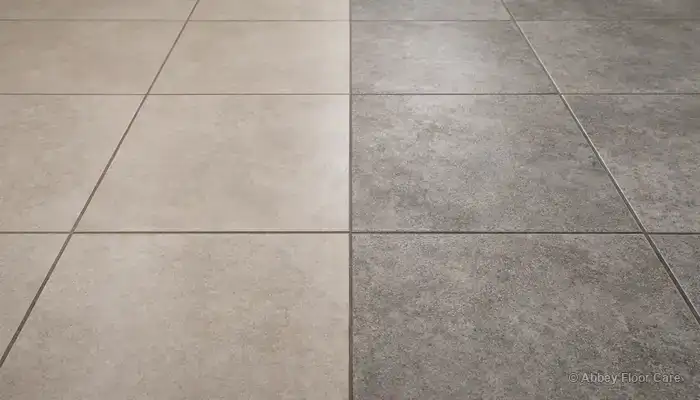
Residue lock-in occurs when soil and cleaning-product residue are held within surface relief or grout rather than sitting as a loose deposit. Homeowners may spot it when a heavily walked area darkens again beside a nearby low-use section; the recurring pattern often follows foot traffic, doorways or kitchen work areas rather than spreading evenly across the tile body. Correction requires targeted cleaning to release and remove the retained material, followed by thorough rinsing, rather than repeated application of more product.
Repeated use presses tracked soil into surface texture and transfers it towards the joints. Damp mopping or wet footwear then redistributes that material, whilst detergent film gives fresh soil something to bond to. The floor can look permanently dirty, but what is visible is often a repeating cycle of redeposition.
Cementitious grout porosity makes the pattern more pronounced. The capillary voids in porous grout can retain organic soil, cooking grease and fine grit even once the tile face looks clear, then reveal or release that contamination again when the area becomes damp. Rapid darkening in a busy zone does not prove that the ceramic tile body has changed.
Hard water can add mineral film to the same cycle, particularly in bathrooms and utility rooms. Mopping water may leave calcium deposits as it evaporates, and tracked soil adheres to that rougher film, making the patch look broader than its original source. Where the surrounding floor remains clear but the same localised residue keeps returning, a professional assessment becomes relevant. Readers can compare that point with the ceramic tile cleaner guidance before repeatedly changing products.
Why the same cleaner gives different results
Different deposits respond differently because they are not the same type of residue. Consistent lighting helps identify whether you are looking at a film, haze or embedded joint discolouration before judging the cleaning result. Organic soil commonly includes grease and biological contamination, whilst mineral films relate to hard water and polymer residue can cling tightly after installation.
Alkaline breakdown targets organic soil through emulsification and degreasing. Controlled acidic dissolution, by contrast, addresses mineral films, calcium deposits and certain cement-based haze. Agitation separates loosened material from grooves and grout, then extraction removes the suspended slurry rather than allowing it to settle again. That is why one household detergent may improve one patch yet leave another unchanged.
Polymer grout haze is not a single-residue problem.
Polymer bonding can leave a tenacious film over the tile face, which is why the two-stage polymer haze protocol separates polymer dissolution from the remaining cementitious residue. The alkaline first stage addresses the polymer component. The acidic second stage deals with mineral residue. Calling both stages simply “cleaning” misses why a single chemistry may not work.
A wet vacuum or slurry extractor matters because contamination must be controlled after agitation. Without slurry extraction, dissolved soil and loosened grout residue can settle back into capillary voids and textured grooves. Readers with recently installed UK flooring can use the deep cleaning ceramic tile guidance to understand the difference between a residue category and a routine maintenance mark.
When added protection is not the answer
Adding protection to the wrong surface leaves the underlying issue untouched. Compare the sealed-looking factory-fired tile face with visibly porous grout joints. A glazed ceramic surface is normally vitreous, kiln-fired and impervious, whereas cementitious grout remains the absorbent part of the installation.
An impregnating grout sealer gives penetrating protection by forming an internal barrier that reduces absorption in cleaned grout. It is suited to sound joints needing preventative help against future soil and moisture, but it will not turn a contaminated joint into a clean one. Its water-repellent effect sits within the porous structure, rather than forming a shiny coating across the tile.
Protection cannot correct material that has failed, become contaminated or is structurally unsound. Cracked joints, missing grout, mould-colonised sealant and residue beneath an existing coating need diagnosis of the underlying condition before a barrier is considered. Grout protection is intended to reduce future absorption in sound material, not to conceal existing defects.
Glazed tile faces generally do not need sealing. Applying a product can leave surface residue that attracts soil or creates a tacky appearance. Textured or worn areas may need separate assessment because grooves and scratches can retain contamination mechanically, but that does not make routine sealing suitable for every ceramic tile flooring installation. The ceramic tile sealing guidance explains this boundary without presenting protection as a cure.
When a mark is not just residue
If your ceramic or porcelain floor keeps showing the same mark after the surrounding area looks clear, inspect where it sits before assuming more routine cleaning will remove it. A mark confined to a grout joint, silicone bead or tile face follows a different decision path from residue spread broadly across an otherwise intact installation.
Cracked or missing grout is a physical joint defect. It may show as an open line, a recessed gap or a dark edge that catches soil. Re-grouting addresses this condition because grout removal, joint cleaning and new grout application restore the missing structure. Surface cleaning alone cannot rebuild a joint.
Mould-colonised silicone has a recognisable pattern: dark growth follows the flexible sealant bead around a bath, shower tray or floor-to-wall junction. Silicone replacement is the relevant correction after silicone removal and joint cleaning, since a spray cleaner cannot renew a waterproof barrier that mould has penetrated.
Glaze crazing failure consists of fine surface fissures forming a hairline network rather than a loose deposit. Homeowners may notice dirt trapping, black dye absorption or moisture-related dark lines within that pattern. It needs material assessment because routine care cannot restore a cracked decorative layer.
Persistent haze over otherwise intact tiles can still point to installation residue, whilst isolated marks may indicate glaze damage, metal transfer or a localised joint issue. UK bathrooms, wet rooms and kitchens bring different moisture and traffic conditions, so the mark’s location and persistence matter more than colour alone. The ceramic tile repair contractor guidance is the appropriate route where physical damage or failed joints remain visible.
What to expect as ceramic tile flooring ages
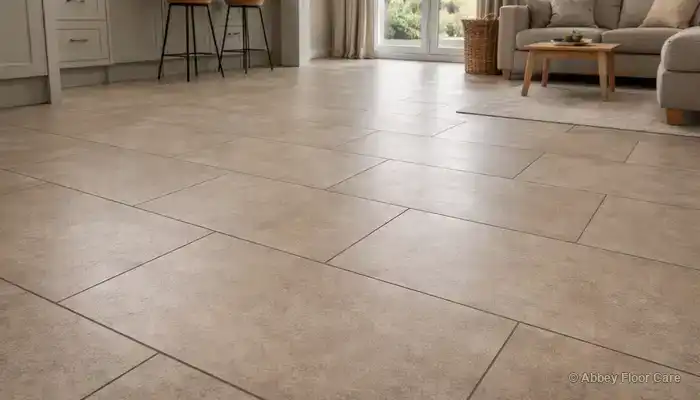
Judge ageing in ceramic flooring by comparing tile faces, grout joints and main traffic routes over time. Do not assume that every change reflects wear in the factory glaze. A stable glazed face should remain broadly consistent, whilst joints, textured areas and traffic lanes generally show the first visible changes.
Routine care works best as a grout-first system. A pH-neutral tile cleaner maintains pH balance with mild surfactants, removes daily soil without leaving residue and avoids the etching risk associated with unsuitable chemistry. Good ongoing maintenance removes loose grit before damp mopping, reduces redeposition and helps the floor stay cleaner for longer. Harsh bleach, strongly acidic supermarket products and abrasive pads should be avoided, as they can degrade grout colour or scratch the glazed surface.
Protection becomes relevant when cleaned grout starts absorbing soil again, not merely because the tile is older. An impregnating grout sealer can reduce absorption through an invisible internal barrier where the joint remains sound. Textured tile areas need watching for renewed soil retention, rather than automatic sealing.
A practical ageing check looks at the tile face for haze, grout for darkening, main walkways for recurring traffic patterns and wet-room joints for moisture-related change. It should also take account of large-format rectified layouts, anti-slip relief and non-reflective matt finishes, because each makes residue and wear look different. Readers can review ongoing ceramic floor care where routine cleaning still restores the appearance and the condition remains stable.
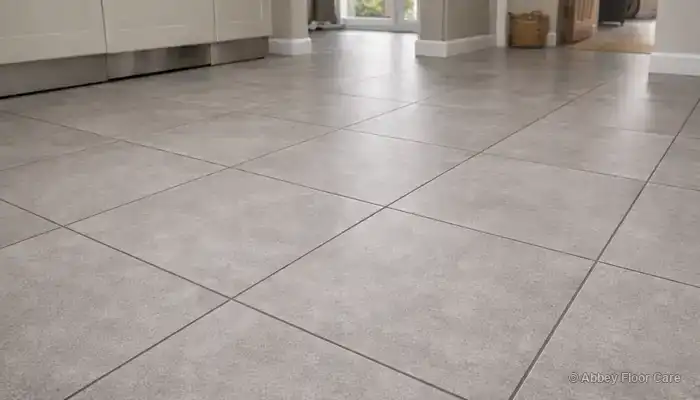
How to tell when routine care has reached its limit
Routine cleaning should not continue indefinitely where a nearby clean area gives you a clear comparison. Persistence and recurrence matter more than the initial darkness. A temporary mark that clears and stays clear belongs to routine care; a localised condition that returns quickly needs closer assessment.
- If tile faces and grout clear together and remain consistent, routine pH-neutral care is still appropriate.
- If residue returns quickly in a traffic path, compare the joint, grooves and surrounding tile face for retention.
- If haze remains once the surrounding surface is clean, treat it as a separate residue category rather than adding stronger household detergent.
- If grout is cracked or missing, or silicone remains mould-colonised, move away from routine care and towards professional assessment.
Persistent glaze lines, damaged joints and recurring moisture-related darkening also move the decision away from repeated mopping. A professional assessment identifies whether the visible condition relates to residue, grout renovation, physical repair or a surface-finish limitation before any treatment category is selected.
Where to go next for each ceramic flooring problem
The next ceramic flooring guide should match what remains visible once the condition has been identified. A stable tile face with temporary soil points towards routine maintenance, whilst polymer haze, mineral film or installation residue needs residue-focused guidance rather than general floor care.
Grout darkening, cracked joints and mould-colonised silicone belong to a grout or joint pathway, because those materials change independently of the tile. Physical chips, glaze fissures and persistent marks limited to the tile face require escalation, especially where the surface no longer behaves like an intact factory finish.
Readers who need the wider comparison can return to the ceramic and porcelain floors hub, which connects ceramic tile flooring behaviour with care, residue recovery, grout-related conditions and repair decisions. The ceramic tile flooring selection guidance also helps where the question relates to a new installation rather than an existing mark.
Correct diagnosis avoids unnecessary changes to a sound tile face. Professional restoration can improve the floor’s appearance and, where the installation allows, make it easier to clean and maintain by dealing with the component that is actually retaining the problem.

David Allen — Abbey Floor Care
David Allen has more than 30 years of experience assessing ceramic and porcelain flooring across the UK through Abbey Floor Care. His work centres on separating factory-finished tile surfaces from grout, residue and installation-related conditions, so homeowners can choose the right care or restoration route.
Recent Posts:
We work throughout the country, just some of our work counties:
Copyright © 2026 Abbey Floor Care. Tile And Natural Stone Cleaning Consultants FAQ - Privacy Policy - Terms And Conditions
Abbey Floor Care is a participant in the Amazon Services LLC Associates Programme, an affiliate advertising programme designed to provide a means for websites to earn advertising fees by linking to Amazon.co.uk. As an Amazon Associate, we earn from qualifying purchases.