Victorian Clay Tiles Cleaning And Sealing Project In Blyth Northumberland
Last Updated on May 5, 2026 by David
Why this Blyth hallway floor stayed dull and patchy no matter how it was cleaned
Initial Condition Assessment
The Blyth hallway floor looked tired because previous cleaning never reached the residue held within the clay body. This wasn’t loose dirt sitting on the surface; old waxes, softened coatings, and traffic grime had settled into the tile itself, muting the colours across the main walkway. That distinction matters. Victorian and Edwardian hallway floors in UK period homes often sit on older permeable sub-floors, where water, residues, and maintenance products behave very differently from modern sealed installations.
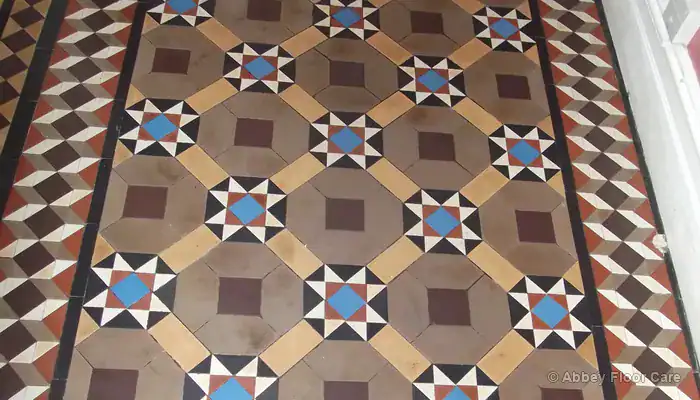
The original floor was a Victorian clay geometric tile scheme, often described as Minton-style due to its patterned layout. The red, buff, and darker tiles still had plenty of character, but their natural finish was buried under layers of residue that caught light unevenly. The patchiness was most obvious where foot traffic had repeatedly introduced grit, damp soil, and cleaning residues over many years.
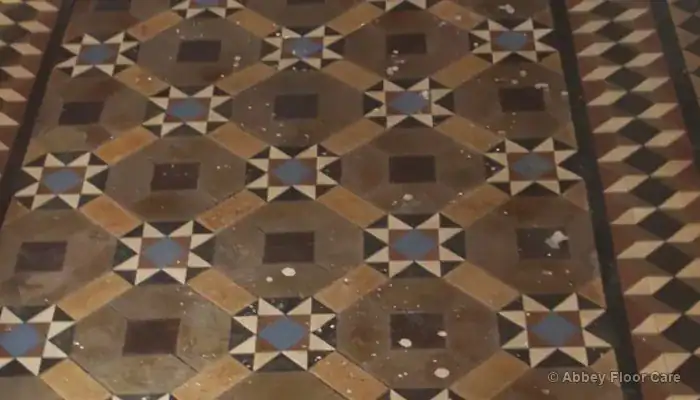
The before image showed paint splashes, dull patches, and uneven colour rather than a single identifiable stain. That changes the approach. A single stain can often be treated locally, but widespread residue means the whole cleaning decision has to account for the tile face, old coatings, the bedding layer, and how the floor responds to moisture. Similar patterns appear in the Victorian clay tile cleaning project in Windsor, where clay absorption and residue build-up dictated the method. Comparing projects like this helps separate genuine floor behaviour from unrelated search noise.
The Problem Identified
The main issue was residue locked into a porous historic clay surface. The tile body had absorbed soil and softened maintenance products, while the surface carried old sealers and wax build-up that ordinary mopping could only smear around. The result is familiar: a floor that still looks dirty immediately after cleaning because the contamination sits within the working surface, not just on top.
Tile porosity explains why the hallway held onto grime so stubbornly. The unglazed clay allows cleaning products, soil, and rinse water to move into fine pores, especially where repeated wet cleaning has taken place without proper extraction. That’s why stronger supermarket cleaners rarely solve it. They tend to add to the problem.
The historic tile fire skin also shaped the cleaning decision. The thin surface layer, vulnerable edges, and clay inlays all need protection from abrasion. Aggressive pads or powders can scratch the surface, accelerate wear, and damage intricate patterns. On a floor like this, conservation-led cleaning means removing residue without overworking the original fired material.
Old residue must be lifted, not scrubbed deeper into historic clay.
Wax build-up played a clear part in the dull film. These coatings soften under a suitable remover, but that’s only half the job. They still require controlled scrubbing, careful water use, and proper extraction to ensure the residue is actually removed rather than redistributed. That uneven removal is what creates the patchy look.
Acrylic sealer residue was also considered. These sealers, along with waxes, often leave behind contaminated surface layers that respond poorly to casual cleaning. The key point here is simple: a surface coating that has become contaminated needs to be stripped before the floor can be judged properly. Adding more sealer on top only traps the problem.
Technical Context
Victorian tile vitrification level influenced the cleaning specification. The type of clay, its porosity, surface condition, and overall strength all determine whether a chemical or mechanical approach is appropriate. Some tiles resist moisture; others readily absorb it and demand tight control throughout the process.
Encaustic clay inlays made abrasion control particularly important. These inlays form durable geometric patterns within the tile, but they are not immune to damage. Excessive abrasion can weaken or remove the historic surface. That’s why this Blyth project remained firmly within controlled cleaning rather than drifting into aggressive restoration.
Abrasive wear was avoided by limiting pressure and using the least aggressive method that would still remove the coating. Treated like modern ceramic, these floors can be permanently altered. And once the surface is flattened or the pattern dulled, it cannot be reversed.
Moisture control was another constraint. Too much water drives moisture into the tiles and subfloor, increasing the risk of lifting, salt movement, and slow drying. This is especially relevant where no damp-proof membrane is present. Similar moisture behaviour is explored in the high-gloss sealer risk guide for Victorian hallway tiles, which becomes relevant when cleaning decisions start to overlap with sealing choices.
Salt efflorescence was also checked. Damp conditions can draw dissolved minerals to the surface, leaving white or cloudy deposits as moisture evaporates. What homeowners see is a recurring pale residue. The correction isn’t aggressive cleaning; it’s moisture-aware treatment, controlled rinsing, and breathable protection once the floor is dry.
Cleaning Objective
The aim was to produce a cleaner, more even hallway without pretending that wear and age could be washed away. Victorian floors carry their history, and the goal is to remove contamination while preserving that character. The target finish was a uniform matte appearance with clearer pattern definition.
Low-moisture gel cleaning principles shaped the approach. Excess liquid can move contaminants deeper into the structure, so the process focused on controlled dwell time and extraction rather than saturation. Rinsing was still necessary, but unnecessary soaking was avoided.
Ongoing maintenance then becomes straightforward. pH-neutral cleaning, removing grit before mopping, and resealing at the correct interval all help slow re-soiling. Steam cleaning, by contrast, tends to over-wet porous clay and can trigger salt movement or structural issues. The broader Victorian and Minton tile cleaning hub sets out that wider context for homeowners deciding their next step.
Why the marks, paint spots, and patchy finish would not wash off properly
If your Victorian tiles show paint spots, cloudy patches, or uneven colour after mopping, the cleaning isn’t reaching the residue that’s locked in. On this Blyth floor, paint marks, waxes, old sealers, and ingrained dirt had formed a layer that needed softening, controlled agitation, and extraction. More water alone just moved it around.
The patchiness came from different residues reacting differently across the floor. Paint and adhesive contamination behave differently to wax or acrylic coatings, and each needs a specific approach. A proper reset clean has to remove the old coating first before the true tile colour can be assessed.
Porosity made the issue more persistent. Once contaminants and rinse water enter the clay, they can reappear as the floor dries. That’s why this was treated as controlled cleaning, not a cosmetic fix or a restoration claim.
How controlled cleaning removed the build-up without damaging the original tile surface
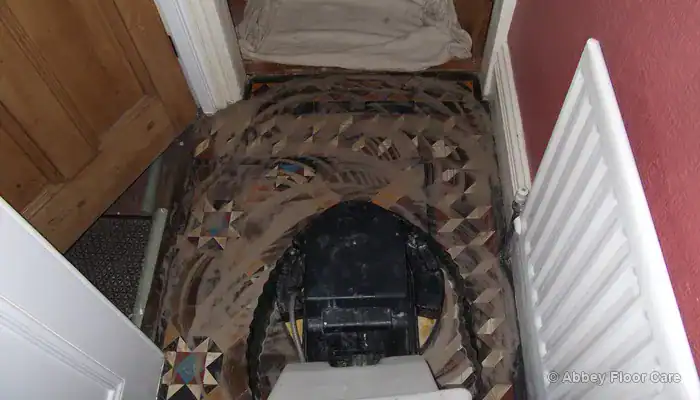
Aggressive scrubbing often damages the surface before it solves the problem. Here, a controlled alkaline cleaning solution was used to soften waxes, acrylic residues, and embedded grime without relying on harsh abrasion. Edges and tighter areas were finished by hand, where mechanical pressure can easily cause damage.
The resulting slurry was then removed using wet vacuum extraction. That step is critical. Without it, the loosened contamination simply dries back into the pores. A similar process appears in the soiled Victorian tile floor cleaning case study in Farnham, where extraction was central to achieving a stable result.
What changed once the residue was fully lifted and the surface evened out
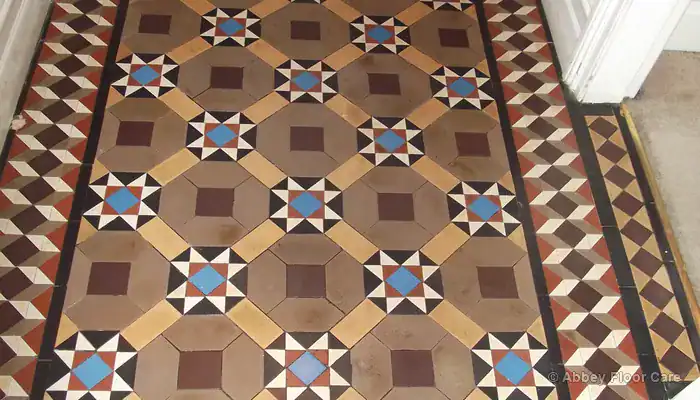
The floor looked more even because the dull surface layer had been removed without disturbing the underlying material. Pattern definition improved, the finish became more consistent, and the hallway regained clarity across the main traffic route. It looked right again, not artificially new.
Before cleaning, the encaustic tiles and clay inlays were masked by cloudy residue and patchy coatings. After cleaning, the original pattern re-emerged with a cleaner, more natural finish because the contamination had been lifted, not sealed in.
A breathable sealer was applied as a final step once the floor had fully dried. The aim was protection without trapping moisture. Comparable outcomes can be seen in the Victorian tiles hallway cleaning project in Darlington, where cleaning and protection follow the same practical sequence.
Where to go next if your Victorian tiles still look dirty after cleaning
Problems like this need to be placed back into the wider material context before deciding what comes next. Some floors need nothing more than residue removal and sensible protection. Others involve loose tiles, missing sections, cement contamination, or salt activity that sit outside a simple cleaning scope. The Victorian tiles cleaning and care hub maps those decisions without drifting away from the evidence shown here.
Tile porosity remains the first practical question. If the floor is still dull after repeated cleaning, the issue is usually below the surface. More water rarely helps. The Victorian clay tile floor cleaning project in Tutbury shows a similar pattern, where embedded residue controlled the outcome. Proper maintenance then protects the result by limiting grit and avoiding over-wetting.

David Allen — Abbey Floor Care
David Allen has cleaned and restored Victorian and encaustic clay tile floors across the UK for over 30 years through Abbey Floor Care. This Blyth, Northumberland case study documents how paint marks, old residue, and patchy coating build-up were corrected with controlled cleaning and moisture-aware protection.
Recent Posts:
We work throughout the country, just some of our work counties:
Copyright © 2025 Abbey Floor Care. Tile And Natural Stone Cleaning Consultants FAQ - Privacy Policy - Terms And Conditions
Abbey Floor Care is a participant in the Amazon Services LLC Associates Programme, an affiliate advertising programme designed to provide a means for websites to earn advertising fees by linking to Amazon.co.uk. As an Amazon Associate, we earn from qualifying purchases.