
Liskeard Travertine Restoration For Soil-Stained Floors
Last Updated on July 28, 2026 by David
Soiling had spread across the travertine tiles, grout and filler, leaving the whole floor in need of specialist attention. The work first removed the ingrained contamination, then lightly refined the stone and sealed it to recover the natural mid-sheen already present in the adjoining rooms.
Liskeard travertine restoration removes ingrained soil from the tiles, grout and filler before worn areas are lightly honed and sealed. On this Menheniot floor, routine mopping could not reach contamination held in the stone’s recessed cavities, so professional agitation and hot-water extraction were needed before the existing mid-sheen could be matched.
The Menheniot project below records how the specialists cleaned, honed and sealed this travertine floor.
Why Deep Dirt Had Left the Tiles, Grout and Filler Visibly Soiled
Photographs of this Menheniot floor near Liskeard showed widespread contamination across the travertine tiles, grout and filled areas. The initial quotation covered cleaning the floor, replacing lost grout and sealing the stone.
The travertine continued from the kitchen into the adjoining dining room, hallway and lounge. Because visible soil affected the tile faces, grout lines and existing filler throughout the worked surface, the floor needed more than isolated treatment or routine mopping.
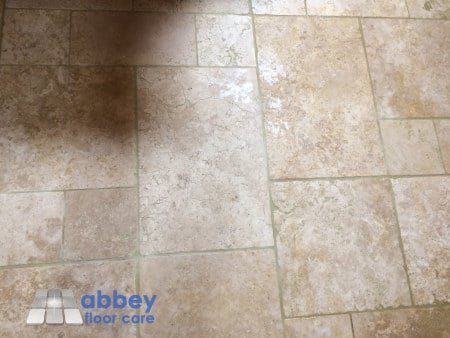
The photographs also confirmed that this was a high-quality filled travertine floor whose appearance had been obscured by ingrained dirt. The specialists first needed to remove the contamination before they could judge whether the remaining dullness belonged to the finish rather than soil still sitting on or within the surface.
The photograph below records the floor after deep cleaning. With the tiles, grout and filler clean, dull and uneven areas remained visible, confirming that the compromised finish still required controlled correction before sealing.
Removing the Soil Before Matching the Existing Mid-Sheen
Cleaning sand and rotary agitation helped lift ingrained soil from the travertine tiles, grout and filler.
Travertine forms when mineral-rich spring deposits release carbon dioxide, leaving natural cavities through the stone body beneath a thin surface cap. These structural holes trap dirt mechanically rather than absorbing it into the dense calcite around them. And because spring-deposited limestone contains voids and areas of differing density, open holes must be stabilised and filled before honing can create an even surface.
Mopping passes over the tile face, whereas extraction draws released grime out of the recessed holes.
Professional-grade alkaline chemistry loosened the organic grime through a controlled application. A low-speed rotary machine and soft nylon brush then provided gentle agitation without scratching the stone plane. Smooth cleaning sand was worked into the smaller pits and crevices, helping the brush disturb compacted material around the edges of the voids. Crucially, this method delivered deep soil removal without aggressively cutting through the remaining surface cap.
The floor was then pressure-rinsed with hot water, while the spent solution and remaining soil were captured as the work progressed.
Once the ingrained material had gone, the technicians could distinguish dullness caused by wear from dullness caused by remaining dirt. A detailed account of why ordinary mopping misses recessed grime appears in the guide to cleaning trapped soil from travertine floors. That distinction matters because stronger domestic products often leave more residue without providing the extraction needed to remove it.
Controlled surface refinement dealt with the remaining dullness once cleaning had revealed the true condition of the tiles. Technicians began with 800-grit diamond pads because the floor did not require heavy grinding or unnecessary surface reduction. The first pass improved clarity, although it left slightly less sheen than the adjoining dining room, hallway and lounge.
A light 1500-grit polish then brought the finish much closer to the existing natural mid-sheen across the adjoining dining room, hallway and lounge.
On honed and filled travertine, the worked face of the tile presents as a smooth satin plane. Tumbled or unfilled stone exposes more of its natural openings. Whether those holes remain open or are filled, they usually appear as matt details beside the surrounding finish.
Calcium-carbonate composition governed every chemical choice. Contact with bathroom acids, descalers, wine or fruit juice attacks the calcite, leaving rough pale marks, cloudy patches and dullness that remains after cleaning. Ordinary cleaning cannot reverse that chemical dissolution. Mechanical correction must remove the altered surface instead, while the broader causes of staining and dullness are covered in professional travertine floor cleaning guidance. Both the cleaning and honing methods were therefore selected to suit the calcium-carbonate composition of the stone.
The specialists finally chose an impregnating sealer to protect the travertine without changing its natural appearance or the matched mid-sheen.
The completed process combined deep cleaning, hot-water extraction, controlled honing and impregnating sealing. The result was a clean floor with a natural mid-sheen. Sealer selection still depends on the finish and the homeowner’s maintenance expectations, as the guide to choosing a travertine sealer explains.
From Ingrained Grime to a Consistent Natural Mid-Sheen
Once the ingrained contamination had been removed, the specialists could see which dull areas were caused by wear rather than remaining soil.
Before the work, visible grime affected the tiles, grout and existing filler.
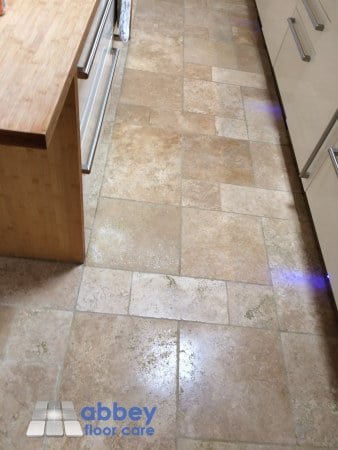
Controlled honing corrected the uneven areas, and a light polish brought the kitchen closer to the balanced mid-sheen already present in the adjoining dining room, hallway and lounge.
Low-angle light should no longer pick out abrupt changes across the worked surface. The stone’s surviving pits and natural openings may still be visible, but at Menheniot they appeared as subdued matt details within the satin finish.
Once completed, the clean travertine and matched natural mid-sheen continued consistently from the kitchen into the adjoining rooms. The impregnating sealer protected the stone without altering its appearance.
For future maintenance, the specialists recommended suitable microfibre cleaning equipment and LTP Floor Shine. The image below records the floor after honing and sealing.
Keeping Deep Dirt and Stains From Returning During Routine Care
After cleaning, honing and sealing, routine care should remove loose contamination without damaging the calcite surface or allowing excess solution to collect in the grout and natural pits. The specialists also recommended protective wax near the cooker and sink, where spills are more likely.
Acidic cleaners must be kept away from travertine because they can dissolve the stone surface. Bathroom descalers, vinegar and similar products may leave pale, rough marks that rinsing will not remove. UK hard-water deposits therefore need stone-safe mechanical treatment rather than an acidic limescale cleaner.
Regular maintenance should begin with dry vacuuming to collect abrasive grit. The floor can then be cleaned with a well-wrung microfibre mop and an acid-free, pH-neutral stone cleaner.
The cleaning solution should remain light enough for the mop to collect contamination rather than flood the pits, grout lines and repaired cavities.
If grime remains trapped below the tile face, stronger domestic products are unlikely to solve the problem. They may leave additional residue, while dullness caused by surface wear will remain until the stone is mechanically corrected.
For routine care, the specialists recommended microfibre equipment and LTP Floor Shine. Further practical advice appears within Abbey Floor Care’s travertine care, cleaning and restoration guide.

David Allen — Abbey Floor Care
On this Menheniot case study near Liskeard, the travertine floor was professionally cleaned, lightly honed and protected with an impregnating sealer.
Recent Posts:
We work throughout the country, just some of our work counties:
Copyright © 2025 Abbey Floor Care. Tile And Natural Stone Cleaning Consultants FAQ - Privacy Policy - Terms And Conditions
Abbey Floor Care is a participant in the Amazon Services LLC Associates Programme, an affiliate advertising programme designed to provide a means for websites to earn advertising fees by linking to Amazon.co.uk. As an Amazon Associate, we earn from qualifying purchases.