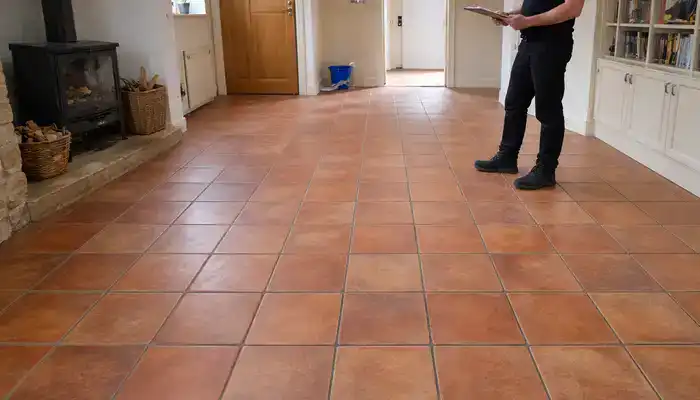
Terracotta Floor Polishing Services for Dundee Homes
Last Updated on January 29, 2026 by David
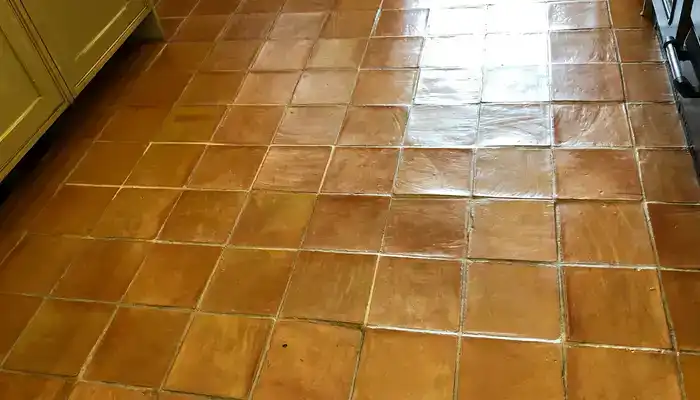
Many homeowners come to us after years of doing their best to care for a terracotta floor that now looks dull, sticky, patchy, or permanently dirty. You may notice darkened grout, uneven colour, or a surface that never quite feels clean, no matter how often it’s mopped. In older Dundee homes, these symptoms are rarely caused by neglect. They are usually the result of well-intended maintenance choices that no longer suit the floor’s condition.
Key Takeaways
- Most tired-looking terracotta floors are affected by old coatings and trapped soil rather than surface damage.
- Polishing terracotta is about careful preparation and control, not aggressive abrasion.
- Complete removal of old waxes and sealers is essential before any refinement work.
- Drying time plays a major role in achieving even colour and a stable finish.
- Long-term success depends on choosing a breathable finish and properly maintaining it.
The Condition We Commonly Find With Older Terracotta Floors
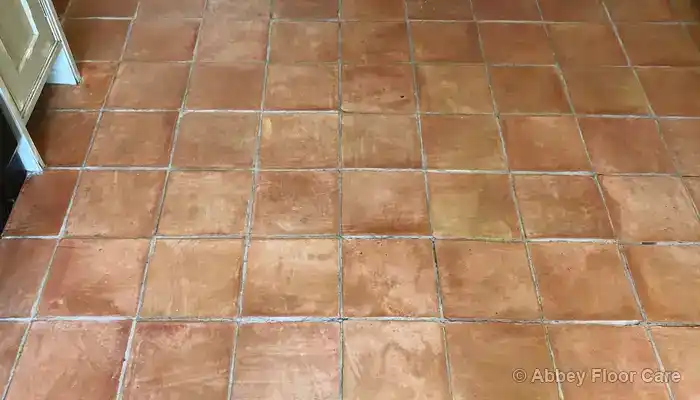
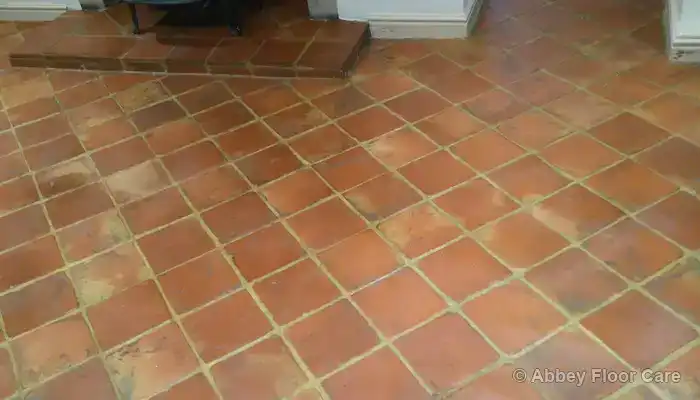
In many Dundee properties, we find floors that have been waxed or sealed repeatedly over decades, creating a heavy wax buildup that traps soil rather than protecting the surface. This often leaves the tiles looking darker in patches, with a greasy feel underfoot.
Because terracotta is so absorbent, once coatings begin to fail, the tile’s natural porosity allows moisture, oils, and dirt to sink deep into the surface. At that point, routine cleaning only spreads contamination rather than removing it.
We also see grout joints that appear permanently blackened, not because they are structurally damaged, but because contamination has settled into the surrounding open clay matrix. It’s important to recognise that this is a coating and contamination issue, not a sign that the tiles themselves are ruined.
What to do next: stop adding new cleaners or sealers until the true cause of the problem is properly identified.
Why Polishing Terracotta Is About Preparation, Not Abrasion
Unlike harder stone, terracotta cannot be treated with grinding or aggressive pads. The goal of polishing in Dundee homes is to restore clarity after decontamination, not to remove material from the Terracotta surface.
The most important stage is what professionals often call The purge — the complete stripping and removal of old waxes, polymers, and embedded soil. Without this step, any attempt to improve appearance simply seals problems back into the floor.
There are clear limits here. Polishing cannot erase every historic mark or make a handmade tile perfectly uniform. Terracotta floors develop character over time, and responsible restoration focuses on stability and cleanliness rather than artificial perfection.
What to do next: understand that safe results depend more on preparation and drying than on how shiny the floor looks on day one.
How a Professional Terracotta Polishing Service Works
A proper service in Dundee begins with controlled cleaning to remove residues without damaging the tile body. This stage prepares the floor so that moisture can escape rather than become trapped, preventing moisture entrapment.
After cleaning, the floor must be allowed to dry fully. Respecting the correct drying protocol is essential to prevent patchy colour and uneven absorption when sealing begins.
Once dry, the surface can be gently refined and protected using a system chosen for the home’s needs. Options may include a penetrating finish, such as an impregnating sealer or a light surface film, for easier maintenance.
This is also where experience matters. We regularly see cases where the over-application of a topical sealer caused stickiness and rapid re-soiling because the floor was never properly cleaned or dried beforehand.
What to do next: choose a service that explains each stage clearly and sets sensible boundaries around what polishing can achieve.
What Changed After Cleaning, Polishing, and Sealing
Once contamination is removed, most Dundee floors regain warmth and clarity without needing heavy intervention. The natural colour becomes more even as the open clay matrix is no longer masked by failing coatings.
Depending on the chosen finish, colour may be left natural or subtly enriched using an enhancing impregnator. This approach deepens tone without creating a surface film that can scratch or peel.
It’s important to remember that any finish applied to terracotta is sacrificial. It is designed to take wear so the tile beneath does not, which means future maintenance is expected and planned for.
What to do next: focus on how the floor feels and cleans, not just how it looks immediately after work is completed.
Ongoing Care, Finish Lifespan, and Sensible Expectations
After restoration, maintenance becomes simpler but still matters. Using gentle methods helps preserve the breathable sealer and slows down the return of embedded soil.
No system lasts forever. In busy Dundee households, wear will show first in traffic areas as sealers gradually thin. This is normal behaviour linked to the floor’s natural porosity, not a failure of the original work.
There are limits to what can be predicted. Drying times, colour response, and wear patterns vary between homes, and responsible professionals avoid promising exact lifespans or permanent outcomes.
What to do next: plan periodic reviews rather than waiting until the floor looks unmanageable again.
When to Seek Specialist Help With Terracotta Floors
If cleaning leaves the floor stickier, darker, or harder to maintain, it is usually a sign that coatings are failing and the wax build-up needs professional removal.
Likewise, if sealers have yellowed or gone cloudy, adding more product will not help. At that stage, expert assessment is needed to prevent further moisture entrapment and deterioration.
If you want to understand what your terracotta floor in Dundee realistically needs, speak with a terracotta specialist who can explain options calmly and safely.
About the Author
David Allen is a natural stone and tile restoration specialist with over 30 years of hands-on experience working in homes across the UK. His work focuses on restoring and protecting traditional floors using safe, proven methods and clear homeowner guidance, helping people care for their surfaces with confidence.
9 Hazel Avenue
Lenzie
Glasgow
G66 4RR
07533-873-476
Copyright © Abbey Floor Care.
We are proud to be your local stone floor cleaning, polishing, and restoration specialists for homes and commercial properties in Central Scotland.
With years of experience working with all types of stone floors, our friendly and professional stone floor cleaning services can’t be beaten on price or service.
FAQ - Privacy Policy - Terms And Conditions
Abbey Floor Care is a participant in the Amazon Services LLC Associates Programme, an affiliate advertising programme designed to provide a means for websites to earn advertising fees by linking to Amazon.co.uk. As an Amazon Associate, we earn from qualifying purchases.