Travertine Sealing Ashbourne – Does Your Travertine Look This Good?
Last Updated on February 3, 2026 by David
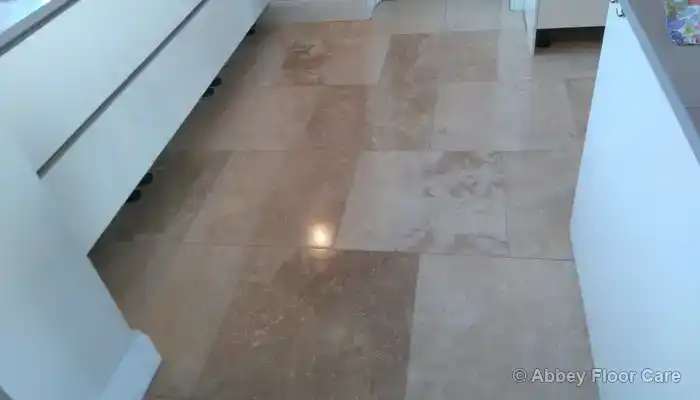
It’s unsettling when a travertine floor that once looked even and smooth starts to show wear in very specific areas. The stone itself hasn’t suddenly failed, but where foot traffic is concentrated — especially around kitchen units — the protective surface can gradually thin and lose its finish.
Travertine Sealing Project – Ashbourne, Derbyshire
This floor was originally restored just over four years before this visit. Over time, repeated daily use around the kitchen had worn through the surface sealer, leaving those areas duller and less even than the rest of the room. The underlying stone was still sound, but the loss of protection meant dirt was holding more easily, and the surface no longer felt as smooth underfoot.
The visible wear had also slightly softened the surface finish, which is common once a travertine sealer has reached the end of its working life in high-use areas.
Stage 1 – Cleaning and Surface Refinement
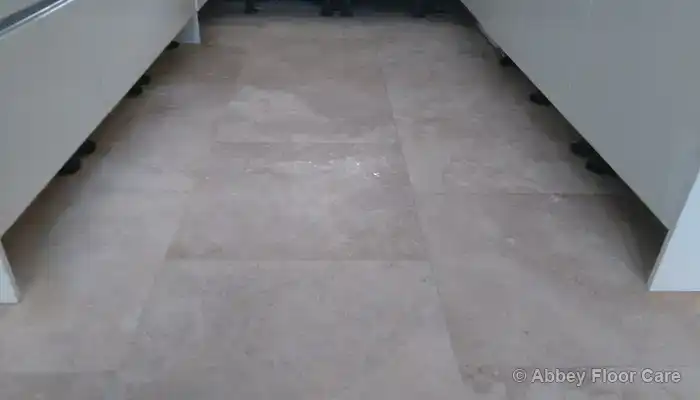
Before any work began, protective sheeting was laid from the entrance through to the work area, and surrounding walls, kitchen units, and adjoining spaces were carefully covered. This ensured that cleaning residues and moisture were contained entirely within the working zone.
The floor was then deep-cleaned using low-speed rotary equipment and a fine honing powder. This allowed the ingrained soil to be removed from both the tile surface and the grout lines without breaking through the stone’s delicate surface layer.
After thorough rinsing, the floor was lightly honed through progressively finer stages. This process reduced visible scuffs and restored a more even surface texture, preparing the stone for resealing without unnecessary material removal.
Any small voids exposed during this stage were filled using a colour-matched grout to stabilise the surface and maintain a consistent appearance.
Stage 2 – Resealing the Floor
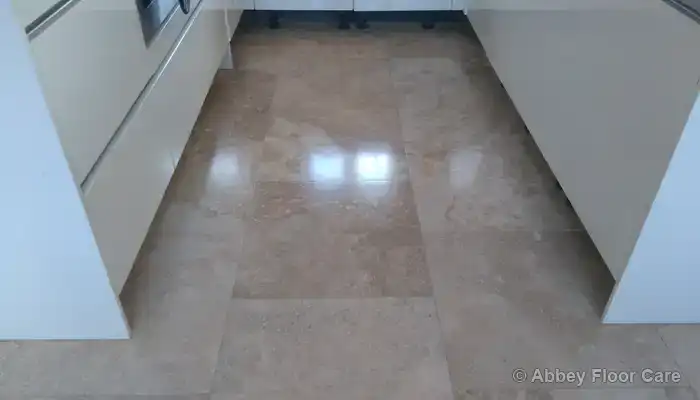
Once the filled areas had fully hardened, the floor was cleaned again and allowed to dry completely. A water-based natural stone surface sealer was then applied in multiple thin coats.
This restored a uniform sheen across the worn areas, aligning them with the rest of the floor and re-establishing a protective barrier against everyday use.
If you’re interested in understanding how travertine floors respond to wear over time, or how sealing behaves in high-traffic domestic areas, this project is part of a wider collection of real-world travertine case studies.

Article by: David Allen – Abbey Floor Care
This article documents the completion of a stone-floor restoration in a private UK home. It records what was observed on site, the work carried out on this floor, and the condition of the surface upon completion, as part of a wider library of real-world case studies.
Recent Posts:
We work throughout the country, just some of our work counties:
Copyright © 2025 Abbey Floor Care. Tile And Natural Stone Cleaning Consultants FAQ - Privacy Policy - Terms And Conditions
Abbey Floor Care is a participant in the Amazon Services LLC Associates Programme, an affiliate advertising programme designed to provide a means for websites to earn advertising fees by linking to Amazon.co.uk. As an Amazon Associate, we earn from qualifying purchases.