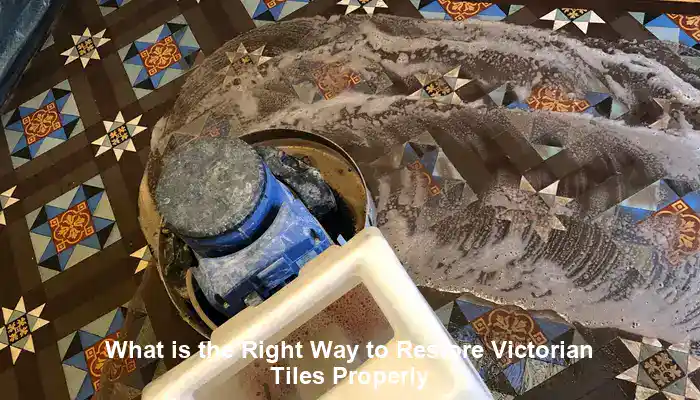
If your floor simply looks dirty, begin with our Victorian tile cleaning guide. If cleaning has failed — or left the surface patchy, dull or uneven — you’re usually dealing with wear, movement or coating failure rather than surface dirt.

Article by: David Allen – Abbey Floor Care Victorian and encaustic clay tile restoration specialist with over 30 years of hands-on experience working on period floors across the UK.
David specialises in restoring worn, damaged and moisture-affected Victorian tile floors. His work centres on stabilising movement, correcting failed sealers, and preventing abrasion damage — particularly on softer earth-coloured clay tiles that can be permanently thinned by aggressive cleaning.
Understanding how historic clay floors behave
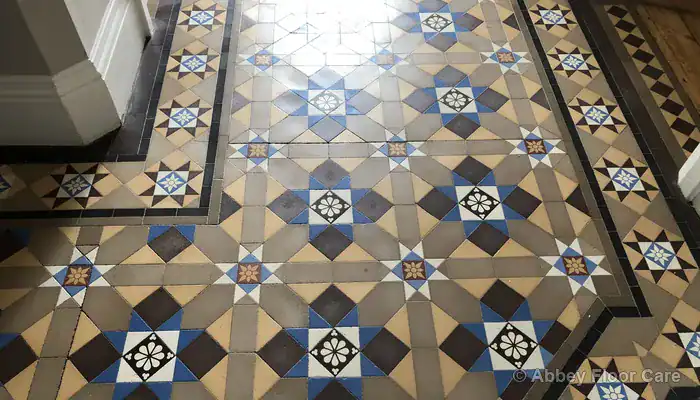
Victorian and encaustic tiles are fired clay bodies with mineral oxide pigmentation fused throughout their full depth. They are square-edged, finely jointed and naturally vapour-permeable by design.
Hardness is not uniform across the floor:
- Earth-toned reds, buffs and ochres are typically softer and wear more quickly.
- Darker manganese and heavily pigmented tiles are often harder.
- In encaustic tiles, the inlaid slip can erode at a different rate from the surrounding clay.
This uneven wear creates the shallow concave depressions known as dishing. Dishing is permanent. It cannot be reversed by cleaning, sealing or polishing.
Mechanical grinding of tile faces is not part of standard restoration and is only considered in rare, tightly controlled conservation situations. Once original clay is removed, it cannot be put back.
When cleaning isn’t enough
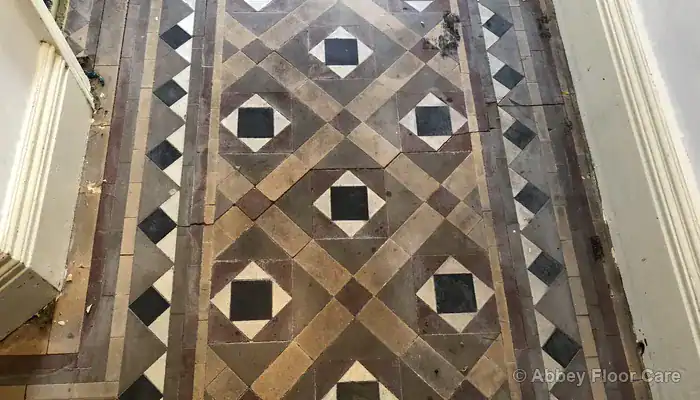
In practice, most Victorian floors that appear “dirty” have already been cleaned many times. The underlying issues are usually more complex.
- Failed wax or acrylic sealers trapping moisture and turning cloudy
- Accelerated abrasion from aggressive pads or retained grit
- Carpet gripper nail damage around the perimeter
- Loose tiles caused by fractured screed or subfloor movement
- Recurring efflorescence from active moisture beneath the slab
Further scrubbing in these conditions only increases pigment loss. Restoration begins with diagnosis rather than abrasion.
Common subfloor structures and movement patterns
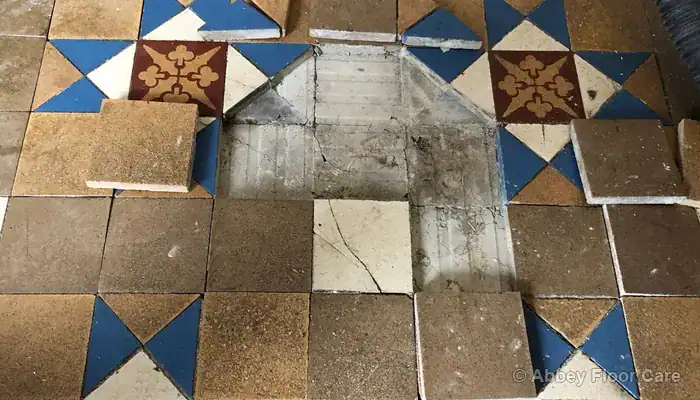
Most domestic Victorian hallways are ground-bearing. They typically sit over compacted earth, brick rubble and a lime-based slab between 75–125mm thick, with a thin screed layer and ½ inch clay tiles above.
Other arrangements include over-cellar brick vaults or suspended timber systems with lime pugging infill. Each behaves differently.
- Ground-bearing floors are settlement-prone and moisture-active.
- Over-cellar systems may crack due to minor structural deflection.
- Suspended timber floors can move as joists deflect.
Movement must be stabilised before cosmetic repair is attempted.
Screed and bedding behaviour
Historic screeds are thin and brittle, with low tensile strength. The bedding layer depends on compression from an intact tile assembly to remain stable.
When screed fractures, tiles may sound hollow and the bedding can appear friable. That appearance does not automatically mean total structural failure.
Wholesale lifting of tiles from rigid screeds carries a high breakage rate. Repairing in situ preserves original material and maintains dimensional integrity wherever possible.
Controlled cleaning and decontamination
Preparation for restoration may involve removing wax, oil residues or inappropriate coatings using suitable alkaline or solvent systems.
- Floors should not be flooded or soaked.
- Acid treatments are reserved strictly for targeted salt or cement residue issues.
- Slurry must be extracted immediately using wet vacuum systems.
The surface must return to a neutral condition before any protective treatment is applied.
Repair philosophy and tile replacement
Restoration prioritises stabilisation over wholesale replacement.
- Loose tiles are lifted and reset where appropriate.
- Original fine joint widths are retained.
- Replacement tiles must respect historic set-out logic and modular geometry.
Back-thinning of replacement tiles may be permissible to accommodate modern adhesive depth. Face grinding of original tiles is not appropriate in standard restoration work.
Moisture and salt management
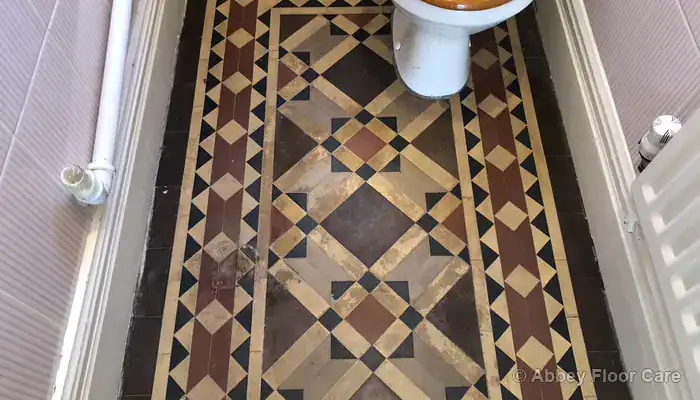
Ground-bearing historic floors should be treated as moisture-active unless proven otherwise. No original damp-proof membrane is present.
Efflorescence occurs when dissolved salts crystallise at the evaporation surface. Blocking evaporation pathways increases salt pressure and can lead to sealer failure.
Drying time matters. Rushing this stage often results in bloom or coating breakdown later on.
Colour revival and finishing choices
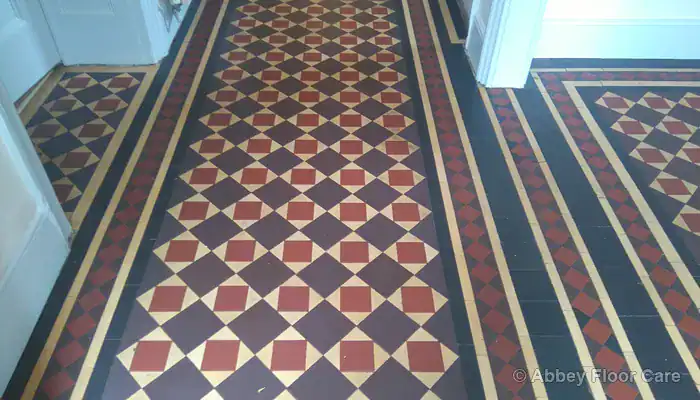
A pale appearance immediately after cleaning is normal. Breathable impregnating enhancers can restore pigment depth without forming a surface film.
Finish selection must reflect moisture behaviour:
- Natural matt: breathable impregnating sealer only.
- Soft satin: wax over impregnator where moisture stability has been confirmed.
- High sheen: film-forming systems only where verified moisture stability exists.
Exterior clay tiling should not be sealed due to frost risk.
What restoration can — and cannot — achieve
Historic floors retain clear evidence of use.
- Dishing remains visible.
- Differential slip wear may not be reversible.
- Repairs blend with the floor but may not disappear entirely.
Restoration enhances stability and visual balance. It does not attempt to erase the floor’s history.
The structured restoration process
- Technical condition assessment
- Controlled residue removal
- Structural stabilisation
- Moisture management and drying
- Breathable protection application
For broader material context, see our Victorian and Edwardian encaustic tile hub.
Victorian Tile Restoration FAQs
Is restoration different from cleaning?
Yes. Cleaning removes contamination. Restoration addresses wear, movement, failed coatings and moisture-related issues.
Can dishing be corrected?
No. Dishing is permanent. Grinding to remove it takes away original clay and is not part of standard restoration practice.
Why do sealers sometimes turn white?
White bloom usually indicates trapped moisture or salt crystallisation beneath a non-breathable coating.
How long should drying take?
Drying time varies depending on structure and season. Ground-bearing floors require patience to prevent future failure.