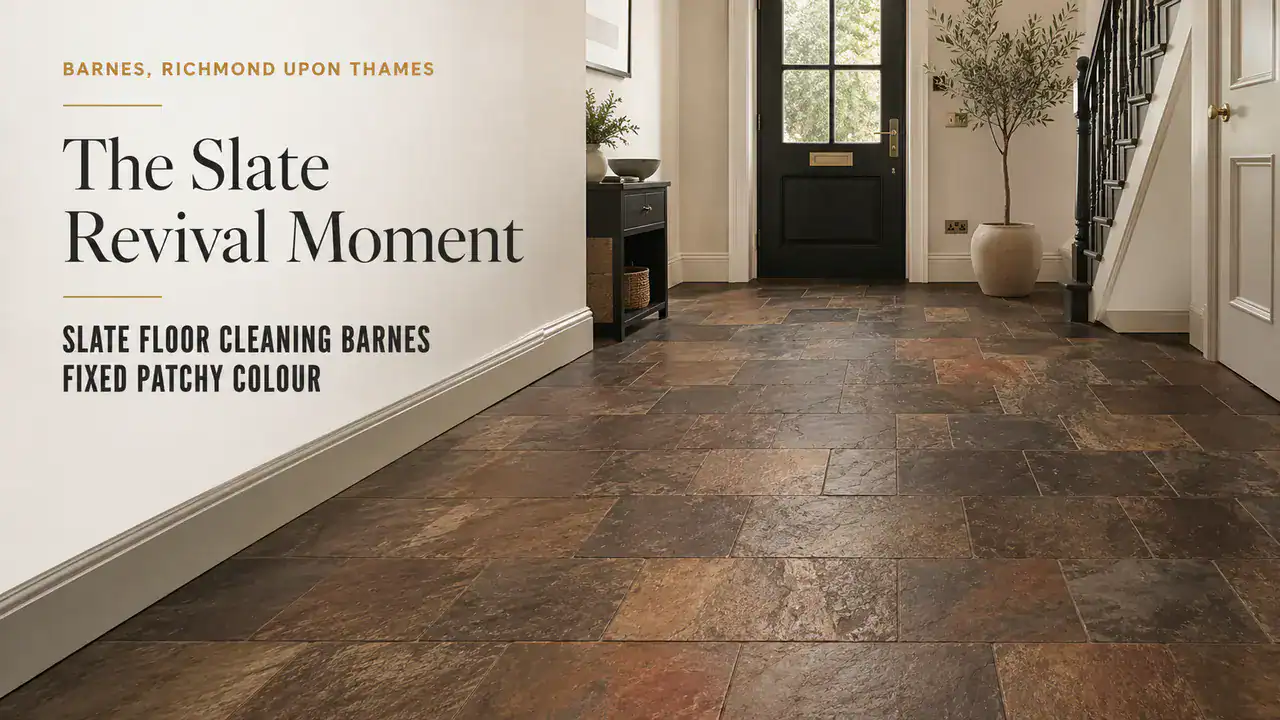
Slate Floor Cleaning Barnes Fixed Patchy Colour
Last Updated on June 13, 2026 by David
Patchy Indian Slate In Barnes After A Previous Sealing Attempt Went Wrong
The Visible Before Condition
If your indian slate looks patchy after sealing, the first problem is not whether it is dirty. The real question is why the floor now looks uneven in normal light. This Barnes floor had a tired, blotchy appearance across the hallway, kitchen and rear extension, with dull patches sitting beside darker areas where old coatings still caught the light.
The floor surface looked fundamentally sound, but the finish made the whole installation feel neglected. The homeowner was not looking at a broken floor; they were looking at a domestic import with higher porosity, softer material behaviour and an absorption risk that had been made more obvious by an earlier sealing requirement that had not been met evenly.
The textured finish made the visual problem harder to read from a doorway. A mechanically split surface does not reflect light as one flat sheet, so ridges, troughs and natural cleavage can make some areas appear deeper in colour whilst recessed areas hold more dull residue. That surface texture was part of the floor’s character, not something to flatten away.

The Barnes Project Setting
The Barnes project involved a sizeable slate floor running through several connected living areas. The floor covered the hallway, kitchen and a significant rear extension, so the patchiness was not tucked away in one small corner. It affected the way the main circulation areas of the home felt every day.
Across Barnes SW13, the local housing stock features a distinct mix of Victorian and Edwardian properties that have been updated with modern rear extensions. In these busy family homes, slate floors are heavily favored in hallways, kitchens, and open-plan living spaces because of their natural durability. Because these properties often combine period architecture with contemporary updates, the slate flooring must handle heavy foot traffic passing from the garden into the main house, making proper sealing and maintenance essential to protect the stone.
The property setting mattered because the floor had to work as a practical surface, not just look attractive in photographs. Hallways and kitchen routes collect loose grit, old mopping residues, food and grease contamination, and dry soil from outdoor traffic. A low-maintenance floor only stays that way when those surface contaminants are removed before protection is renewed.
The Homeowner’s Main Concern
If your floor stays dull even after machine cleaning, the visible problem can feel especially frustrating because the equipment appears to be doing the right job. On this Barnes floor, the homeowner had already seen that ordinary cleaning and mechanical cleaning were not producing the clear, natural colours expected from slate.
The edge areas gave the clearest sign that the floor was not simply dirty. Coating accumulation sat heavily near borders and recessed areas, while topical excess and application residue produced finish unevenness that made the room edges appear darker and more congested than the main walking areas.
The main traffic routes showed a different but related condition. Pale pathways, surface dulling and colour reduction followed busy walkways where loose grit and footfall damage had abraded the top surface. Colour loss is pigment loss caused by traffic abrasion and surface wear, not grime that can be washed away with a stronger cleaner.
The riven face also meant a flat pad could not make even contact with every part of the stone. A textured finish creates a cleaning challenge because small high points and low points receive different contact pressure, so the floor may still look mottled even after a machine has passed over it.
The original page had also drifted towards machine-related searches, so this revised case study keeps the reader focused on what happened on this particular Barnes floor. A slate cleaning machine helped only because the floor was assessed as a real surface with old coatings, natural texture and uneven protection. The machine was part of the work, not the whole answer.
The before condition therefore had three visible parts: patchy colour, dull traffic routes and heavier residue around the edges. Similar dullness problems are covered in why slate floors stay dull after cleaning, but the Barnes project showed how those symptoms looked on one completed floor. The important point for the homeowner was simple: the floor was not beyond saving, but the true surface could not be judged whilst the old coating was still in place.
Why The Floor Looked Sound But Kept Becoming Dull, Tired And Harder To Clean
A sound slate floor can still become dull and difficult to clean when old coating residue and embedded grime start working together. The Barnes floor had coating accumulation around edges, recessed areas holding application residue, and a textured finish that trapped surface contaminants after every wash.
A sound slate floor can still look wrong when old coating traps contamination instead of protecting the stone.
The indian slate itself had not failed, but its Indian origin, higher porosity and softer material response meant the worn areas absorbed contamination more readily once protection had broken down. Old mopping water then carried dirty water into grout lines and low points, creating dulling, detergent traces and residue build-up rather than a clean surface.
Repeated washing made the floor look tired again because cleaning water could not remove what had become locked into the coating and texture. The broader maintenance issue is explained in how slate floors become dull after cleaning, and the Barnes floor showed that pattern clearly. Correct ongoing maintenance removes grit before wet mopping, uses a pH-neutral stone cleaner, and avoids steam cleaning because heat can soften coatings and drive moisture into the riven surface.
Stripping The Old Coating Before The True Slate Condition Could Be Judged
Stripping too little from a coated slate floor leaves the real condition hidden and makes the next cleaning stage unreliable. The Barnes floor first needed solvent action to soften the old coatings, wax dissolution to release the heavy film, and careful coating stripping before any sensible sealing decision could be made.
The cleaning machine then used controlled alkaline pH, surfactants and degreasing action to emulsify organic soil and grease removal residues. Slate is a fine-grained metamorphic rock that cleaves along natural planes — its layered structure prevents mechanical polishing and limits restoration to cleaning and sealing, and makes it sensitive to aggressive cleaning chemistry.

The rotary cleaning pass used a slow speed buffing machine with a diluted solution, then the dirty solution was removed before it could dry back into the floor. A polypropylene brush scrubbed the slate floor through the uneven face while keeping contact with the high and low points. That detail matters on a riven surface.

Slurry extraction was essential because the riven surface could otherwise hold softened residue in the texture. The wet vacuum provided residue removal, redeposition prevention and contamination control, while pressurised rinse and capture helped remove remaining cleaner and old coating from grout lines and low points.
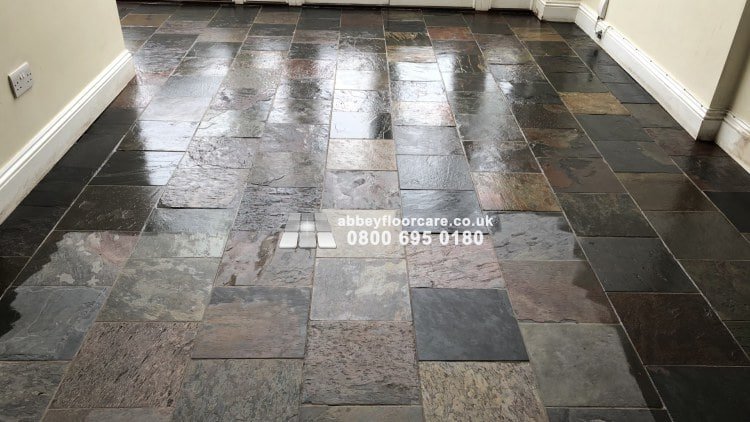
The clean floor was allowed to dry before the remaining condition was judged. That pause mattered because sealing too early risks trapped water, chalky residue, substrate moisture and sealer failure, especially where textured areas and grout lines have held cleaning moisture.
How The Original Slate Character Reappeared Without Leaving The Floor Open To Rapid Re-Soiling
The visible change came from removing what was hiding the slate, not from forcing the floor to look new. Before cleaning, the floor looked patchy, tired and difficult to maintain because coating residue and embedded dirt obscured the natural colours.
After cleaning and sealing, the floor regained clarity, deeper colour and a more even low-sheen appearance whilst keeping its natural riven character. A fine-honed slate floor has a smooth, consistent surface that diffuses light evenly, while an impregnating sealer leaves the natural riven texture unchanged, and a topical sealer adds a low surface sheen.
The final protection was chosen only after moisture level checks confirmed the cleaned tiles were ready. The damp meter stage checked tiles before applying sealer, reducing the risk of excess sealer, poor drying or an ineffective seal. A later water test can show whether resealing is needed in high-traffic areas.
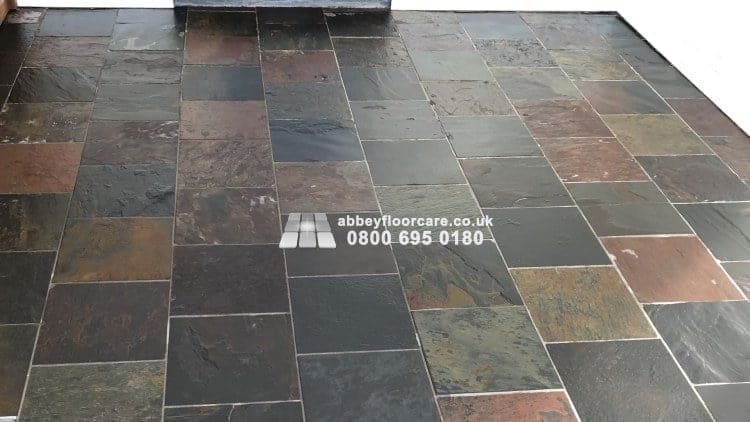
The colour enhancement came from mineral activation and pigment deepening, not dye. The breathable barrier and impregnating protection helped the floor stay cleaner longer, and a professionally restored and correctly sealed floor is significantly easier to clean and maintain than a worn or incorrectly treated floor.
The Barnes result also showed why slate can look significantly better than before intervention and, in many cases, better than when first installed. Related colour behaviour is covered in why some slate floors look faded while others stay vibrant, and the Barnes floor showed that colour recovery depends on clean stone, correct protection and a dry surface. The finished floor kept its original character while becoming simpler to care for day to day.
What This Barnes Slate Cleaning Project Shows About Machine-Led Cleaning And Sensible Protection
This Barnes case shows why machine-led slate cleaning works best when it stays tied to the actual floor in front of you. The machine mattered, but the result depended on identifying how old coatings trapped residue. Controlled pre-treatment loosened the residue, mechanical agitation lifted the contamination, and extraction removed the dirty solution before it could settle back.
David Allen’s 30-plus years of stone floor experience helped keep the project inside a cleaning-led scope rather than turning it into an unnecessary resurfacing job. Comparable project evidence can be seen in slate floor cleaning in Matlock, where cleaning and protection also worked together. The Barnes floor needed the same disciplined sequence: clean first, judge the real surface, then protect it sensibly.
The maintenance handover mattered because correct ongoing care is the single most important factor in extending the floor’s life. pH-neutral cleaning, grit removal before wet mopping and resealing at the right interval protect natural colours, while vinegar, limescale remover and bleach can cause colour change, sealant stripping and permanent surface damage. Broader material behaviour is covered in slate floors in UK homes, and practical coating-removal principles are developed in cleaning and sealing a slate floor. Singapore slate can also carry acrylic sealer on its riven nature, so the same caution applies: the floor type must be tested before strong alkaline chemical cleaning or rotary scrubber work begins.
The completed Barnes floor proved that machine cleaning can restore appearance dramatically when it is paired with proper extraction and sensible protection. The outcome was not a generic service claim; it was one project where a tired, patchy floor was returned to a cleaner, richer and lower-maintenance condition.
Products Used In This Guide
No third-party product or supplier links were present in the original HTML for this case study. The Barnes project is therefore documented as a completed cleaning and sealing case study rather than a product-led guide.

David Allen — Abbey Floor Care
David Allen has restored natural stone and slate floors across the UK for over 30 years with Abbey Floor Care. This Barnes case study documents how a patchy slate floor in SW13 was corrected by removing old coating, extracting contaminated slurry and applying controlled protection once the floor was dry enough to seal.
Recent Posts:
We work throughout the country, just some of our work counties:
Copyright © 2026 Abbey Floor Care. Tile And Natural Stone Cleaning Consultants FAQ - Privacy Policy - Terms And Conditions
Abbey Floor Care is a participant in the Amazon Services LLC Associates Programme, an affiliate advertising programme designed to provide a means for websites to earn advertising fees by linking to Amazon.co.uk. As an Amazon Associate, we earn from qualifying purchases.